The exhaust fan determines whether the grout stays clean, the caulk stays mold-free, the paint stays on the ceiling, and the framing above stays dry. It is also the component most often specified by whoever had the cheapest unit at the supply house. A beautifully tiled bathroom with an inadequate fan will look worse in three years than a modest bathroom with a properly sized and ducted one. The fan matters more than the tile because the fan determines how long the tile stays beautiful.
That is not a minor claim. It is a claim that most remodeling budgets are organized to ignore. Tile is visible. Tile has selection sheets and material samples and Pinterest boards dedicated to it. The fan is a white plastic box that gets installed in a rough opening and disappears behind a grille. In most renovations, it receives about thirty minutes of attention and about sixty dollars of budget.
The results are predictable.
What The Fan Actually Does
A bathroom exhaust fan does three things, and most homeowners understand only one of them.
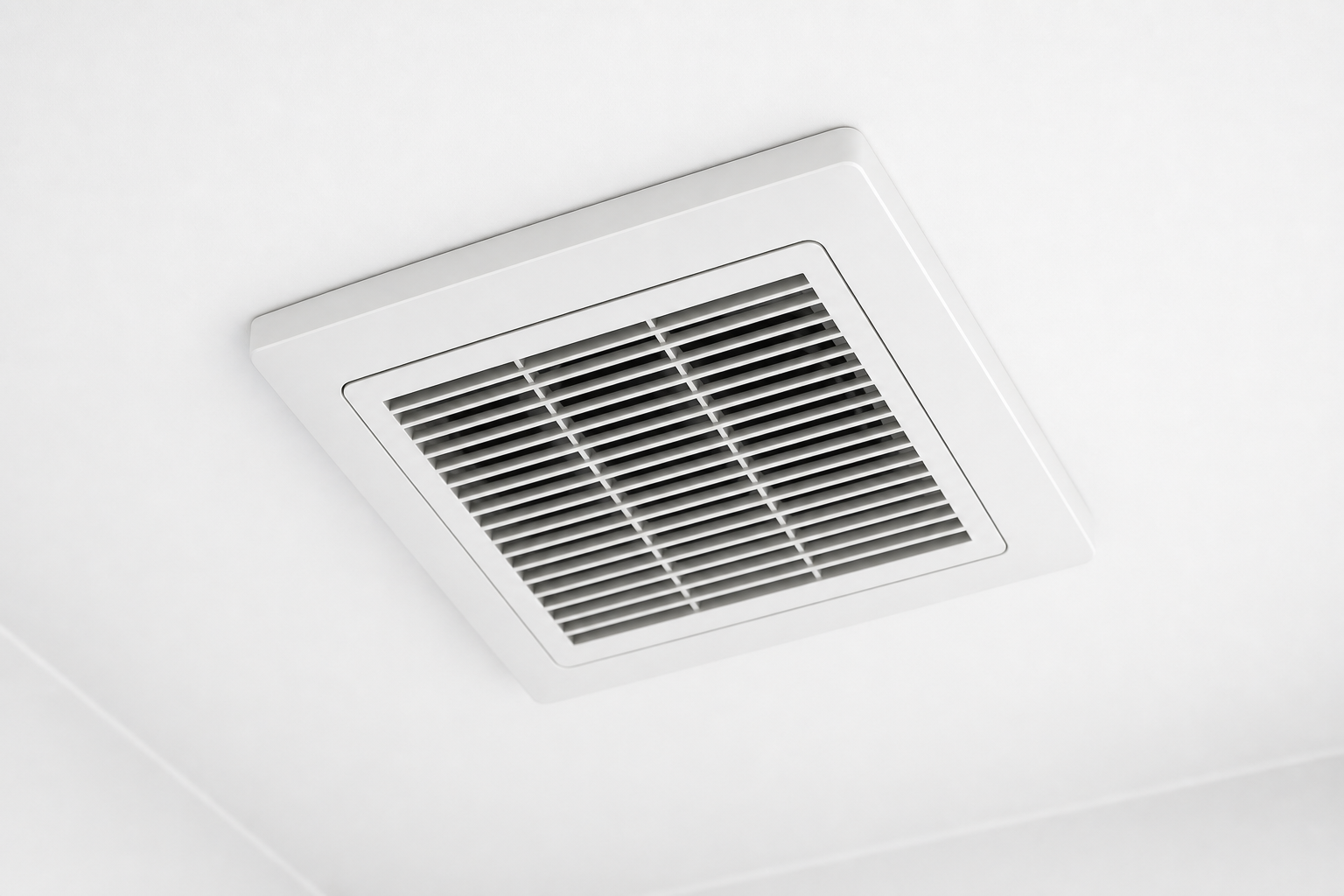
The obvious function is odor control. Fans move air out of the room, carrying odors with it. This is the function that most people are aware of and the reason most building codes require mechanical ventilation in bathrooms without operable windows.
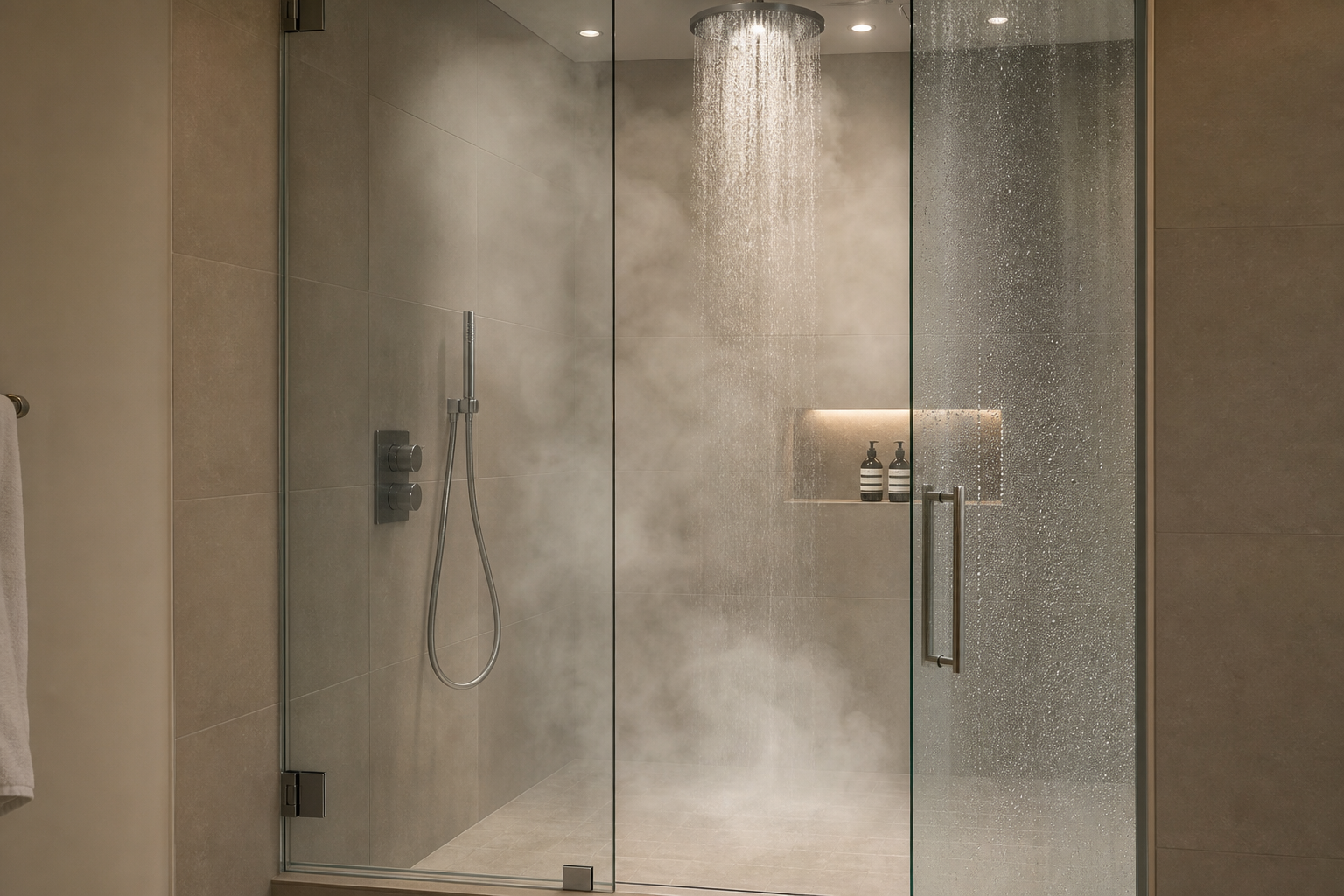
The second function is moisture removal. Hot showers introduce large quantities of water vapor into the bathroom air. The air inside a shower enclosure during a typical hot shower can approach 100 percent relative humidity. When that vapor-laden air spreads from the shower into the rest of the bathroom, it contacts cooler surfaces and begins to condense. Condensation on grout promotes mold. Condensation on painted ceilings softens the film and eventually causes peeling. Condensation on wood trim, vanity tops, and cabinet faces creates the slow, humid degradation that distinguishes a chronically damp bathroom from a dry one.
The third function is the one almost nobody thinks about: protecting the building assembly above and around the bathroom. When exhaust fans underperform, vapor migrates into ceiling framing, attic spaces, and wall cavities. The Home Ventilating Institute has documented that inadequate bathroom ventilation is a leading contributor to attic moisture problems, condensation on roof sheathing, and reduced insulation effectiveness. The damage is invisible from inside the bathroom and very expensive to address from above.
These three functions require the same mechanism: moving a sufficient volume of air out of the room, consistently, through a duct path that actually delivers that air to the exterior. When the fan fails at any point in that chain, all three functions degrade together.
The Rated CFM Problem
Exhaust fan performance is expressed in cubic feet per minute (CFM), which describes the volume of air the fan moves per unit of time. The Home Ventilating Institute provides minimum sizing guidance: bathrooms under 100 square feet need at least 1 CFM per square foot of floor area, with a minimum of 50 CFM regardless of size. Bathrooms with separate toilet compartments, tubs, and showers may need supplemental fans or higher total capacity to address each zone effectively.
Those are minimum guidelines. They also assume something that is never stated on the fan box: that the installed fan will deliver its rated CFM under actual field conditions.
It will not.
Every exhaust fan is rated at a specific static pressure condition, typically 0.1 inches of water column, which represents nearly zero resistance. The moment you add ductwork, the static pressure increases and the delivered CFM drops. How much it drops depends on the length of the duct run, the number of elbows and bends, the duct diameter, and whether rigid or flexible duct is used.
The HVI publishes data on this degradation, and the numbers are significant. A fan rated at 110 CFM at 0.1 inches of static pressure may deliver only 70 CFM when installed with a typical duct run. A fan rated at 50 CFM installed with an 8-foot flex duct run terminating at an undersized roof cap may deliver 30 CFM or less, which is below the minimum threshold for a bathroom half the size it is serving.
This is not an obscure technical issue. It is the normal operating condition for most installed exhaust fans. The fan that appears to be running is often doing far less than the box promised, because nobody calculated the installed performance as distinct from the rated performance.
How Ductwork Destroys Fan Performance
The most common duct problems in bathroom ventilation are not catastrophic. They are the cumulative result of small compromises that each seem minor and together eliminate most of the fan's effectiveness.
Flex duct is the first problem. Flexible duct, the corrugated silver tubing found in most residential bathroom ventilation installations, has significantly higher friction resistance than smooth rigid duct. The corrugations create turbulence at every ripple, and the turbulence converts kinetic energy in the airstream into heat rather than flow. A well-supported, fully extended flex duct run performs adequately. A flex duct that sags, compresses, or runs in excess of about ten feet delivers performance numbers that bear little relationship to what the fan rating implies. Most flex duct installations in bathrooms are not well-supported, not fully extended, and often significantly longer than ten feet.
Elbows compound the problem. Each 90-degree elbow in a duct run creates a pressure drop equivalent to several feet of straight duct. An installation with four elbows has effectively added significant equivalent length to the run before accounting for any of the actual straight runs. Most bathroom exhaust duct routes involve multiple direction changes because the framing is in the way, the roof pitch is not convenient, or the installer took the easiest path rather than the most direct one.
Termination caps are the third problem. The cap where the duct exits the building creates backpressure whenever the fan runs because air must push past the cap flapper or louver. Undersized caps, caps clogged with debris, caps installed at angles that allow backflow, and caps with inadequate free area all restrict airflow. The fan pushes against the cap, the static pressure rises, the CFM delivered drops, and the homeowner has no way to observe any of this because it is all happening inside the wall.
The IRC Section M1507 requires that bathroom exhaust fans duct to the outdoors and not terminate in an attic, crawlspace, or soffit. That minimum requirement is frequently violated, particularly in renovations where the existing fan was ducted incorrectly and nobody wanted to reopen the ceiling to fix it.
What Quiet Means For Whether People Actually Use It
Fan noise is not an aesthetic issue. It is a usage compliance issue.
Bathroom exhaust fans that are loud are not used. This is not speculation; it is the observed behavior of most households. A fan that sounds like a box fan on high creates an unpleasant acoustic environment in the small reflective space of a bathroom. People turn it off after a few minutes. People who live with other sleeping family members do not turn it on at all. The fan installed in the wall does the work of zero fans because nobody runs it.
Fan noise is rated in sones. A rating of 1.0 sone is considered quiet for most people. A rating of 4.0 sones is loud enough to be a consistent deterrent to use. Most low-cost fans installed in builder-grade renovations fall in the 3.0 to 4.0 sone range. A quality unit can achieve 0.3 sones at the same or higher CFM output.
The difference in cost between a loud fan and a quiet fan in a renovation context is typically small relative to the total project cost. The difference in how often the fan actually runs is large, because it is a function of whether the people living in the house choose to engage with it. A quiet fan that runs during every shower removes moisture. A loud fan that nobody runs removes nothing.
The combination of a quiet fan, a motion or humidity sensor, and a timer override is the configuration most likely to ensure that ventilation occurs without requiring deliberate action. A humidity-sensing controller turns the fan on when relative humidity rises above a set point and keeps it running until the humidity drops back below threshold. This approach removes the human variable entirely and ensures the fan runs for exactly as long as the moisture load requires, regardless of whether anyone remembered to press the switch.
The Three-Year Test
A bathroom's appearance at three years is largely a function of how well it dried after every shower during those three years.
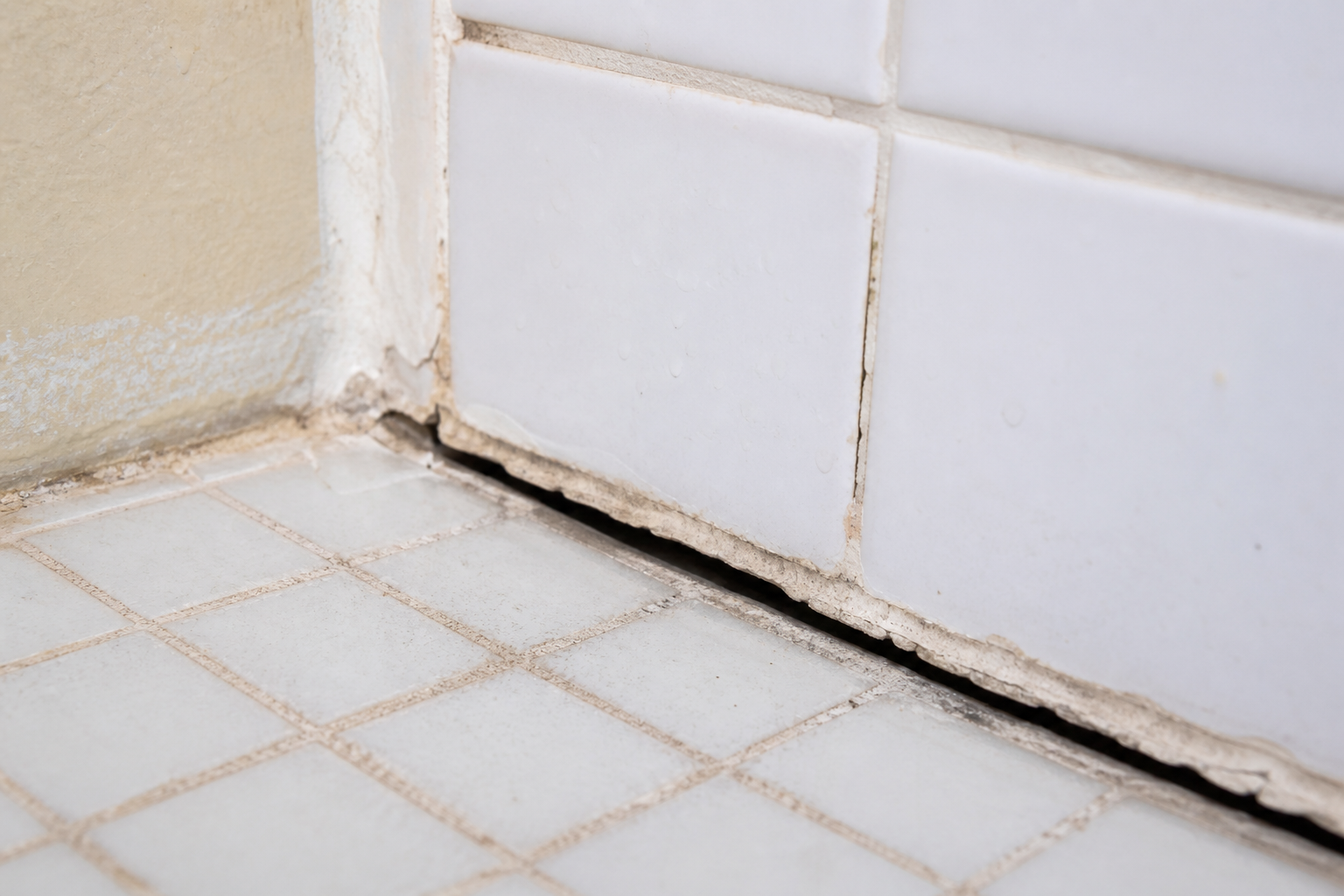
Grout that dries consistently between uses stays light and resists biological growth. Grout that stays damp becomes a reliable growth medium for mold and mildew, particularly in the characteristic black pattern that appears first at horizontal joints and at the base of walls where standing water lingers. Cleaning this growth removes it visually but does not address the underlying condition: the grout is chronically damp and the growth returns.
Caulk at the perimeter of the tub or shower tray is similarly sensitive to drying conditions. Properly formulated silicone caulk in a dry environment can last ten years without significant deterioration. In a chronically damp environment, even good silicone begins to release from one surface within a few years, and the resulting gap is both a waterproofing failure and an aesthetically obvious problem. Recaulking is not expensive, but it should not be necessary every eighteen months in a well-built room.
The ceiling paint in a bathroom with a working fan stays on the ceiling. In a bathroom where humidity regularly exceeds 80 percent for extended periods after showering, latex paint softens and eventually blisters, cracks, and peels. Repainting a bathroom ceiling is not complicated, but it is a symptom of a ventilation failure that is also doing worse things to the structure above.
None of this is subtle. The bathroom that needs its grout cleaned every month, its caulk replaced every two years, and its ceiling repainted every four years is communicating exactly what its fan has been doing since the renovation was finished.
We specify exhaust fans by delivered CFM, not rated CFM, and we duct them with rigid or semi-rigid material to minimize the static pressure loss that reduces performance. The fan spec and duct routing are confirmed before any tile is discussed.