Here is the claim upfront: in a bathroom, porcelain is often the more durable, more forgiving, and more honestly luxurious choice. Natural stone can be beautiful. It can also become a maintenance obligation that quietly degrades the room's appearance over a decade while the homeowner blames themselves for not caring for it properly.
That is not the intuition most people have. Stone feels expensive. Stone feels real. Stone feels like the choice a person makes when they can afford the best. And in some applications, that intuition is correct. A polished marble slab on a vanity wall that never gets wet can look extraordinary for decades with minimal attention. But in a shower, on a floor that sees daily water, in a bathroom where humidity and cleaning chemicals and hard water all meet porous material every single day... the physics changes the calculation.
This article is about that physics. Not which material is prettier on day one. Which material is prettier on day three thousand.
What "Porcelain" Actually Means (It Is a Physics Category)
The word porcelain gets used loosely in showrooms. Technically, it has a precise definition. Under ANSI A137.1, porcelain tile is any ceramic tile with a water absorption rate of 0.5 percent or less, as measured by ASTM C373. That means if you submerge the tile in water for 24 hours under vacuum, it gains less than half a percent of its dry weight in moisture.
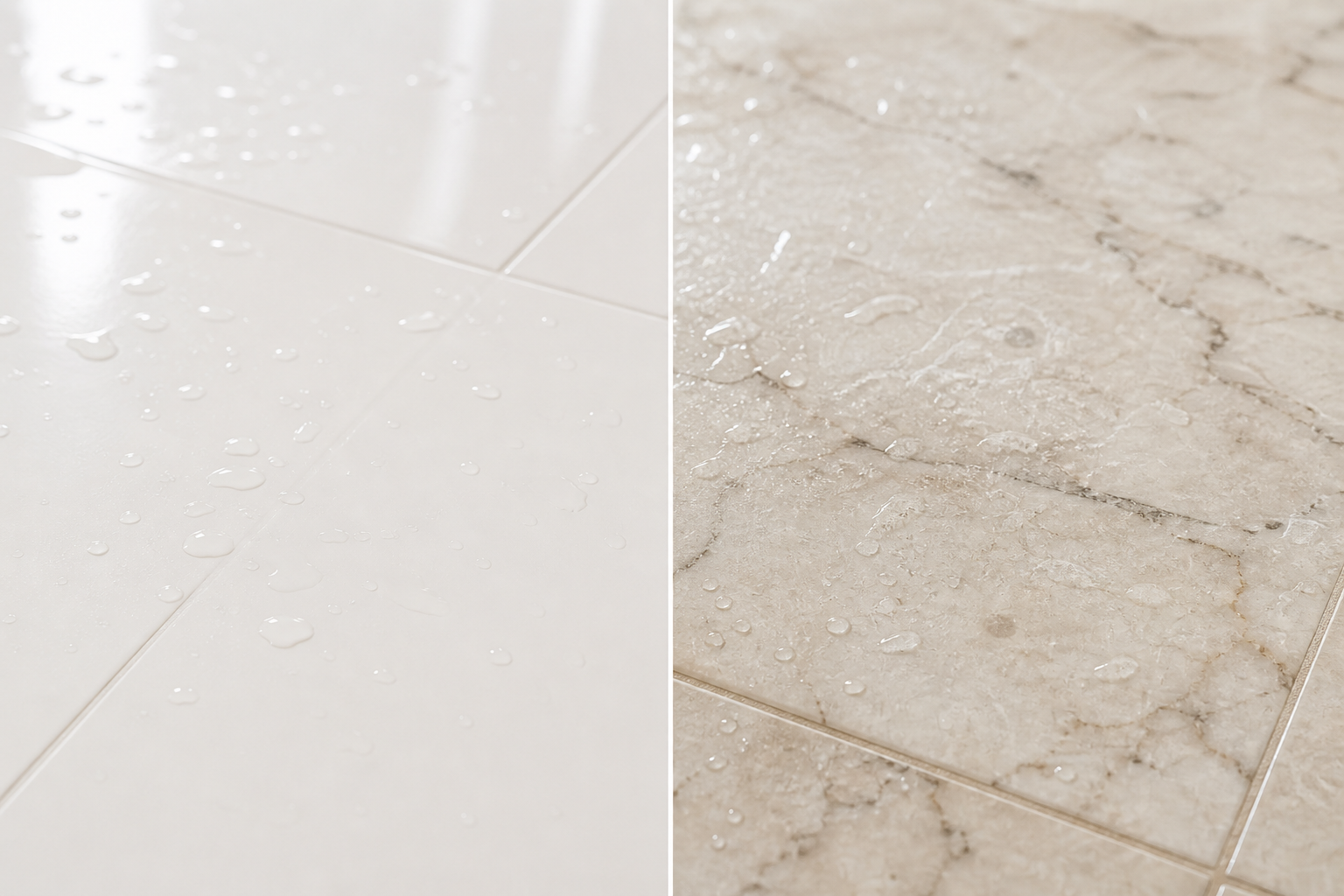
That number matters more than any finish, glaze, or pattern. It means the tile body is essentially impervious. Water cannot meaningfully enter the material. Stains cannot penetrate. Freeze-thaw cannot damage it. The tile does not change when exposed to moisture, because moisture cannot reach its interior.
Most quality porcelain tiles test well below that threshold. Premium lines from major manufacturers regularly measure at 0.05 to 0.1 percent absorption. At that level, the material is functionally inert in a wet environment. It does not need sealing. It does not react to bathroom cleaners. It does not etch from acidic products. It does not absorb soap residue into its body. It simply sits there, doing its job, looking the same in year ten as it did in year one.
This is not a marketing claim. It is a measurable physical property, certified by the Porcelain Tile Certification Agency (PTCA) through third-party lab testing.
What Natural Stone Actually Does in a Wet Bathroom
Natural stone is beautiful because it is variable. Each slab is unique. The veining, the color shifts, the fossil traces, the crystalline structure... all of it comes from the stone being formed over geological time with no two pieces identical. That variability is the aesthetic appeal.
It is also the engineering vulnerability.
Natural stone is porous. The degree varies by type. Granite absorbs relatively little (0.1 to 0.4 percent, depending on variety). Marble ranges from 0.2 to 0.6 percent. Travertine can range from 1 to 5 percent. Limestone can absorb 2 to 12 percent of its weight in water.
In a bathroom, porosity creates three distinct problems that compound over time:
Staining. Porous materials absorb liquids. In a bathroom, that means soap residue, shampoo, hard water minerals, hair products, and cleaning chemicals can migrate into the stone. Once below the surface, these substances discolor the material in ways that surface cleaning cannot reach. Removal requires a poultice application that draws the stain back out through capillary action over 24 to 48 hours. Most homeowners never learn this technique and instead scrub harder, which accomplishes nothing except frustration.
Etching. Marble, limestone, and travertine are calcium carbonate stones. Calcium carbonate reacts chemically with acids. The reaction dissolves a microscopic layer of the polished surface, leaving a dull spot. This is not a stain. It is chemical erosion. Common bathroom acids include citrus-based cleaners, vinegar (which many people use as a "natural" cleaner), certain shampoos, and even some toothpastes. Critically, sealing does not prevent etching. Sealers fill the pores below the surface to slow stain absorption. They do nothing to stop an acid reaction that happens on the surface itself.
Maintenance compounding. Stone requires resealing every one to three years in bathroom applications. Each resealing cycle must be preceded by thorough cleaning to avoid sealing contaminants into the stone. If sealing lapses, the stone becomes increasingly vulnerable to the staining and moisture problems the sealer was preventing. Over a decade, many homeowners fall behind on sealing, and the stone's appearance degrades incrementally. By year seven or eight, the stone looks tired, and the homeowner often assumes the material was a bad choice rather than recognizing that the maintenance schedule lapsed.
The Honest Comparison: Ten Years of Daily Use
Here is what each material looks like after a decade of normal family bathroom use with realistic (not perfect) maintenance:
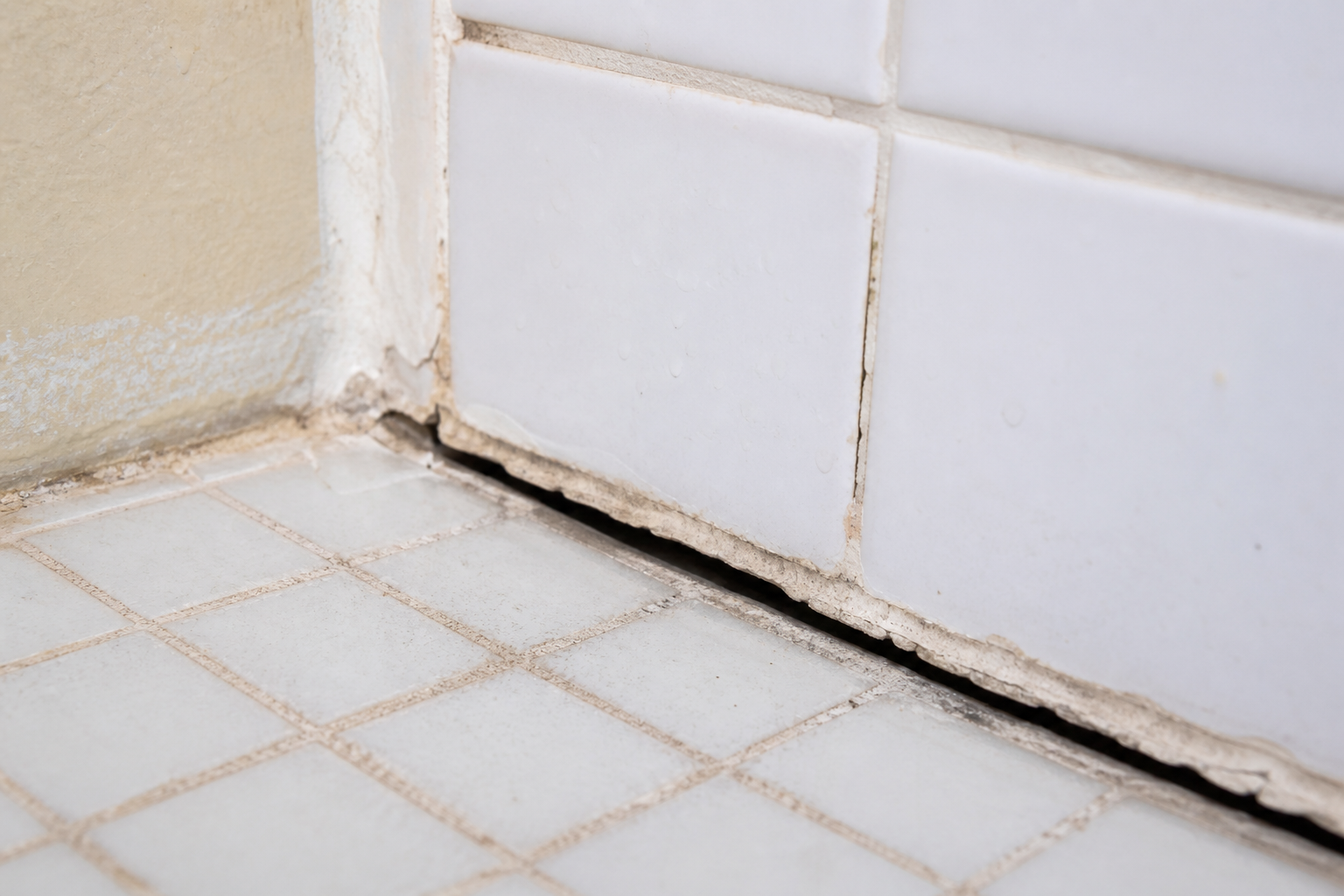
Porcelain after ten years: The tile looks essentially the same. The grout may have stained slightly (grout is a different material and more porous than the tile itself). The tile surface shows no wear, no etching, no staining, no degradation. The only maintenance it received was normal cleaning with whatever products were on hand. Total material-related maintenance cost beyond cleaning: zero.
Marble after ten years with average maintenance: The stone shows accumulated etch marks from cleaning products, water spots from hard water, and some staining in areas that saw repeated moisture contact. The sealer lapsed around year four and was never reapplied. The stone is not ruined, but it no longer looks polished or fresh. Professional restoration (diamond honing and repolishing) would cost several hundred to several thousand dollars depending on area. The homeowner is mildly disappointed and considers the marble "too high-maintenance."
Marble after ten years with diligent maintenance: The stone looks beautiful. The homeowner has resealed every eighteen months, uses only pH-neutral cleaners, squeegees after every shower, and had professional honing done once around year six. Total ten-year maintenance cost beyond cleaning: likely $1,500 to $3,000 in sealing products and one professional service. The stone still reads as luxury because the homeowner committed to the upkeep.
This is the honest picture. Natural stone can look extraordinary at year ten. But it requires a commitment to specific ongoing care that most people do not sustain over a decade. Porcelain requires no such commitment and delivers consistent appearance regardless of how attentive the homeowner is.
When Stone Is the Right Answer
None of this means natural stone is wrong for every bathroom. It means the decision should be made with clear expectations rather than showroom impressions.
Stone makes sense when:
- The application is a dry or infrequently wet surface (a vanity backsplash, a feature wall outside the shower, a floor in a powder room that sees minimal moisture).
- The homeowner genuinely enjoys material stewardship and will maintain a sealing schedule without resentment.
- The specific stone is a dense, low-porosity variety (honed granite, dense quartzite) that tolerates moisture without the acid sensitivity of marble.
- The design intent values the unique character of natural material more than long-term uniformity of appearance, and the homeowner understands that patina is part of the experience.
Stone does not make sense when:
- It will be inside a shower that sees daily use and hard water.
- The homeowner wants a room that looks the same in year ten as it does on installation day.
- The cleaning routine will include whatever products are convenient rather than stone-specific chemistry.
- The household is busy and the idea of annual sealing and post-shower squeegeeing feels like a burden rather than a pleasure.
Why This Distinction Matters for a Remodel Budget
There is a financial argument here that often goes unexamined. Natural stone typically costs more per square foot than porcelain. Installation can cost more because stone requires different handling, more careful lippage control, and compatible setting materials. And then the stone requires ongoing investment in sealing and potential restoration that porcelain never needs.
Meanwhile, porcelain manufacturing has advanced to the point where large-format porcelain slabs can replicate the visual of marble, quartzite, or onyx with remarkable fidelity. These are not the crude stone-look tiles of fifteen years ago. Modern porcelain slabs are printed using high-definition inkjet technology with randomized vein patterns that avoid repetition. They are available in full-slab dimensions (up to 63 by 126 inches) that minimize grout lines, just as natural stone would.
This creates a genuine question: if the visual can be closely approximated by a material that performs better in a wet environment, requires no maintenance, costs less to install, and looks the same after a decade... when is real stone the right choice? The answer is when the homeowner values the authenticity, the uniqueness, and the lived quality of real stone more than they value maintenance simplicity. That is a legitimate preference. But it should be a conscious choice, not an assumption that stone is automatically the "better" material.
Our default specification for shower tile in primary bathrooms is impervious porcelain. Where a client wants natural stone, we discuss the specific application, the stone's density, and the maintenance relationship the household is signing up for before we include it in the scope. Marble in a shower is a twenty-year commitment to a specific cleaning routine; we make sure that is understood before we specify it. Stone on a dry vanity wall is a different conversation with different risk, and we treat it that way.
The Real Luxury Is a Room That Does Not Punish You
The deepest version of this argument is not about cost or maintenance hours. It is about what luxury means in a room you use every day.
If luxury means visual impact on installation day, stone wins in many applications. If luxury means a room that still looks as good as the day it was finished after ten years of real life with real cleaning habits and real hard water and real morning routines... porcelain is often the more honest answer.
A bathroom that punishes you for using the wrong cleaner, that shows every lapse in sealing, that accumulates evidence of imperfect maintenance... that bathroom becomes a source of low-grade guilt rather than daily comfort. It reads as high-maintenance in the emotional sense, not just the practical sense.
A bathroom built with materials that tolerate real life without demanding vigilance feels generous. It reads as confident rather than delicate. It ages without apology.
That confidence is a form of luxury that does not show up in a material specification sheet. But it shows up every morning for the next fifteen years.