Showrooms are designed to make fixtures look good in isolation. Your bathroom is a specific room with specific proportions, lighting, and competing materials, and those variables change how every fixture reads. The showroom is not lying. It is simply showing you a different room.
This is the mechanism behind one of the most common post-renovation disappointments: the faucet you loved on the display wall arrives and feels flat. The vanity light that looked substantial in the store reads small above your mirror. The brushed nickel hardware that appeared warm and soft under showroom cans looks cold and sharp next to your gray tile. Homeowners conclude they chose wrong. In most cases, they chose correctly under the wrong conditions.
Understanding why requires understanding what a showroom actually optimizes for, and what your bathroom actually presents to the eye.
What a Showroom Is Optimizing For
A fixture showroom is a retail environment. Its job is to make products legible, attractive, and easy to compare. That job has almost nothing to do with making products look accurate in your specific bathroom.
Showrooms control the variables that interfere with product display. Ceilings are often higher than residential bathrooms, which makes pendant lights and sconces feel more proportional. Walls are neutral white or light gray, which removes color competition and makes every finish read clearly. Spacing between displays is generous, so each fixture has visual breathing room. Nothing competes for attention except the product itself.
Lighting in showrooms is tuned for clarity, not for living. Display areas commonly run at four thousand Kelvin or higher, sometimes supplemented with directional spots aimed at the product surface. That temperature renders chrome crisp, makes brushed finishes read evenly, and eliminates the warm amber cast that makes the same fixture feel different at home. MOSS Objects, an architectural lighting manufacturer, describes this directly: showrooms present product at its best, with no competing ambient light, no challenging ceiling treatment, and no height constraint. The scale relationship between fixture and space is carefully managed. None of this is dishonest. It is merchandising.
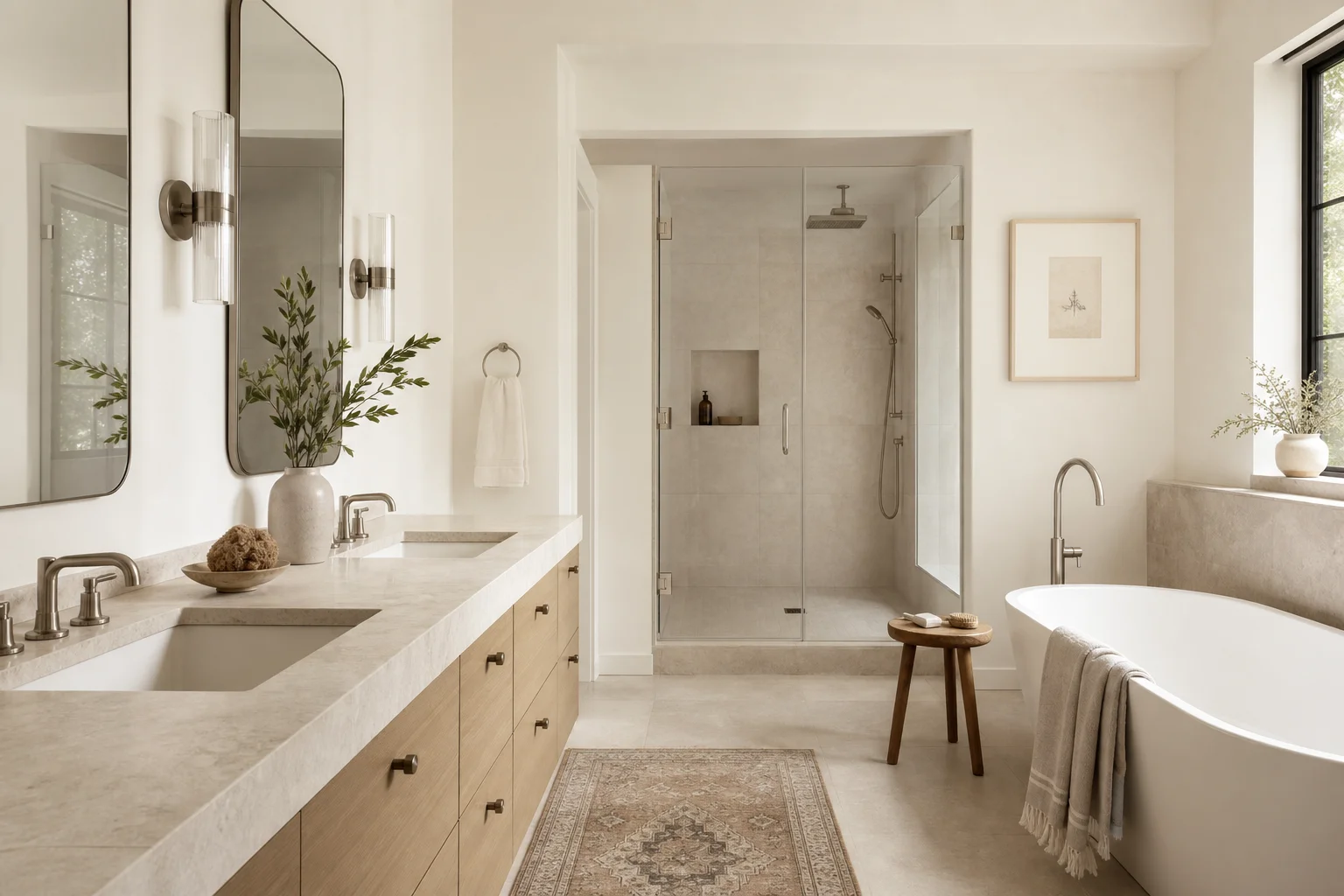
Your bathroom offers none of those conditions. It has a fixed ceiling height, often eight feet or less. It has tile, paint, stone, or wood with specific undertones. It has a window orientation that may deliver cool north light in the morning and nothing at all after dark. It has a mirror that doubles visual mass. It has a vanity that occupies half the wall. The fixture you selected is no longer the subject of the composition. It is one element in a composition that already existed before you walked in.
That shift alone changes how the fixture reads.
Light Temperature Changes Every Finish
The single variable that produces the most fixture regret is color temperature, and it operates independently of fixture quality.
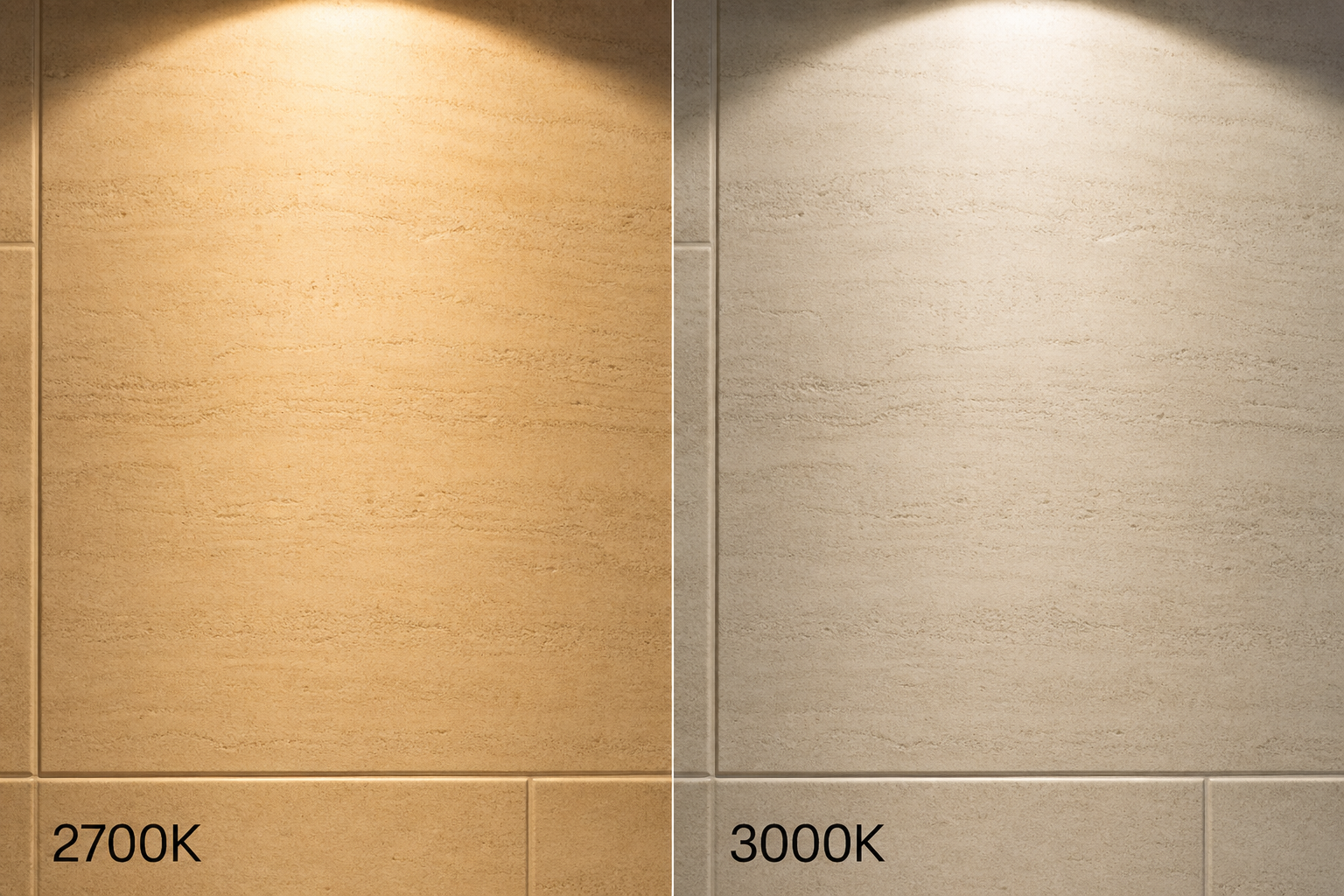
Brushed nickel under four thousand Kelvin showroom light reads silvery and neutral. The same nickel under twenty-seven hundred Kelvin at home reads warmer, sometimes yellowish, sometimes muddy depending on the Color Rendering Index of the bulb. Polished chrome under cool display light looks sharp and modern. Under warm vanity sconces, it can look dated or brassy. Matte black that appeared sophisticated under directional spots can look flat under a single overhead can with poor CRI.
This is metamerism: two materials can match under one light source and diverge under another because the spectral content of the sources differs. The fixture did not change. The light changed how your eye interprets its surface.
Maple Electric Supply and most residential lighting guidance recommend three thousand to thirty-five hundred Kelvin for bathrooms, with a Color Rendering Index of ninety or above at the vanity. Showrooms rarely display fixtures under those conditions because clarity sells product. Warmth sells rooms. The gap between those two objectives produces the mismatch homeowners experience after installation.
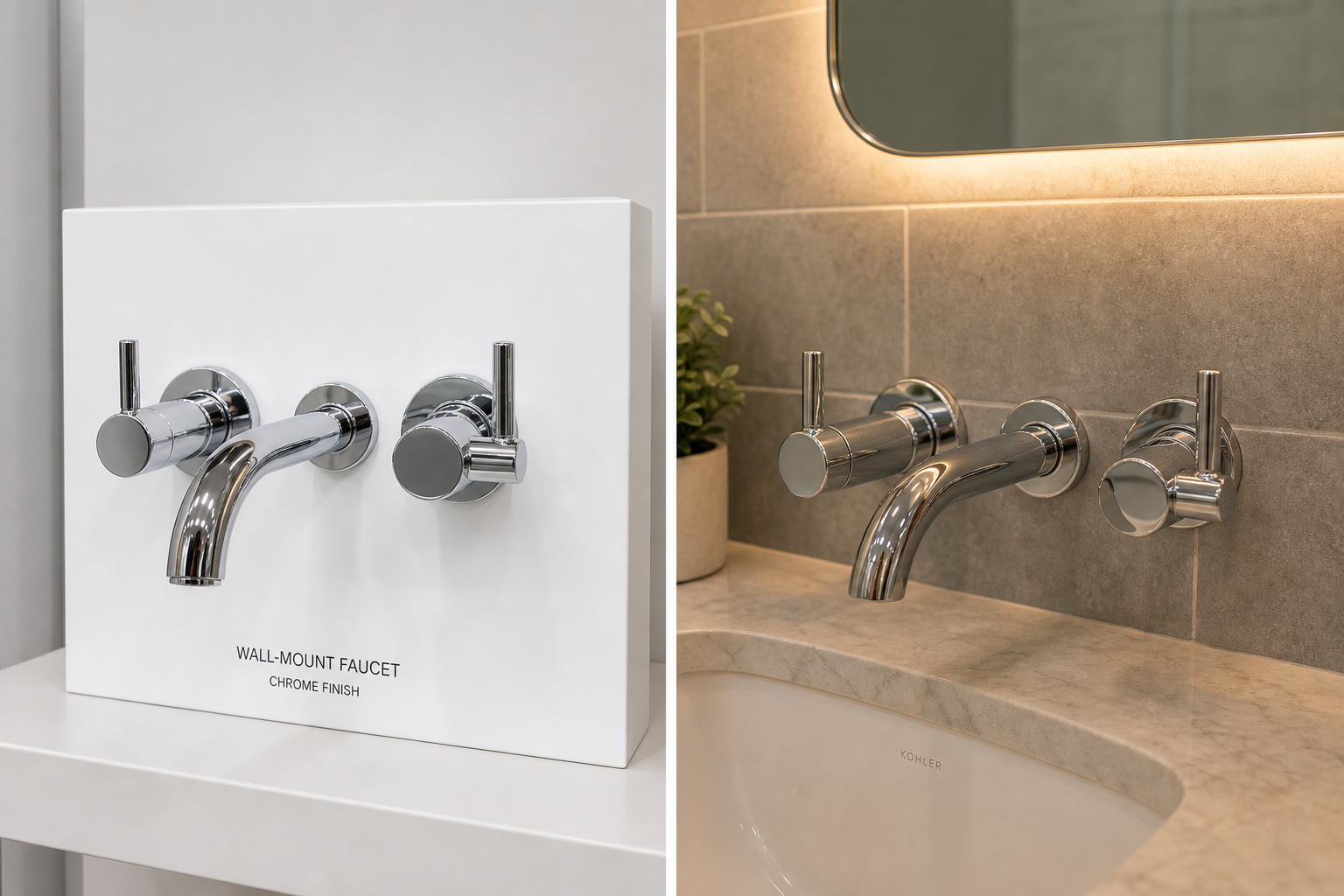
The practical implication is that fixture selection cannot happen under showroom light alone. The finish you evaluate must be viewed under the temperature and intensity your bathroom will actually have at the location where the fixture lives. A faucet displayed under a spotlight tells you how the faucet looks under a spotlight. It tells you almost nothing about how that faucet reads next to your specific tile at six in the morning.
Scale and Proportion Read Differently in Context
A second common disappointment is scale. A fixture that felt substantial on a showroom wall can feel visually weak once installed above a thirty-six-inch vanity with a framed mirror and two sconces flanking it.
Showrooms display fixtures with ideal spacing. A wall-mount faucet on a display panel has no adjacent cabinetry, no mirror edge, no towel bar competing for attention. The faucet occupies the visual field. In your bathroom, the same faucet shares the wall with four other objects, each with its own finish and mass. The faucet becomes one note in a chord rather than a solo.
Ceiling height amplifies the effect. Pendant lights and flush mounts are sized relative to the room they occupy. A fixture that looked appropriately scaled in a showroom with ten-foot ceilings can feel undersized in an eight-foot bathroom. Conversely, a fixture that felt dramatic on a display can overwhelm a small powder room once the door closes and the walls press in.
Butte Lighting, a residential lighting retailer, identifies scale mismatch as one of the most common reasons homeowners feel underwhelmed after installation. The fixture is not necessarily wrong. The proportion relationship between fixture and room changed when the environment changed.
The evaluation method that reduces scale surprises is mock-up, not imagination. Hold a sample of the finish against your tile. Hang a cardboard cutout at the proposed mounting height. Stand at the doorway and look. The fixture that looked perfect in isolation may need to be larger, smaller, or a different finish once context is restored.
Competing Materials Change How Finishes Behave
Fixtures do not exist in a vacuum. They sit adjacent to tile, stone, paint, wood, glass, and other metal finishes, each with its own undertone and reflectivity.
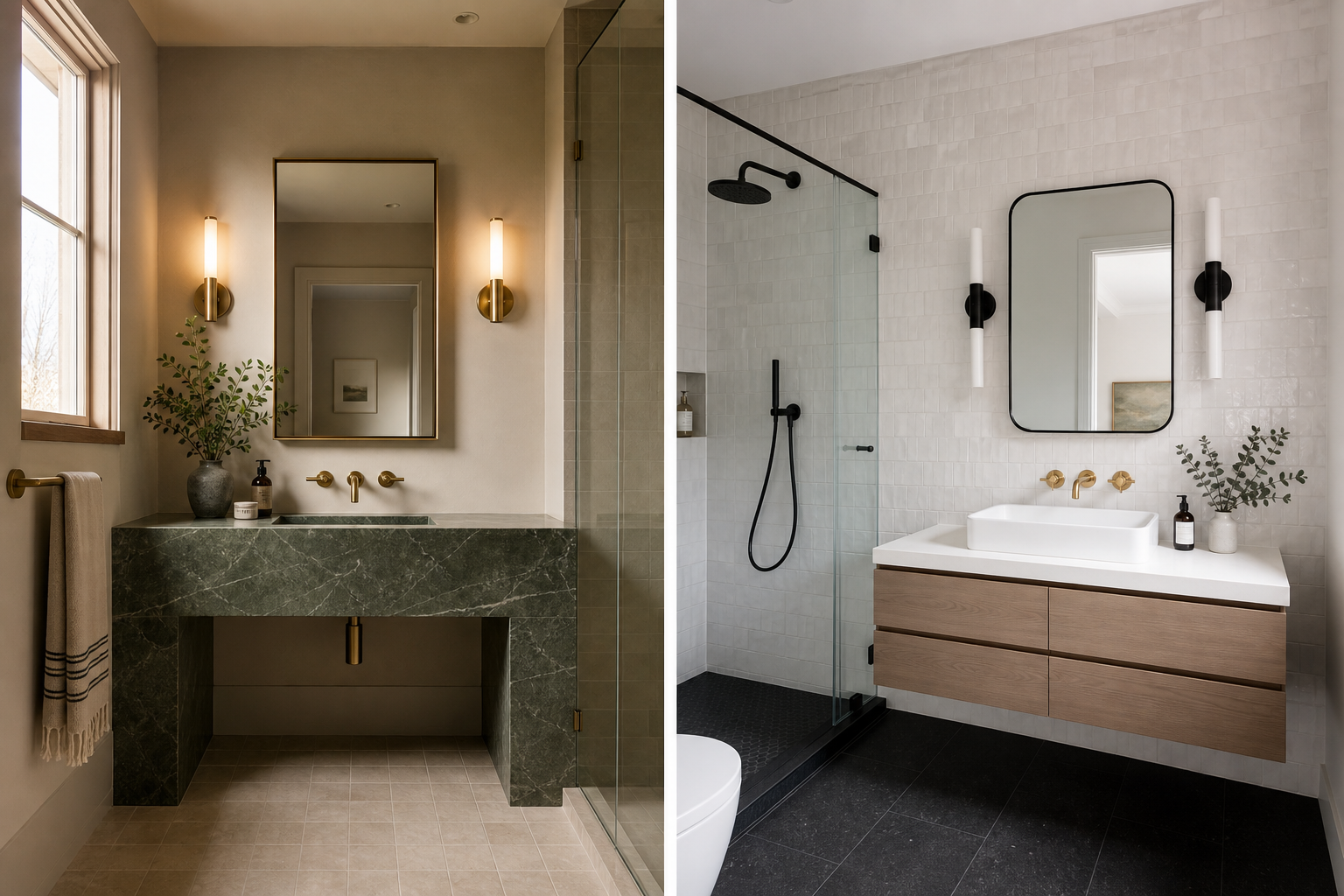
A warm brass faucet displayed against a white showroom wall reads clearly as brass. Installed next to gray porcelain with cool undertones and chrome towel bars, the same brass can read as an error rather than a choice. Brushed nickel beside warm beige tile can feel harmonious. The same nickel beside blue-gray tile can feel cold and institutional. The fixture did not change. The adjacent materials changed the color context in which your eye evaluates it.
This is why mixed-metal bathrooms require more judgment than single-finish bathrooms. Each metal interacts with every other surface. A showroom that displays one faucet on one wall cannot simulate those interactions. Only your room can.
Material hierarchy matters as well. In a bathroom where tile dominates visually, fixtures are supporting actors. In a bathroom with minimal tile and strong vanity cabinetry, fixtures carry more visual weight. The same faucet reads differently depending on which material leads the room. Showrooms typically display fixtures as the lead. Your bathroom may not agree.
The Context Effect in Design Judgment
Psychologists call this the context effect: the perception of an object changes depending on the surrounding environment. Interior designers encounter it constantly. Homeowners encounter it once, expensively, after the order is placed.
The context effect explains why two bathrooms can use identical faucets and one feels resolved while the other feels like a catalog display in the wrong house. The faucet is not the variable. The room is.
It also explains why online fixture shopping produces a high return rate. Product photography uses the same optimization as showrooms: neutral backgrounds, controlled light, ideal angles. Creative Home Idea, a home design publication, notes that without context such as ceiling height, wall color, and natural light levels, it is difficult to know whether a fixture will perform as expected. The thumbnail shows the product. It does not show the product in your product.
The fix is not to avoid showrooms. Showrooms are useful for tactile evaluation: the weight of a handle, the smoothness of a valve action, the actual depth of a basin. They are poor environments for finish and scale judgment unless you bring context with you.
How to Evaluate Fixtures Before You Commit
The evaluation sequence that reduces regret starts with specification, not shopping.
First, document your bathroom's actual conditions. Ceiling height at the fixture location. Wall color and tile undertone. Existing or planned light source, including Kelvin temperature and CRI if known. Window orientation and what natural light enters at the time you use the room. These are not preferences. They are the environment your fixture must survive.
Second, view finish samples in that environment, not in the showroom. Many showrooms will lend small finish chips or allow you to photograph products under your phone's white balance correction. Better: bring your tile sample to the showroom and hold it next to the fixture finish under the showroom light, then mentally adjust for the temperature difference you know exists. Best: view the fixture finish in your bathroom under a portable lamp set to your specified Kelvin.
Third, evaluate scale with a physical reference. Cut a piece of cardboard to the fixture's dimensions. Tape it at the proposed mounting height. Live with it for a day. Walk past it at the hour you normally use the bathroom. If it disappears, it may be too small. If it dominates, it may be too large or the wrong finish for a supporting role.
Fourth, evaluate function separately from appearance. A beautiful faucet with a reach too short for your basin depth will annoy you daily regardless of how it looks. A stunning pendant placed where you bump your head is not a design success. Showrooms optimize for appearance. Your bathroom requires both.
Fifth, sequence the decision correctly. Fixture finish should be chosen after tile, paint, and lighting temperature are specified, not before. Choosing a faucet first and then hunting for tile that matches it inverts the dependency chain. The room leads. The fixture follows.
What Showrooms Do Well and Poorly
Showrooms excel at mechanical evaluation. You can operate a valve. You can feel handle resistance. You can see drain placement on a lavatory. You can compare basin depths side by side. These are real and valuable data points that photographs cannot provide.
Showrooms perform poorly at contextual evaluation. They cannot show you your tile adjacent to their faucet. They cannot replicate your ceiling height. They cannot simulate your morning light. They cannot demonstrate how a finish reads when you are half awake at six a.m. versus how it reads under noon sun through a frosted window.
Treat showroom visits as one step in a longer evaluation, not as the decision itself. The fixture you love in the showroom is a candidate. The fixture you confirm in your bathroom, under your light, next to your materials, is the choice.
We evaluate fixtures in mock-up conditions when possible. For critical selections, we bring samples to the project site before anything is ordered.