The primary bathroom in most homes is designed for one person and shared by two. That gap is not a coincidence and it is not a budget problem. It is a design assumption that has been repeated so many times it has stopped looking like an assumption and started looking like a fact.
It is not a fact. It is a failure of layout, and it is almost entirely fixable before the first tile is chosen.
You know the 7am version of this problem. One person is at the sink with the mirror. The other is waiting to get into the shower, or already in the shower and filling the room with steam. The shower person has to walk through the sink person's space, or wait, or get dressed somewhere else, or some combination of all three. The mirror is too small for two faces, or lit in a way that only works when one face is in front of it. The toilet is in the middle of everything, and using it means announcing yourself to whoever else is in the room. There is one towel hook. There is nowhere to put a coffee cup.
None of this is dramatic. It is just low-grade friction, every weekday morning, for as long as you own the house. And because it accumulates in minutes rather than incidents, it rarely gets named as a design problem. It gets named as a scheduling problem, or a patience problem, or a problem of one person taking too long.
It is a design problem. And the opinion worth stating plainly is this: no primary bathroom that is going to be shared by two people should be designed as a single-user space. That is the choice being made every time a designer defaults to the standard linear strip layout, and it is the wrong choice. Here is what fixing it actually looks like.
The Geometry of Two People at Once
The morning overlap is not chaos. It is predictable. In a typical two-adult household, the overlap follows a small number of patterns: one person showers while the other gets ready at the vanity; both people arrive at the mirror within minutes of each other after separate showers; one person uses the toilet while the other is at the sink. These are the scenarios that repeat, every weekday, indefinitely.
Each pattern requires something specific from the room. Showering and using the vanity can happen simultaneously if, and only if, the shower's steam does not envelop the person at the mirror. Two people at the vanity at the same time can happen if there is counter space and mirror space for both of them without either person being squeezed to one side. The toilet can be used while someone is at the sink if the toilet has enough visual separation from the grooming area that neither person feels like they are performing.
Most primary bathrooms fail all three conditions, and they fail for the same reason: the room was laid out as a linear strip. One wall holds the vanity, the toilet sits in the middle, and the shower or tub sits at the far end. That layout fits neatly into a floor plan. It makes efficient use of a rectangular room. It is efficient in almost every sense except the one that matters, which is actual simultaneous use by two adults on a schedule.
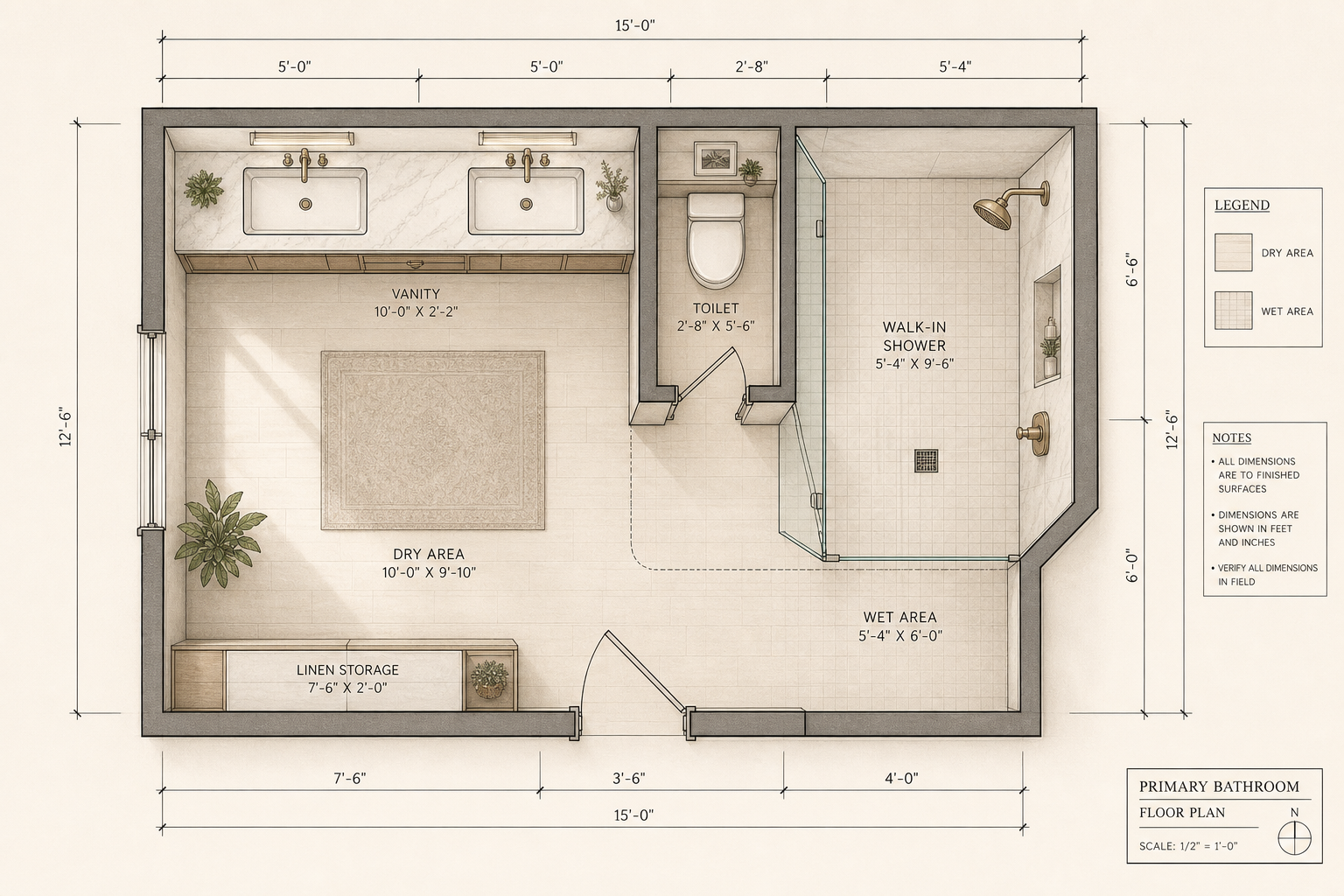
The fix requires thinking about the bathroom not as a corridor with fixtures but as three distinct zones: the wet zone, the dry zone, and the private zone. Separating those zones does not always require more square footage. It requires a different arrangement of the same square footage.
Wet Zone and Dry Zone: Why the Separation Matters
The wet zone is the shower (and the tub, if there is one). The dry zone is the vanity. In a linear bathroom, they share the same room volume, and the wet zone dominates it whenever the shower is running.
Steam moves toward the door and toward the temperature differential. In a room where the shower is at one end and the vanity is at the other, and the shower door or opening faces down the length of the room, steam travels directly toward the mirror and the person standing in front of it. This is not a ventilation problem, though better ventilation helps. It is a geometry problem. The two zones are oriented so that steam migration is inevitable.
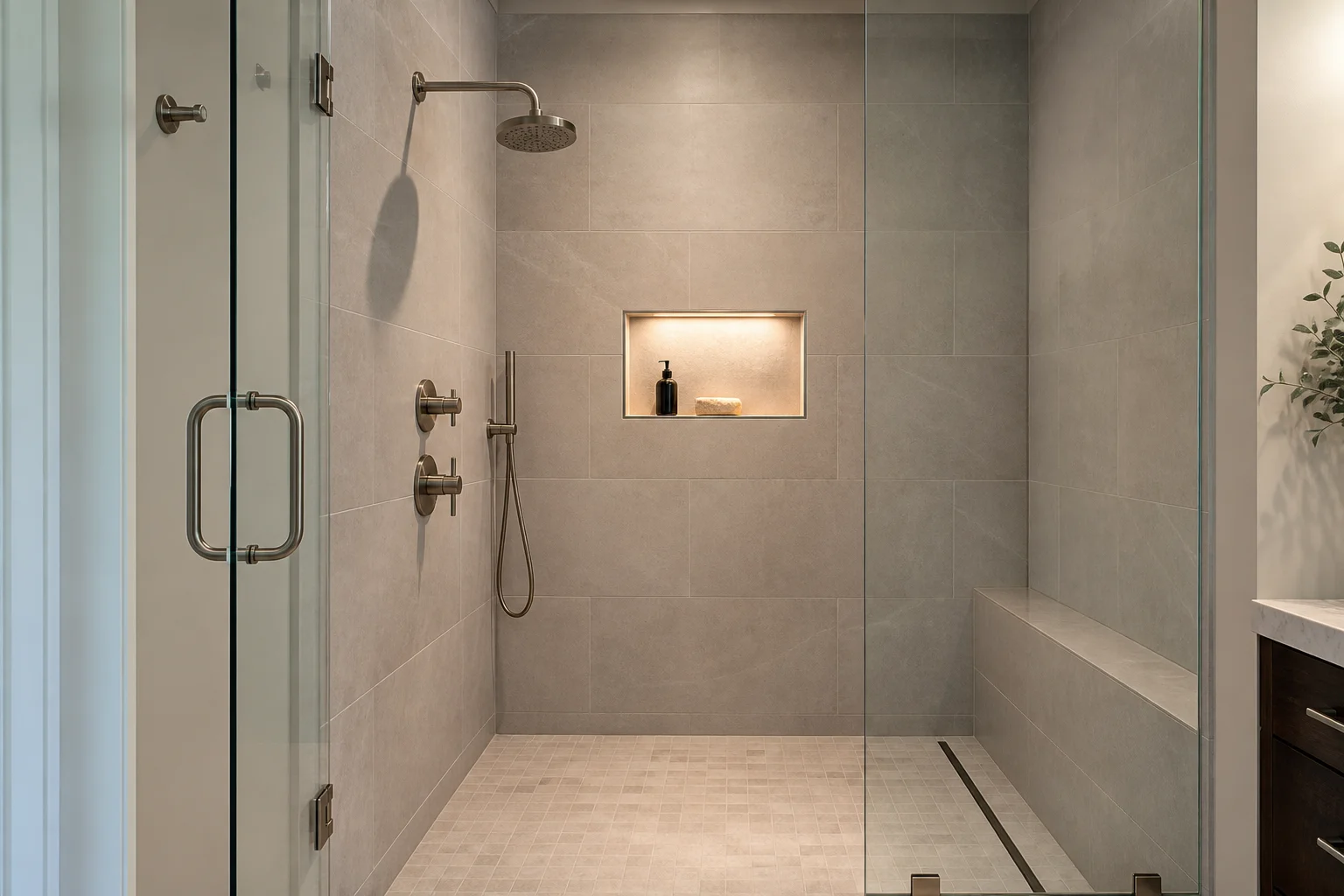
The geometric solution is to orient the shower so its entry does not face the vanity. A corner shower with a glass panel along one side can be positioned so the opening faces a side wall rather than the corridor. A shower alcove at the back of the room puts the wet zone behind the dry zone rather than beside it, which means someone can shower while someone else does their hair at the vanity without either person being in the other's steam path, sight line, or way.
In larger primary bathrooms, the wet and dry zones can be fully separated by a half wall, a partial divider, or simply by a layout that puts meaningful distance between the shower entry and the vanity. A partial wall between the shower entry and the vanity does not require closing off the room. Even a knee wall at the entry of the shower, three feet high, creates enough of a physical break that steam stays in the wet zone and the person at the mirror stays dry.
The practical test is simple: if the shower can run while the vanity mirror remains usable, the zones are adequately separated. If the mirror fogs within two minutes of the shower turning on, they are not.
Double Sinks and the 36-Inch Rule
If there is one dimension in bathroom design for two people that is non-negotiable, it is the center-to-center spacing of a double vanity.
The NKBA Bath Planning Guidelines recommend a minimum of 36 inches between the centerlines of two lavatories. The code minimum is 30 inches, which is the distance at which two standard sinks can fit without their edges touching. Those six inches are not a technicality. At 30 inches of center-to-center spacing, two people cannot use the sinks at the same time without their elbows colliding and their view of the mirror overlapping. At 36 inches, both people have their own space at the counter. They can both lean over the sink, open the faucet, and look at the mirror without crowding each other.
The same logic applies to the floor in front of the vanity. The NKBA recommends 30 inches of clear floor space from the front edge of the vanity to any opposing wall or fixture. The code minimum is 21 inches. Twenty-one inches is enough for one person to stand at the sink. It is not enough for one person to stand there while another opens a lower cabinet drawer, crouches to reach the hair dryer, or walks past on the way to the shower. In a two-person bathroom, the 30-inch clear zone is not a luxury. It is the floor space required for two people to be in the vanity zone at the same time.
Counter length matters just as much as sink spacing. A 48-inch vanity with two sinks has almost no counter space for either person. Their toothbrushes are competing for the same square foot of stone. Sixty inches is the practical minimum for a two-person vanity that gives both people somewhere to put their things. Seventy-two inches is more comfortable, and it is the size at which two people can each feel like they have their own section of counter rather than sharing one counter between them.
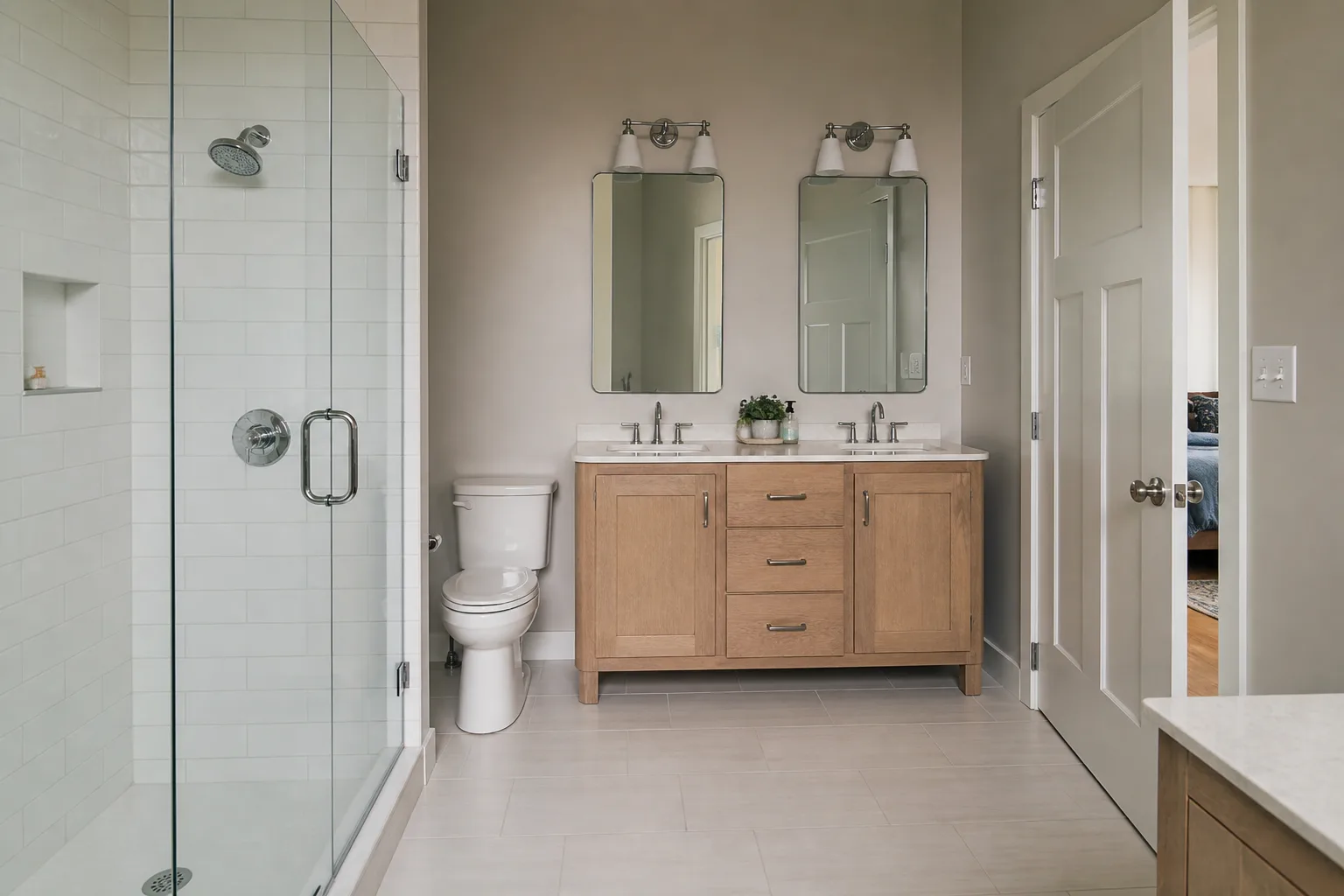
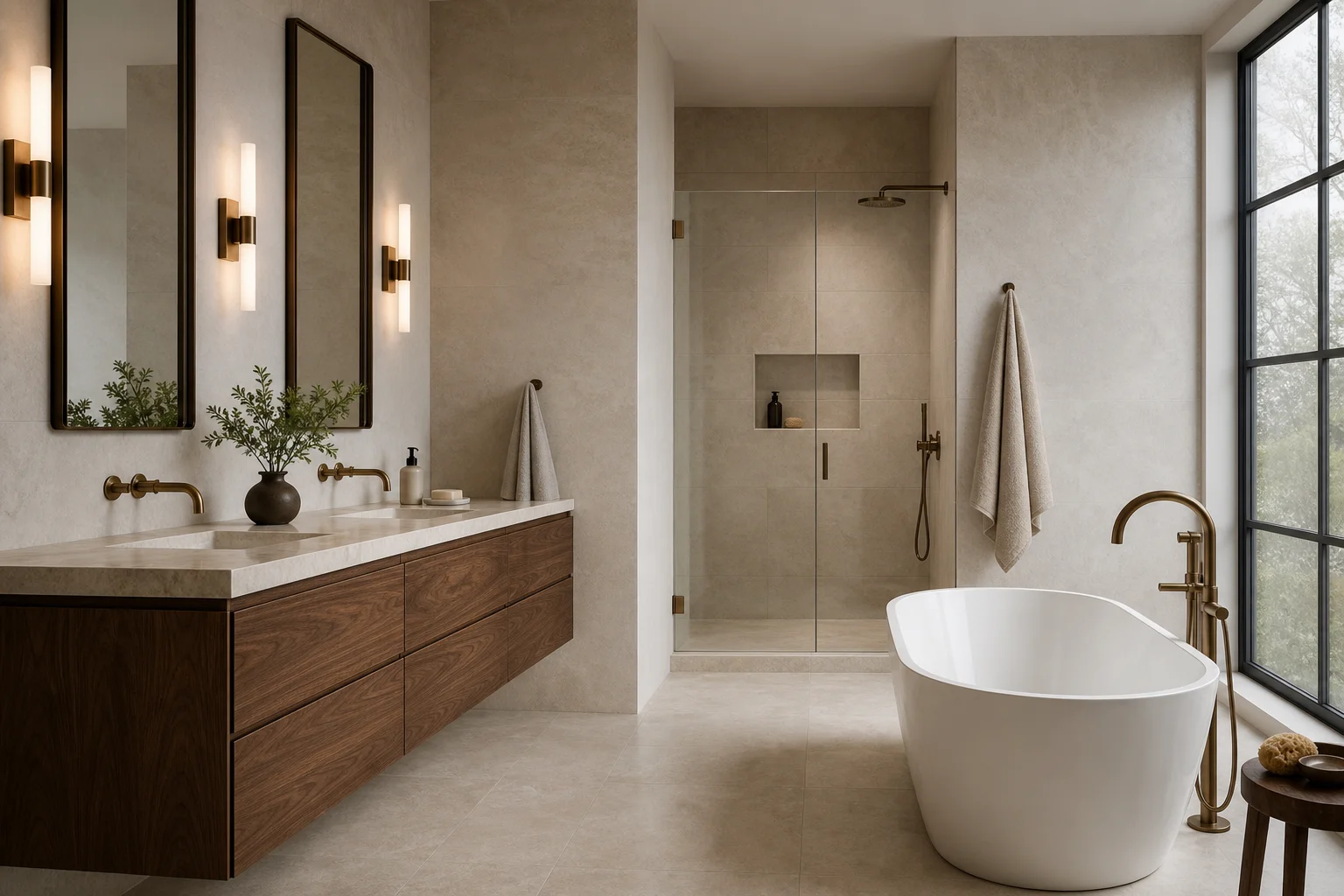
In primary bathrooms where the floor plan allows, separate vanity sections on opposing walls take this further. Each person has their own mirror, their own lighting, their own counter zone, and their own sink. One person can be getting ready while the other is still in the shower, and when the second person comes out, they go directly to their section of the room without needing the first person to move. That layout requires a wider or longer bathroom, but the principle does not require a large room. Even a bathroom that can fit two separate 30-inch vanities on opposing walls functions better for two people than a single 60-inch double vanity on one wall, because the two vanities create two separate zones rather than one shared one.
The Toilet Problem
In a primary bathroom, the toilet is almost always in the worst possible location.
It sits where it sits because that is where the drain is, and plumbing routing drives more bathroom layouts than any design consideration. The result is a toilet centered in the room, visible from the vanity, in full view of anyone at the sink, with no separation from the grooming area.
This is a functional problem as much as a privacy one. Most people do not want to use the toilet in the same visual field as their partner's morning routine. Most partners do not want to be in that field either. The friction this creates is real and low-level and persistent, and it almost never comes up in design conversations because it feels like the wrong kind of thing to raise with a contractor. It is worth raising.
The NKBA recommends a separate toilet compartment of at least 36 by 66 inches with a swing-out or pocket door. The code minimum is 30 by 60 inches, which is a functional compartment but a tight one. At the NKBA recommendation, the compartment has enough room to move, enough room for a small storage niche, and enough room that a person inside does not feel like they are in a coat closet. The door can swing outward into an adjacent hallway or closet space, slide as a barn door along the wall, or retract as a pocket door if the wall framing accommodates one.
Not every primary bathroom can fit a full toilet compartment. But most bathrooms that cannot fit one can still solve most of the problem through placement. A toilet that is positioned around a corner from the vanity, or recessed into its own alcove with a partial divider wall, or simply placed far enough back that the direct sightline from the sink does not reach it, accomplishes most of what a compartment accomplishes without requiring additional floor area or a door. The functional goal is not architectural separation for its own sake. It is that two people can be in the room at the same time without either one feeling exposed.
What Two People Need from a Mirror
The standard bathroom mirror is sized for one person. It is typically as wide as the sink below it or, in better installations, slightly wider. Two people standing at a double vanity will both be partly outside its useful range unless the mirror spans the full width of the counter.
A 36-inch mirror over a 72-inch vanity serves neither person well. Both people are partly in the mirror and partly watching each other's reflection in the margin. The fix is either a mirror that runs the full width of the vanity, giving both people access to the full field regardless of where they stand, or two separate mirrors each centered on one sink, giving each person a dedicated view at a height that suits them.
The full-width mirror is more flexible. Either person can stand anywhere along the counter and have a full view of their face. Two separate mirrors are better when the people are significantly different heights, because each mirror can be mounted at the ideal height for its user without compromise.
Lighting at a double vanity deserves its own attention. The NKBA recommends task lighting beside the mirror at eye level, with the light source not visible to the eye. Side-mounted fixtures flanking the mirror, rather than recessed cans directly overhead, eliminate the most common failure mode of bathroom lighting: a fixture above the mirror that puts light on the top of the head and casts shadows across the face. For shaving or applying makeup, overhead lighting is nearly useless. Side lighting at eye level illuminates the face evenly, eliminates the shadows under the eyes and chin, and works for two people simultaneously when the fixtures span the width of the vanity rather than flanking a single central mirror.
For a two-person vanity, that means either a pair of sconces flanking each separate mirror, or a continuous lit mirror that spans the full counter length and provides even illumination across the entire grooming zone. Both approaches work. Neither approach is more expensive than a well-specified set of recessed cans, and both are dramatically better at the actual task the lighting is supposed to serve.
What the Room Becomes
A primary bathroom designed for two people does not look dramatically different from a bathroom designed for one. It has two sinks instead of one, a shower oriented away from the vanity, a toilet that has visual privacy from the rest of the room, and a mirror that works for two faces. None of those elements are exotic. None of them require a larger room than the standard primary bathroom footprint. They are the natural consequence of taking the layout seriously rather than defaulting to the arrangement that was easiest to draw.
What changes is the experience of Monday through Friday. Two people can move through the same room at the same time without either person having to wait, leave, negotiate, or step around the other. The shower running does not force the person at the mirror to move. The person at the mirror does not make the person at the toilet feel like they are in public. The counter has room for two people's things without one set of objects crowding the other into the soap dish.
The room stops being a bottleneck and starts being a room. That sounds like a modest outcome. Ask anyone who has lived in both kinds of bathroom whether the difference is modest.
When we start a layout review for a primary bathroom used by two people, the first question we ask is what the 7am overlap looks like. Who needs the mirror, who needs the shower, and whether those two activities can happen at the same time without one person having to leave the room. The answer to that question shapes every decision that comes after it, from where the plumbing goes to how the mirror is lit.