The most expensive bathroom faucet is not the most expensive to own if the brand discontinues its cartridge within a decade. Long-term parts availability is a specification consideration that matters as much as finish durability for a fixture in a room you plan to own for twenty years, and it is the variable most commonly ignored during the selection process.
Nobody buys a bathroom faucet thinking about the cartridge. They think about the finish: brushed nickel, matte black, unlacquered brass. They think about the spout height and reach. They think about whether it matches the towel bar and the shower trim. The cartridge is invisible, buried inside the valve body, and it works without any apparent effort until one day it does not. At that point, the question is not what the faucet looks like. The question is whether the part still exists, whether it ships within a reasonable window, and whether a local plumber has it on the truck or has to order it from a regional distributor who has to order it from a national warehouse who has to find it in inventory they may or may not have.
That experience varies enormously by brand, and the variation does not track cleanly with price.
How the Three Dominant Brands Actually Differ
Delta, Moen, and Kohler account for a large share of the residential bathroom faucet market in North America, and they differ in meaningful ways at the service level that their marketing materials do not emphasize.
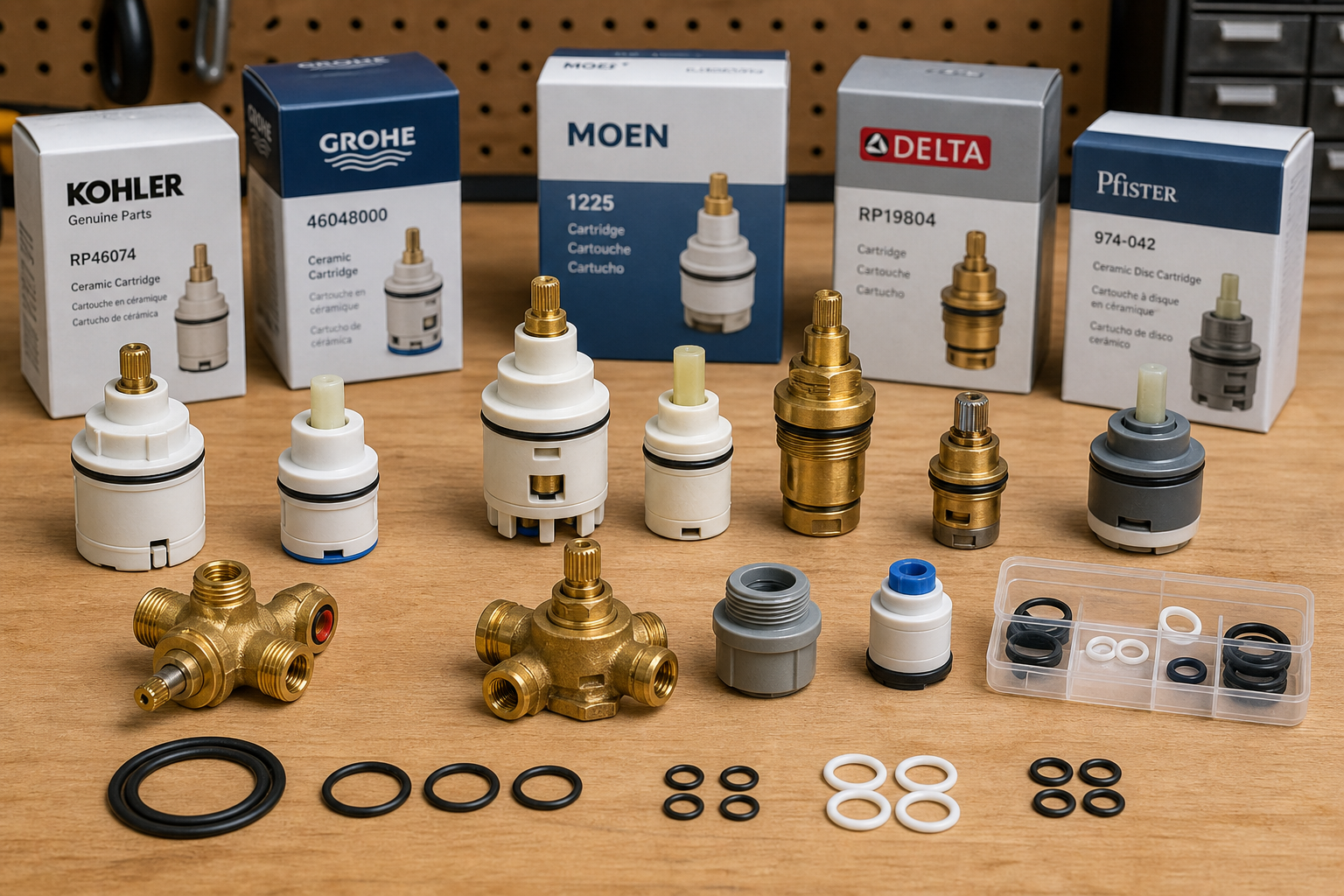
Moen's cartridge system is the most widely stocked replacement part in the residential plumbing industry. The 1225 and 1222 cartridges appear at virtually every hardware store with a plumbing aisle, and plumbers who service residential fixtures typically carry them without special-ordering. When a Moen faucet develops a drip, the repair is a single cartridge replacement that takes less than an hour and costs a small fraction of the fixture price. Moen also offers free cartridge replacements under its limited lifetime warranty for the original purchaser, which means the cost of the first repair is often nothing.
Delta's valve system uses a different internal design, the Diamond Seal Technology in most current products, and the parts are similarly available at major retailers and plumbing supply houses. The specific advantage of the Diamond Seal design is durability under hard water conditions; the ceramic disc mechanism is less susceptible to mineral buildup than rubber seat cartridges, which means the intervals between required service are often longer in areas with aggressive water.
Kohler manufactures high-quality fixtures with strong design pedigree. The parts availability picture is different. Kohler parts are available, but they may require direct ordering from Kohler or from a Kohler-authorized distributor rather than being stocked on the shelf at a local hardware store. For a homeowner comfortable with online ordering and a one-week wait, that gap is manageable. For a rental property or a commercial application where a non-functioning fixture needs same-day repair, it is a real operational inconvenience. Instant Plumbing, a licensed plumbing contractor, documents this directly in their brand comparison: while Kohler parts are generally available, replacement parts can be harder to source locally when something needs service years later, which is distinct from both Moen and Delta whose parts are stocked at virtually every plumbing supplier.
None of this makes Kohler a bad specification. The design quality is real. The finish durability is real. The warranty is real. It makes Kohler a specification where you should know going in that service will occasionally require planning rather than a quick trip to the hardware store.
What Happens Above That Price Point
The domestic major brands are comparatively transparent about their parts programs. The situation becomes meaningfully more complex when the specification moves into the imported European luxury category.
Brands sold at the high end of the residential bath market can deliver a genuinely different product: heavier construction, tighter tolerances, finishes with more depth and specificity, a design coherence that comes from narrower catalogs developed by smaller teams. Some of those brands support their products for twenty or thirty years. Others discontinue specific product lines within five to eight years, leaving owners with attractive fixtures whose internal cartridges are no longer manufactured.
The variable is not brand reputation in the general sense. It is product line continuity. A brand that rotates its collections frequently to stay design-current will discontinue old models faster than a brand that maintains a more stable catalog. When a model is discontinued, the cartridges specific to that valve body may be discontinued with it. At that point, a plumber is left trying to find a compatible third-party cartridge that fits the valve housing, hoping the dimensional tolerances are close enough to seal correctly, or recommending replacement of the entire fixture.
This is not hypothetical. It is a repeating pattern in renovations of homes that received high-end European bathroom fixtures ten to fifteen years ago. The tile is still in excellent condition. The fixtures often still look fine. The cartridges are unavailable through normal channels, and finding compatible alternatives requires a specialist who knows the product well. What started as a planned maintenance visit becomes a fixture replacement project.
How to Evaluate Parts Availability Before You Specify
The question to ask is not "Does this brand have a warranty?" Every brand at this price point has a warranty. The relevant questions are more specific.
First: can you order replacement cartridges for this model today through a domestic distributor, without going through a custom import channel? If a brand's parts require international ordering or a direct factory relationship to source, that situation is unlikely to improve over time. The distribution infrastructure for service parts reflects how the brand thinks about product life cycle.
Second: how long has this specific product line been in the catalog, and does the brand have a documented history of maintaining parts availability after discontinuation? Some manufacturers commit to ten-year parts availability after a product is removed from active production. Others do not. That commitment, if it exists, should appear in the brand's official documentation rather than in a sales representative's verbal assurance.
Third: what is the internal mechanism, and does it use a proprietary cartridge or an industry-standard size? Some valves accept cartridges that are dimensionally compatible with third-party manufacturers, which provides a backup supply chain when the original cartridge becomes unavailable. Others use housings machined to accept only the manufacturer's own cartridge, which creates complete dependence on the manufacturer's supply chain for the life of the fixture.
Fourth: does a licensed plumber in your area have direct experience servicing this brand? Theoretical parts availability is different from practical parts availability. A plumber who has to research an unfamiliar brand's parts program from scratch during a service call is billing time you are paying while they figure out what to order.
The Warranty That Matters and the One That Does Not
Nearly every fixture brand at a price point above roughly $200 offers a "limited lifetime warranty." That phrase sounds reassuring until you read what it covers and what it does not.
In the residential plumbing industry, a limited lifetime warranty typically covers defects in materials and workmanship for the original purchaser. It does not typically cover finish wear from normal use, damage from mineral deposits, or the cartridge failures that occur from years of operating cycles. Some warranties cover cartridge replacement for the original purchaser; others cover it only for a defined period. The key clause is always the same: the warranty applies to the original purchaser for the life of the product in the original installation.
That sounds comprehensive. In practice, what matters more than the warranty text is whether the brand honors it smoothly when you call. A warranty from a brand with a responsive customer service infrastructure means a replacement cartridge is in the mail within a few days. A warranty from a brand without a domestic support organization means a phone call that routes internationally, a process that requires proof of purchase from a decade ago, and a timeline that makes the warranty functionally useless compared to simply buying a replacement part.
The most useful proxy for warranty quality is the same as for parts availability: how long has the brand been in the US market, and do plumbers in your area know who to call when a product needs service?
The Relationship Between Finish Longevity and Cartridge Life
Finish durability and cartridge life are separate considerations that do not always move together, and confusing them is easy.
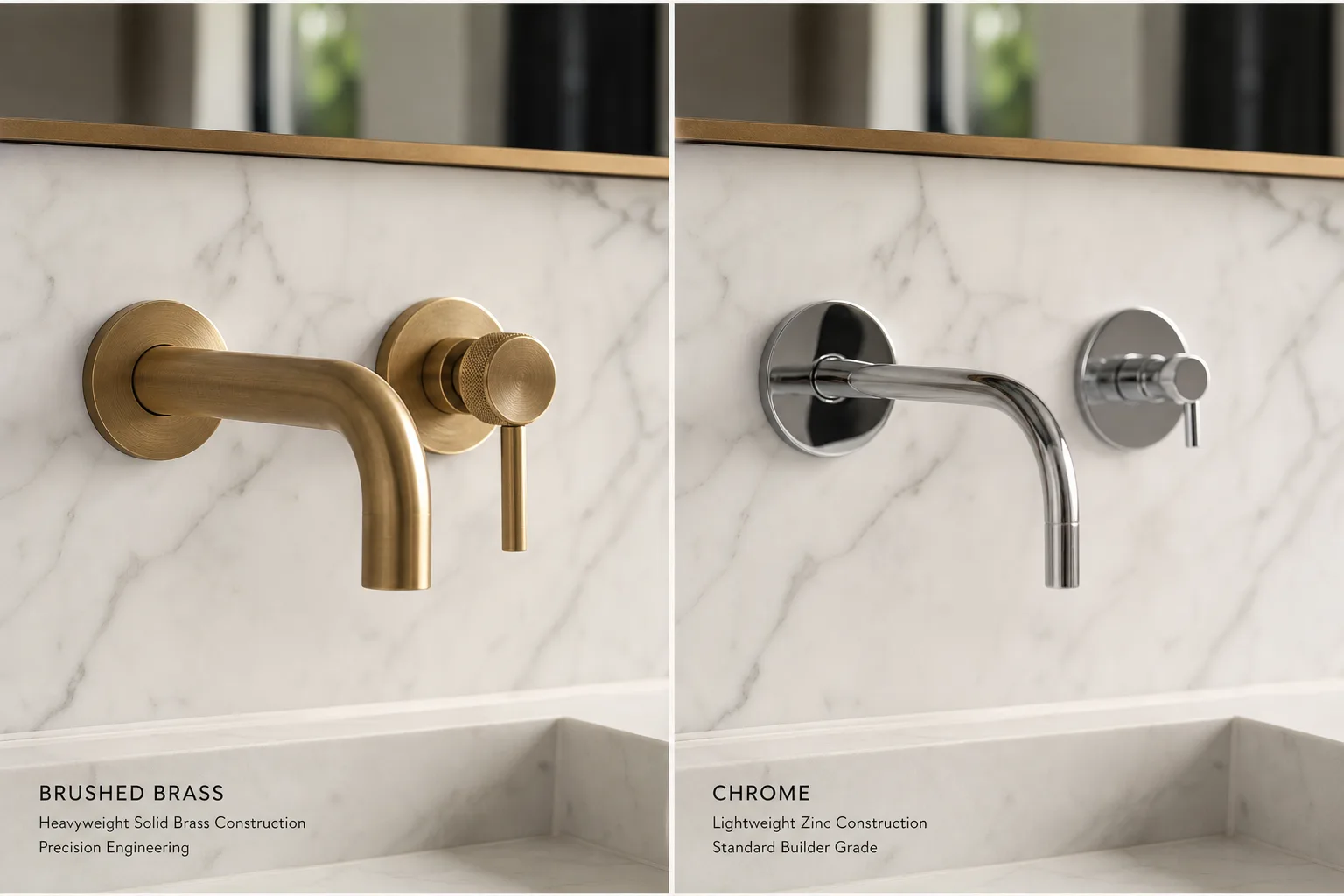
A physically durable finish will hold its appearance for many years under normal use. Physical vapor deposition (PVD) finishes used by several premium brands are genuinely more resistant to corrosion, scratching, and finish wear than traditional lacquered or electroplated surfaces. The fixture may look essentially new fifteen years after installation. The cartridge inside it, which has been cycling through thousands of open-and-close operations in water that may have varying mineral content and acidity, is subject to its own wear timeline independent of the exterior finish.
A faucet that looks perfect at twelve years but cannot be repaired because the cartridge is unavailable presents a specific frustration: the part that is failing is invisible and inexpensive to replace if the part exists. The part that looks fine and would be expensive to replace is the fixture body and finish. The mismatch between what fails and what is expensive to replace is where parts availability decisions have the most practical consequence.
The same calculus applies to shower valves, which have even more demanding operating conditions than sink faucets. A thermostatic shower valve with a cartridge that fails at year eight is a comfortable repair if the cartridge is stocked. It is a significant project if the valve body is integrated into the wall and the cartridge is no longer manufactured.
What This Means for a Renovation Specification
The specification decision is not to avoid expensive fixtures. It is to apply the parts availability question as a filter before expensive fixtures are selected, rather than after.
The domestic major brands have demonstrated long-term parts support through their distribution infrastructure and manufacturing continuity. That does not mean they are always the right choice aesthetically. It means that if you specify a Moen or Delta or Kohler valve, you are accepting a known parts story. If you specify a less common brand, you should research that brand's parts program specifically before the specification is final.
For high-end European brands that have been in the US market long enough to have a service history, that history is usually documentable. You can find plumbers who have serviced the product, distributors who stock the parts, and documentation about the brand's commitment to parts availability post-discontinuation. That research takes time. It is the right time to spend before installation rather than after a cartridge fails.
Before we include any brand in a specification, we verify that replacement cartridges are available domestically and that the brand has a consistent product line history. Brands with frequent discontinuations or opaque parts programs do not make our default list.