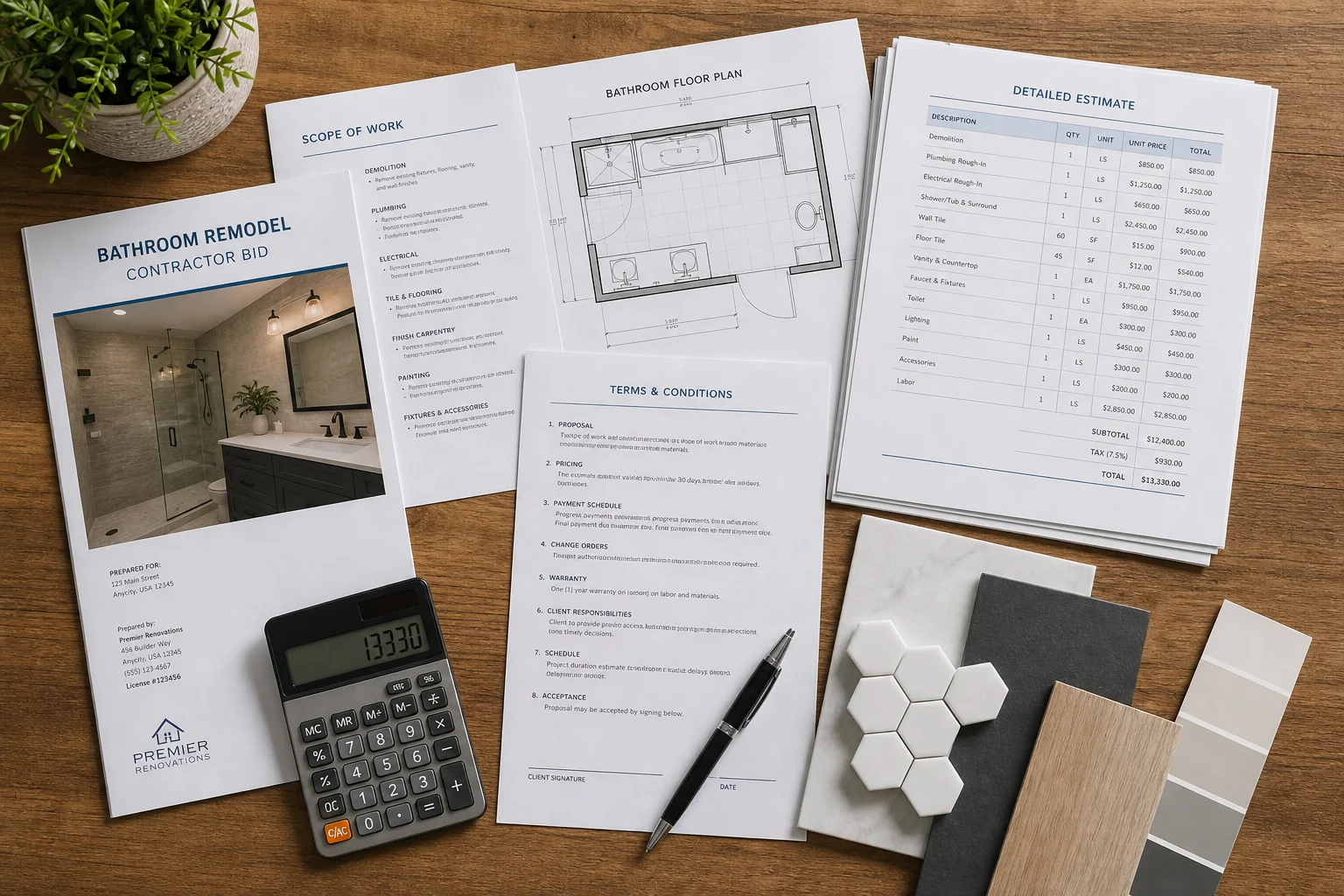
A contingency is not padding. It is not the contractor's profit margin dressed up in polite language. It is the budget that covers what the walls are hiding, and it is the single biggest predictor of whether a bathroom renovation stays rational or becomes a hostage negotiation. Contractors who bid low contingencies are not being generous; they are shifting risk onto the homeowner while keeping the signed contract.
Understanding why that is true requires understanding what actually happens when a bathroom is opened for renovation. Most homeowners have a mental model of remodeling as an additive process: you remove the old things, the room is empty, and you install the new things. That model is wrong in a specific and expensive way. What renovation actually involves is opening a system that has been sealed for decades and discovering what that system has been doing in the dark.
What Demo Actually Finds
Every bathroom has a floor assembly, a wall assembly, and a plumbing system. Each of these is capable of concealing conditions that will add cost and time to any project, and none of them reveal those conditions until something is torn out.
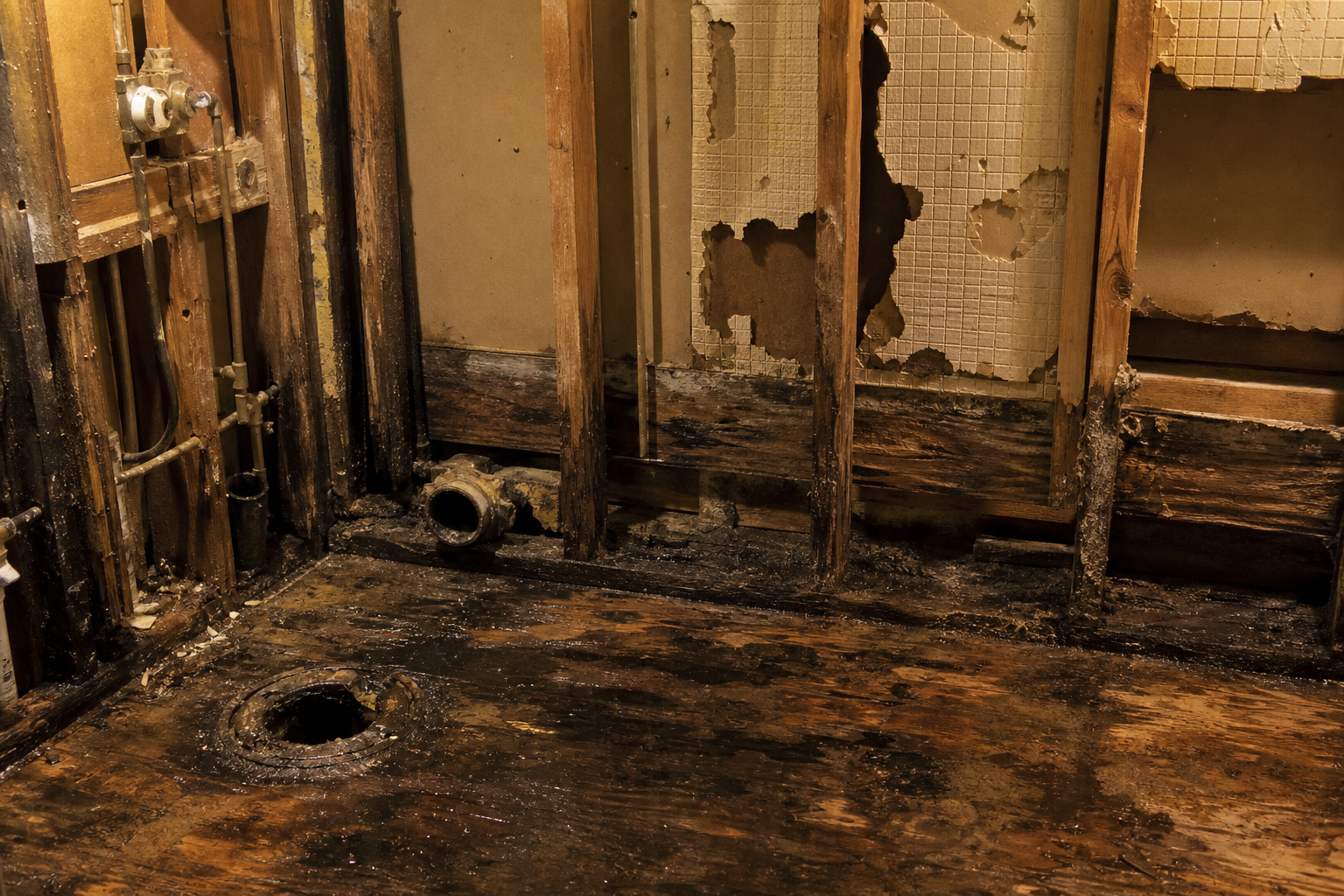
The most common discovery is subfloor damage under the toilet. Toilet flanges develop slow leaks over time; the wax ring degrades, or the flange itself corrodes, and water begins seeping downward with each flush. Because the leak is slow, it does not announce itself the way a burst pipe does. It accumulates over months or years, saturating the subfloor plywood until the wood fibers begin to delaminate and rot. The floor might feel slightly soft if you know to test it. Usually, it does not feel like anything at all until a contractor pulls the toilet and finds a section of subfloor that collapses under a screwdriver probe.
Repair cost for subfloor rot depends on how far the damage has spread. A localized patch around the flange area, say twenty square feet, typically runs $500 to $1,000 in labor and materials. If the water has tracked along the grain to reach the floor joists below, sistering a joist runs $200 to $500 each. If rot has reached multiple joists or if the damage covers most of the bathroom footprint, full subfloor replacement with joist repair can reach $2,000 to $3,500 before any tile goes back down. None of this is visible from above before demo begins.
The shower wall assembly tells a similar story. Tile over cement board, correctly waterproofed, will last decades without incident. Tile over greenboard drywall, which was standard practice well into the 1990s, will eventually fail at the grout lines, allowing water to penetrate and wick into the paper-faced substrate. Once that process starts, it is invisible until the tile comes down. What contractors find ranges from a surface mold colony that requires treatment and encapsulation ($500 to $1,500) to systemic black mold penetration into the framing that requires full remediation ($1,500 to $15,000 and a longer timeline than anyone planned for).
The plumbing system offers its own set of discoveries, and they depend heavily on the age of the house. Homes built before roughly 1970 are frequently supplied by galvanized steel pipe. Galvanized corrodes from the inside out: the interior surface of the pipe accumulates scale over decades, reducing water pressure and eventually causing rust to flake off into the water supply. This is not visible from the outside of the pipe. The pipe looks intact. It is failing internally. Once a wall is opened for a remodel, a contractor who finds galvanized supply lines faces a real choice: close the wall over known-failing infrastructure, or replace the lines. Replacing a single bathroom's galvanized supply typically runs $1,200 to $2,500 depending on run length. Replacing branch lines that feed multiple fixtures can reach $3,000 to $6,000.
Homes in a certain middle age range, built from the 1950s through the 1970s, often add electrical discoveries: ungrounded outlets in a wet location, aluminum wiring at branch circuits, or a GFCI requirement that cannot be met without running a new circuit from the panel. Each is a legitimate code compliance issue that becomes the contractor's legal responsibility to address once the wall is open.
The last category of discovery is structural. Out-of-level framing matters in a bathroom because tile and stone require a flat, stable substrate to prevent cracking at the grout lines. A floor that deflects is a floor that eventually cracks tile. An out-of-plumb wall complicates every aspect of a tile installation. These conditions are partially diagnosable before demo; a contractor who looks carefully can identify a soft floor or a wall that reads out of plumb on a level. But the extent of what is needed to correct them is only determinable once the assembly is open.
Why These Conditions Cannot Be Priced Before Demo
The diagnostic limitation is not a failure of expertise. It is a physical constraint. A contractor standing in an intact bathroom is looking at surfaces. The subfloor is under tile. The framing is behind cement board or drywall. The supply lines are inside wall cavities. Short of demolishing the room before pricing it, which is not practical before a contract is signed, no one can see what is there.
Experienced contractors develop pattern recognition over time. A floor that feels springy near the toilet is worth flagging. A grout line that has cracked in a regular pattern often indicates a wet wall behind it. A bathroom in a house built in 1965 in a wet climate almost certainly has galvanized supply lines. These observations inform an honest contingency estimate. They do not replace it.
The honest version of this conversation sounds like: "We cannot know what we will find until demo. Based on the age of the house and what I can see on the surface, I am flagging galvanized plumbing as likely and some subfloor softness as possible. My contingency line covers those scenarios. If we find nothing, you keep the money."
What a Real Contingency Percentage Looks Like
The range you will see cited most consistently across the remodeling industry is 10 to 20 percent of the total project contract. That range is correct, and the distinction between 10 and 20 is not arbitrary.
For newer construction, defined broadly as homes built within the last twenty years, a 10 percent contingency is generally adequate. Systems are younger and more likely to be in serviceable condition; plumbing is almost certainly PEX or copper; subfloor materials are more likely to be intact; electrical is likely already code-compliant.
For homes in the twenty-to-forty-year range, 15 percent is a more defensible number. This cohort includes homes that may have original galvanized supply lines, homes where the first-generation shower installations used materials that are now degrading, and homes old enough to have had a previous bathroom renovation whose quality is unknown. "We don't know what the last person did in here" is a legitimate reason to carry more contingency.
For homes over forty years old, or any home with visible signs of deferred maintenance, moisture history, or prior amateur work, 20 percent is the floor, not the ceiling. Contractors working regularly in older housing stock sometimes recommend 25 percent, and the research supports them: one Chicago-area contractor surveyed its own completed projects and found that surprise costs appeared in 60 to 70 percent of older-home bathroom remodels. The question is not whether something will be found. It is whether the budget is ready for it.
There is one more variable that drives contingency independent of home age: scope. A cosmetic refresh that does not touch plumbing, does not demo walls, and does not move anything requires less contingency than a gut remodel. If you are replacing fixtures in place, 10 percent is adequate regardless of the home's age. If you are gutting a tiled shower to the studs, 15 to 20 percent is the right starting point regardless of how new the house is.
Why Contractors Lowball It
The mechanism is straightforward. Contingency is a line item that homeowners instinctively push back on. It is not tile. It is not fixtures. It is a number on a page that represents the possibility that something goes wrong. When a homeowner sees a bid with a 20 percent contingency and a competing bid with a 5 percent contingency, the second bid looks like a lower project cost. It often wins.
The contractor who bid 5 percent is not planning to absorb the cost if something is found behind those walls. They are planning to issue a change order. A change order is a legal document that adds scope and cost to an existing contract; it is the mechanism by which a contractor converts a low-bid project into a profitable one after the homeowner has already signed. By the time a change order arrives, the project is already underway, the walls are already open, and the homeowner has limited leverage to negotiate. Accepting the change order is usually less disruptive than stopping the project.
This is not always deliberate. The remodeling industry includes contractors who genuinely believe they can complete projects at their bid price; they underestimate the frequency of discovery events or they have not been in business long enough to have experienced the full range of what older homes contain. But the financial effect on the homeowner is the same whether the low contingency was strategic or optimistic.
Michael Stone, a construction business analyst at Markup and Profit, has documented the pattern explicitly: some contractors deliberately undercut bids and plan to recover the difference through change orders. The structural incentive is real, and homeowners who understand it are better positioned to evaluate what a bid actually means.
The signal in the bid is this: a contingency line of less than 10 percent on any gut remodel is either a calculation that the contractor expects to change-order, a sign that the contractor has not priced the risk, or an indication that the estimate is missing scope. All three of those outcomes are expensive for the homeowner.
How to Tell Whether a Contingency Is Honest
The first test is whether the contingency exists as a named line item at all. Some contractors bake a small contingency into their overhead or profit margin without disclosing it; others do not carry one at all and rely entirely on change orders for cost overruns. Neither approach is transparent. A contingency that does not appear explicitly in the estimate is a contingency the homeowner cannot evaluate.
The second test is whether the contractor can explain what the contingency is intended to cover. "It's standard" is not an answer. The right answer names the specific conditions that are possible in your specific home. "This house is from 1972, so I'm carrying 18 percent because galvanized plumbing is likely once we open the wall, and there's a reasonable chance of subfloor softness near the toilet given the age of the fixture" is an answer that tells you the contractor has thought about your project. The number is connected to a risk model, not plucked from industry convention.
The third test is what happens if the contingency is not used. A well-structured project has a defined process for returning unused contingency to the homeowner or applying it to an elective upgrade. If a contractor's answer to "what happens to the contingency if nothing goes wrong?" is vague or evasive, the contingency may be functioning as additional margin rather than a genuine reserve.
A fourth, less obvious test: ask how change orders are handled above and beyond the contingency. No contingency covers every possible scenario. A home with a concealed structural deficiency, or a bathroom with a drain stack that turns out to be cast iron crumbling at the hubs, might exceed even a well-sized contingency. The question is whether that scenario triggers a written change order with a priced description of additional work and a timeline adjustment, or whether it triggers a phone call demanding more money with construction stopped.
We include a contingency as a named line item in every project estimate we provide. For homes built before 1990, we recommend 20 percent as the starting figure, because the discovery rate in that cohort justifies it. For newer construction, we typically carry 10 to 15 percent depending on visible condition indicators at the site walk. We name it as a line item because a contingency that is hidden inside the margin is a contingency the client cannot see, reason about, or hold us accountable to. If the contingency is unused, we have that conversation explicitly before the project closes.
The Budget That Owns the Project
The homeowner who builds a real contingency into their budget owns the renovation. When demo reveals rotted subfloor, the response is "we have contingency for that" rather than "how much will this cost us." When galvanized plumbing shows up behind a wall, the decision to replace it is a practical one, not a financial emergency. The project continues on its planned schedule because the financial architecture anticipated imperfection.
The homeowner who does not carry a real contingency gets owned by it. The first change order arrives and the reaction is either to deplete savings that were not allocated for this, to defer the discovered condition and close the wall over a known problem, or to enter a negotiation with a contractor in a room that is already torn open. None of those outcomes serve the project.
A contingency is, in the most practical sense, the acknowledgment that a bathroom opened for renovation is not an empty room waiting to receive new fixtures. It is a system with a history, and that history includes water, time, and conditions that no one who built it or lived in it was watching. The budget that understands that is the budget that survives the project intact.