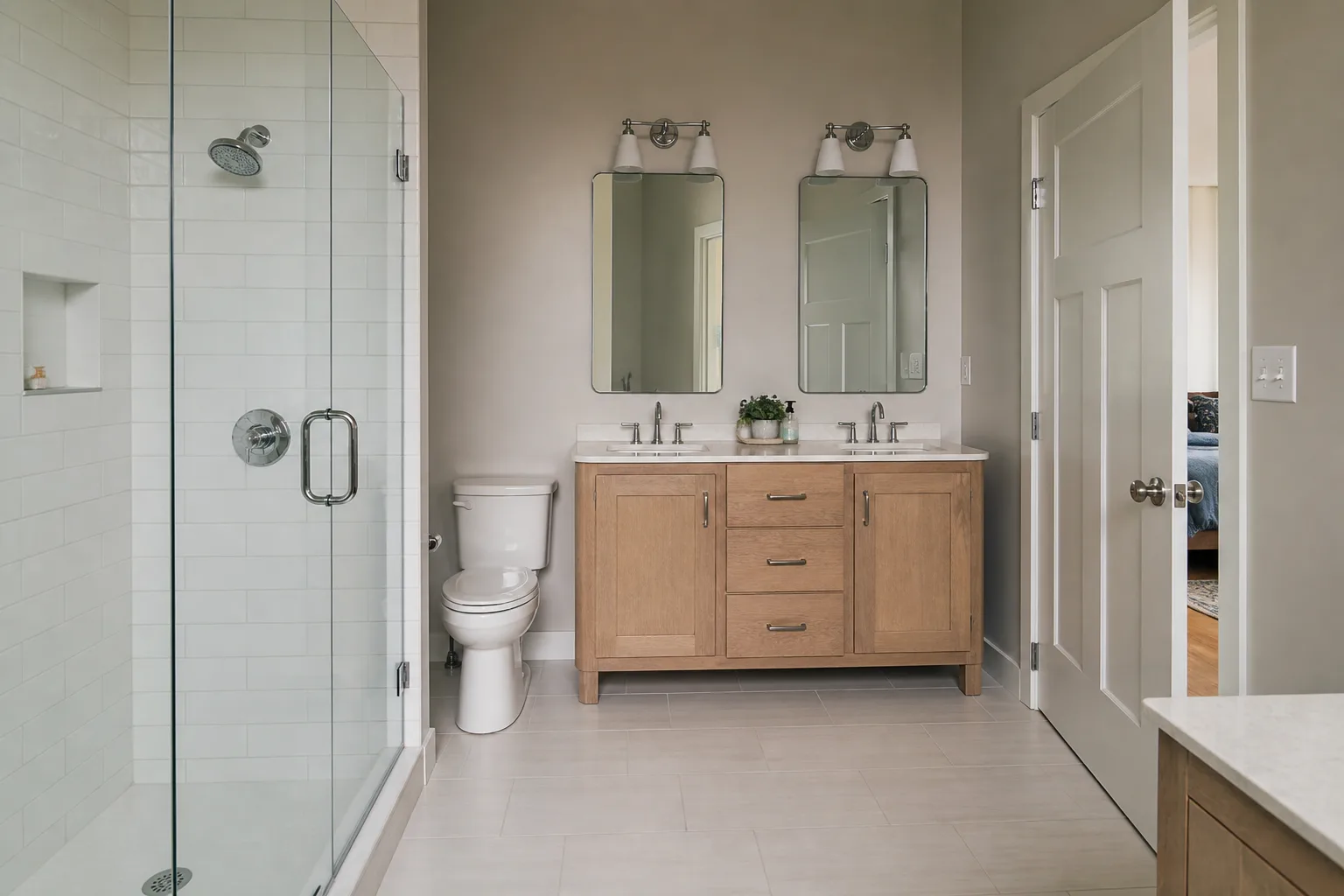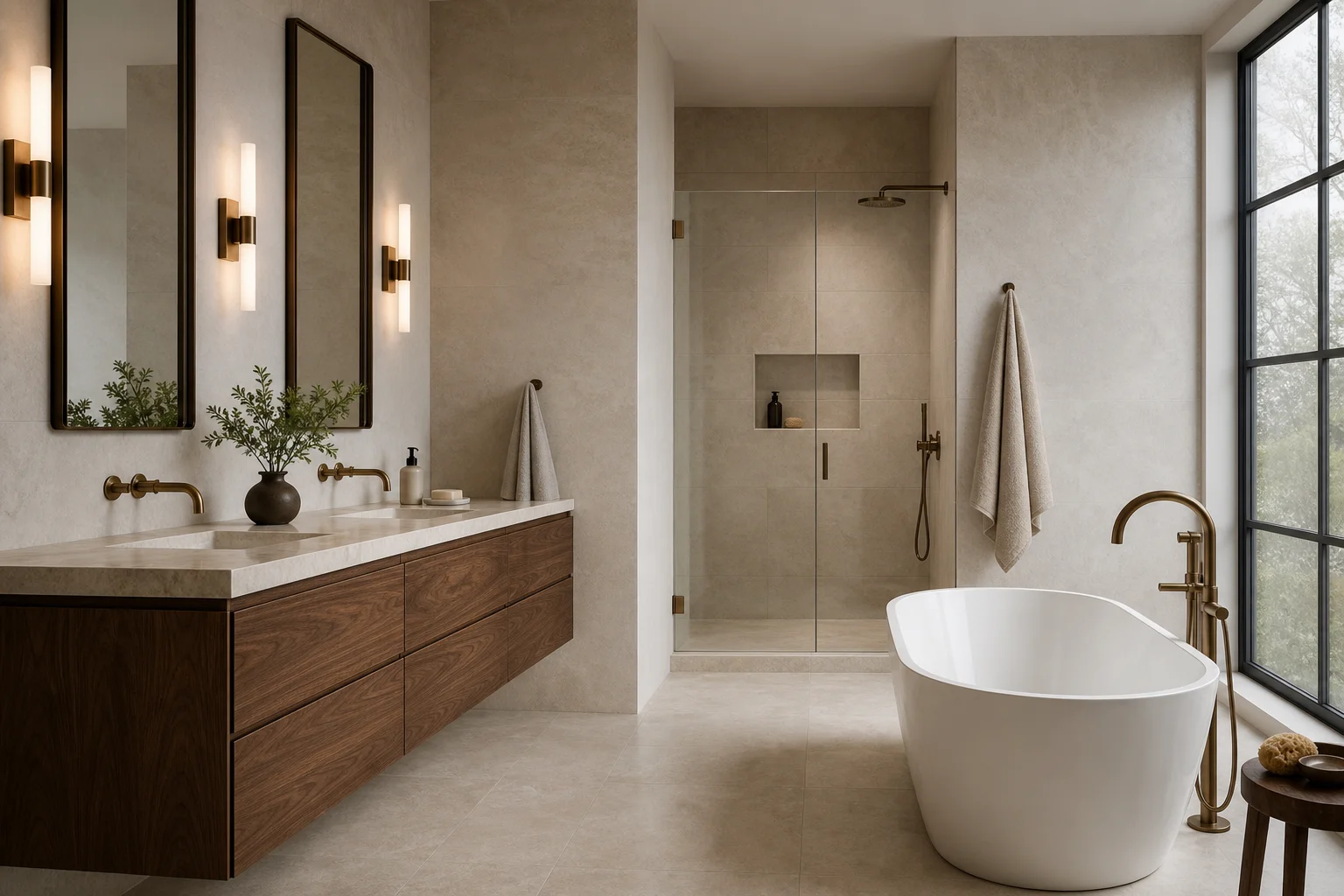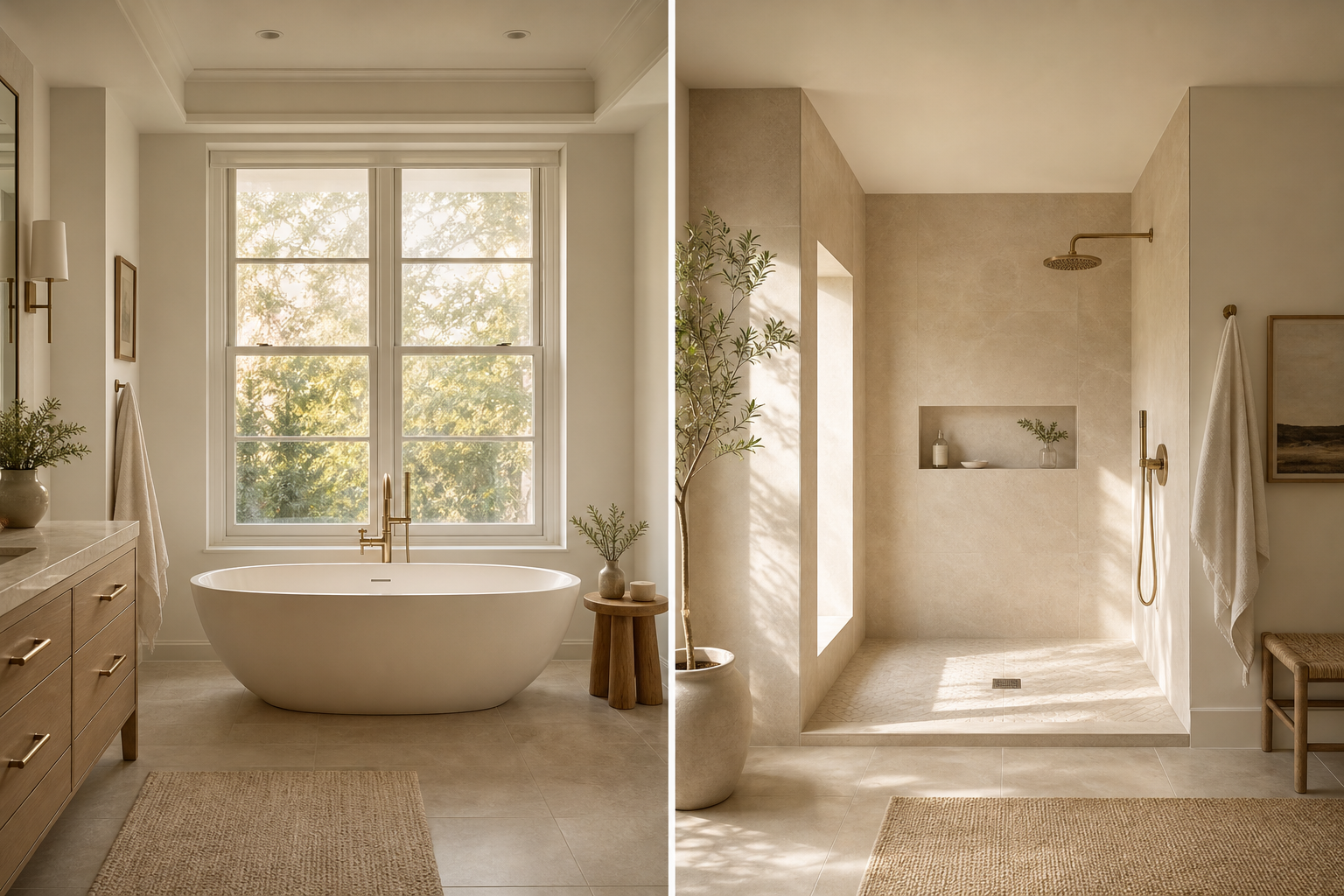
The tub-versus-shower decision in a primary bath is not a preference question. It is a usage question, a resale question, and a footprint question, in that order. And the answer for most households with children at home is different from the answer for households without children, different again for households where someone bathes regularly for physical recovery or relaxation, and different again for households planning to age in place.
Most homeowners start in the wrong place. They open a Houzz board, fall in love with a freestanding tub in front of a window, and then try to reverse-engineer a justification. Or they read a resale article, panic about removing anything with a drain that holds more than two inches of water, and keep a tub they have not used since the novelty wore off. Both paths treat the tub as a symbol. The room does not care about symbols. It cares about square footage, clearances, and the bodies that move through it every morning.
The Usage Question Comes First
Survey data and renovation trends tell a consistent story about actual tub use: most adults in primary bathrooms do not soak with any regularity after the first few months in a renovated room. The tub that felt essential during design becomes a ledge for folded towels, a surface for product bottles, or a visual anchor in photos that no longer matches anyone's Tuesday night.
That is not an argument against tubs. It is an argument against keeping a tub by default.
The exceptions matter, and they are specific. Young children bathe in tubs. Not occasionally. Daily, for years. If your household has a child under eight who bathes in the primary bathroom, the tub is not decorative. It is infrastructure. A shower can replace a tub for adults. It cannot replace a tub for a four-year-old who needs to sit in six inches of water while someone washes their hair.
The second exception is the daily bather, not the occasional bather. There is a meaningful difference between someone who takes a bath on a Sunday when the house is quiet and someone who takes a bath four or five nights a week as part of how they manage pain, sleep, or stress. The first person will adapt to a good shower. The second person will miss the tub in month two, not year five. If you are unsure which category you fall into, look at the last twelve months honestly. Count the baths. Not the baths you intended to take. The baths that actually happened.
Houzz bathroom trend research reflects this gap between aspiration and use. In the 2025 U.S. Bathroom Trends Study, 26% of renovating homeowners removed their bathtub altogether during a bathroom renovation. Among those who kept or upgraded a tub, soaking tubs dominated the selection at 62%. The market is not abandoning bathing. It is sorting households into those who soak and those who thought they would.
The honest question is blunt: if you had this tub for three years, would you use it? If the answer is no, you have answered the layout question. If the answer is yes, the next question is whether the primary bath is the right place for that use, or whether a secondary bathroom with a standard tub would serve the household just as well while freeing the primary suite for the fixture everyone actually uses every day.
The Footprint Question Changes Everything
A standard alcove tub occupies roughly 60 inches of wall length and 30 to 32 inches of depth. With the NKBA-recommended 30 inches of clear floor space in front of it, the tub claims approximately 14 to 18 square feet of functional floor area before you account for the dressing circle a bather needs to dry off and step into clothing. NKBA planning guidance suggests 42 to 48 inches for that dressing circle when the tub is the drying station. In a compact primary bath, the tub does not just take the footprint of the tub itself. It takes the approach space in front of it, and that space often competes directly with the vanity, the toilet, or the shower entry.
Give that same wall run to a shower, and the math shifts. A code-minimum shower interior is 30 by 30 inches. NKBA recommends 36 by 36 inches as the practical minimum for one adult to stand comfortably with arms raised. A shower that actually functions well for daily use, with a niche, a bench, and room to turn without hitting an elbow on tile, typically needs more. A generous single-user shower often lands in the 42-by-60-inch range or larger. A curbless shower with a linear drain and proper slope needs even more careful planning, but the payoff is a wet zone that serves the entire household every day rather than one fixture that serves one ritual occasionally.
In a primary bath under 80 square feet, the trade is rarely neutral. You get tub plus undersized shower, or no tub plus a shower that finally breathes. Those are not equivalent swaps. An undersized shower is the fixture you resent on the morning when you cannot bend down to shave your legs without your shoulder against glass, when the niche is too shallow for a real shampoo bottle, when two people cannot pass each other without choreography. A tub you do not use is wasted space. A shower that is too small is a daily friction point that compounds for as long as you own the house.
The mechanism is simple. Bathrooms are zero-sum rooms. Every inch given to a fixture is an inch not available for clearance, storage, a wider vanity, a toilet compartment, or a better door swing. When a designer shows you a rendering with a freestanding tub and a separate glass shower in a 65-square-foot room, ask what the shower dimensions actually are. Renderings lie by omission. Floor plans with dimensions tell the truth.
This is why the footprint question belongs second, immediately after usage. If nobody in the house will miss the tub, the footprint it occupies is the most valuable square footage in the room. If someone will miss it daily, the footprint may be worth paying. The error is paying the footprint cost for a tub that functions as furniture.
The Resale Question Is More Nuanced Than the Headlines
Real estate guidance on tubs has sharpened in the last decade, but it is often reported in headlines that create unnecessary fear. The useful distinction is not "tub versus no tub." It is "no tub anywhere in the home" versus "no tub in the primary bath when another bathroom has one."
The National Association of Home Builders' 2024 What Home Buyers Really Want study, summarized by NAHB's Eye on Housing blog, found that 78% of home buyers rated having both a shower stall and a tub in the primary bathroom as essential or desirable. That number has topped bathroom feature lists in every iteration of the survey. It is real data, and it should not be dismissed.
But context matters. The same survey ecosystem breaks responses by household type, age, and price point. A young family with children weights tub access differently than empty nesters renovating a primary suite. Industry renovation data from Houzz shows that among homeowners who removed a bathtub, a large share did so specifically to enlarge the shower, and many of those homes retained a tub elsewhere. In Houzz's 2017 bathroom trends research, 78% of homeowners who removed the master bathtub had another tub in the home.
The resale risk that agents consistently flag is a home with zero bathtubs. Buyers with young children, pet owners who need to wash a dog, and households that want the option of soaking expect at least one functional tub somewhere on the property. A primary suite configured as a large walk-in shower plus a secondary bathroom with a standard tub often satisfies that expectation while delivering the daily-use upgrade buyers increasingly expect in the primary bath.
NKBA industry trend surveys reflect the same shift from the design side. In recent NKBA bath trends reporting, 55% of industry professionals said enlarging the shower is more important to customers than including a bathtub in the primary bath, and 77% noted that removing tubs to create larger showers remains a significant renovation pattern. That does not mean tubs are obsolete. It means the primary bath is being optimized for daily shower use while the tub requirement migrates to another bathroom or to homes large enough to accommodate both without compromise.
If you are planning to sell within three years, keeping at least one tub in the home is prudent. If you have two or more full bathrooms and the only tub is in the primary suite, moving the tub function to a secondary bath while upgrading the primary shower is a layout strategy that aligns with both livability and market expectations in most suburban and move-up housing stock. If you have one bathroom in the entire home, removing the only tub is a different calculation entirely. That is the scenario where resale anxiety is justified.
The Honest Middle: When the Tub Earns Its Place
Some households genuinely use a freestanding soaking tub. They are not rare. They are just smaller than Pinterest suggests.
For those households, the question shifts from whether to have a tub to where it earns its footprint. A freestanding tub in a primary bath that is 100 square feet or larger can coexist with a properly sized shower if the layout is planned as two wet zones rather than as a tub squeezed beside a compromise shower. In that footprint range, both fixtures can meet NKBA clearance recommendations without forcing the vanity into an awkward corner or eliminating the toilet compartment buyers also rate highly.
The tub that earns its place has a user, a frequency, and a physical requirement. Deep enough for shoulder immersion. Correctly placed for the bather's entry and exit. Located where it does not block the path between the vanity and the shower. Filled from a fixture that does not take ten minutes to produce a usable bath. Drained without leaving the bather climbing over a high wall. These are ergonomic details, not aesthetic ones, and they separate a tub that gets used from a tub that gets photographed.
A tub used twice a year is furniture. It occupies the same square footage as a bench in the shower, a wider vanity, or a pocket door that separates the toilet from the grooming zone. There is nothing wrong with furniture in a home. There is something wrong with calling it plumbing and letting it dictate the layout of the room's most-used fixture.
Households planning to age in place introduce another variable. Walk-in tubs solve a specific accessibility problem but create others: long fill and drain times, seated bathing that not every user wants, and a fixture that reads clinical in a primary suite. A curbless shower with a bench, a handheld showerhead, and blocking for future grab bars often serves aging-in-place goals better than a tub for households whose daily routine is showering, not soaking. If soaking is part of pain management or physical therapy, the tub conversation returns to the daily bather exception, and the layout must accommodate safe entry and exit, not just a beautiful silhouette.
What the Right Morning Looks Like
Picture a weekday in a primary bath where the layout decision was made for how this household actually lives.
The alarm goes off at 6:40. One person is in the shower by 6:48. The enclosure is large enough that the showerhead is not hitting the door glass. The niche holds full-size bottles at reachable height. The bench is where it should be, not blocking the spray. Steam rises, but the fan, ducted correctly to the exterior, is already pulling moisture before it reaches the mirror.
The other person is at the vanity, drying hair, without waiting for the shower to finish because the wet zone and dry zone were separated in plan view, not just in conversation. The mirror does not fog. The floor outside the shower stays dry because the curb detail and slope were built for real use, not just for a photograph of a curbless entry.
If this household has young children, the bath happens in the secondary bathroom down the hall, where the tub is sized for kneeling beside it, where the floor has a mat with grip, where toy storage was built into the plan because someone asked how Tuesday night actually works. The primary bath was not sacrificed for a tub that would have held twelve inches of water twice a week while the adults showered in a space too small to turn around in.
If this household has a daily bather, the soaking tub is in the primary suite because someone counted the baths and the count justified the footprint. The shower is still generous, because the other adult uses it every morning, and a layout that serves only one person's ritual while compressing everyone else's daily routine is a bad trade no matter how beautiful the tub looks in morning light.
That is the payoff. Not a vague promise that you will love the room. A specific morning where nothing requires negotiation, where the fixture you chose matches the frequency of the activity it supports, and where the square footage works for bodies rather than for regret.
When we sit down with a client who is torn between keeping a tub and expanding the shower, we start with a simple audit before any fixture schedule is written. We ask how many baths were taken in the last year, who took them, and whether another bathroom in the home already has a tub that serves the household's child-bathing or guest-bathing needs. We measure the existing room and map what a 36-by-36-inch shower actually feels like versus a 42-by-60-inch shower in the footprint the tub currently holds. We note whether the door swing, vanity depth, and toilet location allow NKBA clearances if both fixtures stay, or whether keeping the tub guarantees an undersized shower no one will want to use in year three. That conversation usually resolves the decision before tile samples arrive, and the layout that follows is built around verified use rather than imagined use.