The clinical bathroom is clean, functional, and miserable to be in. It is the bathroom where everything technically works and nothing feels right. The light is accurate but harsh. The surfaces are durable but cold. The room is quiet but not peaceful; it is the quiet of a waiting room, not a room that knows you. You know the difference the moment you walk in, and so does every guest.
The clinical bathroom is usually the result of optimizing for the wrong things: sanitation legibility, surface durability, visual simplicity, and cost efficiency. All reasonable goals. Combined without anything that serves the human experience of being in the room, they produce a space that registers as institutional.
The calm bathroom is not harder to build or significantly more expensive. It requires making a different set of decisions, and knowing which mechanisms produce the experience rather than just the appearance.
Light Is the First Mechanism
A bathroom that feels clinical is almost always lit harshly. Blue-white light (4000K and above) renders everything with high contrast and no warmth. Overhead-only sources produce shadows that make faces look hollow. Bright ambient light with no softer alternative means the room offers only one mode: operating theater.
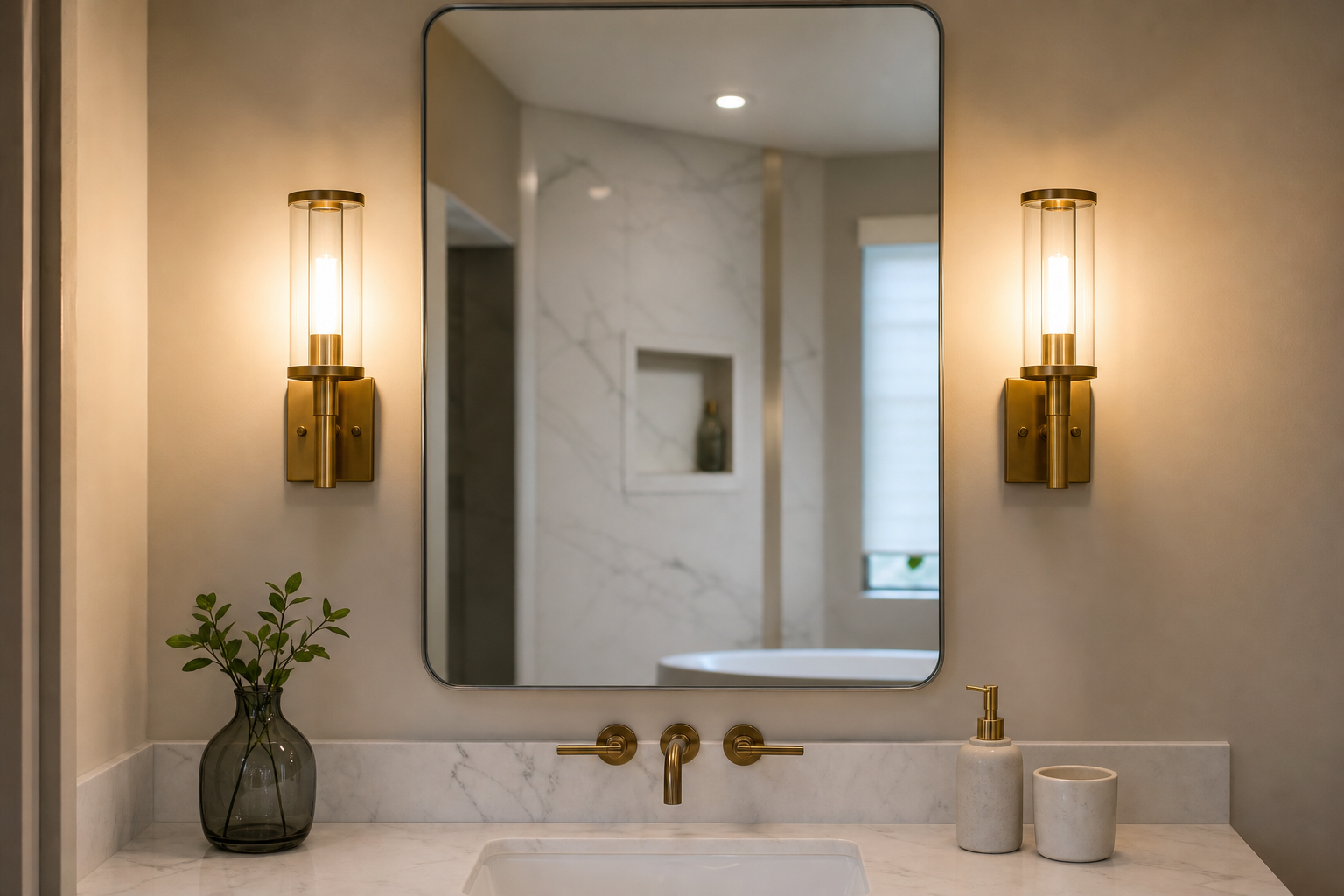
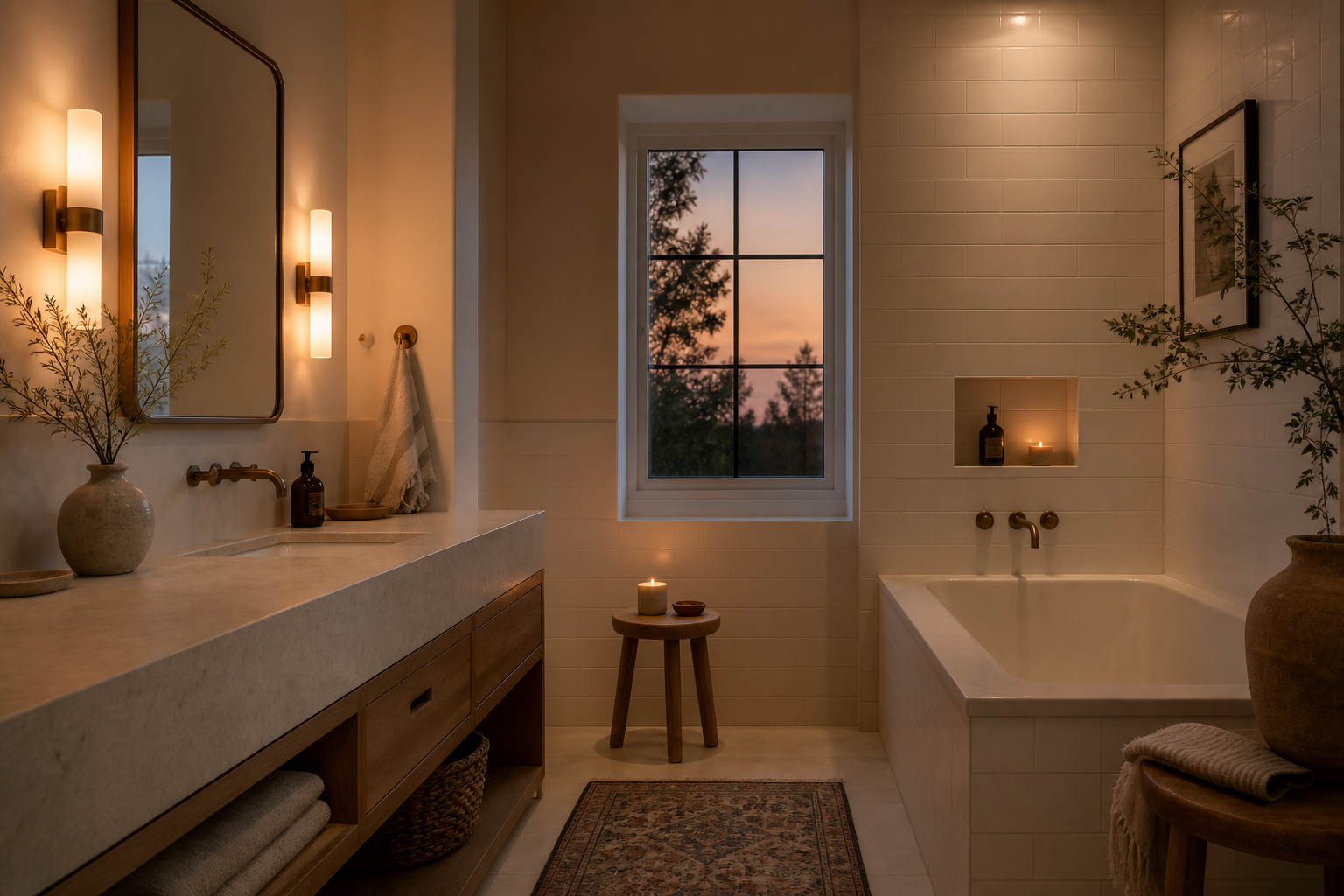
The shift from clinical to calm begins with warm light sources. Not dim; the room still needs to function. But 3000K rather than 4000K changes the color temperature from cool precision to something closer to morning light. Side-lit vanity mirrors remove the overhead shadows. A dimmer on the ambient circuit means the room has a different register in the evening than at 7am. That range is the most important thing a lighting plan can provide, and it costs nothing at the planning stage.
Light color temperature and biological experience are directly connected in ways the body registers without the mind naming them. Warm light is associated with rest and safety; cool light with alertness and caution. A bathroom used to decompress at the end of the day that is lit at 4500K is working against its own purpose.
Materials That Receive Rather Than Repel
Clinical surfaces are hard, reflective, and visually uniform. Polished chrome, glossy white tile, bright artificial light: every surface returns information at full volume. Nothing absorbs. Nothing yields. The room does not rest.
The counterpoint is not softness for its own sake. It is variation: a material that reflects alongside a material that absorbs; a smooth surface next to one with slight texture; a warm tone against a neutral one. The contrast is what gives the eye somewhere to land and stop. A room where everything is the same hardness and reflectivity has no resting point. A room with variation in texture and light absorption allows the eye to settle.
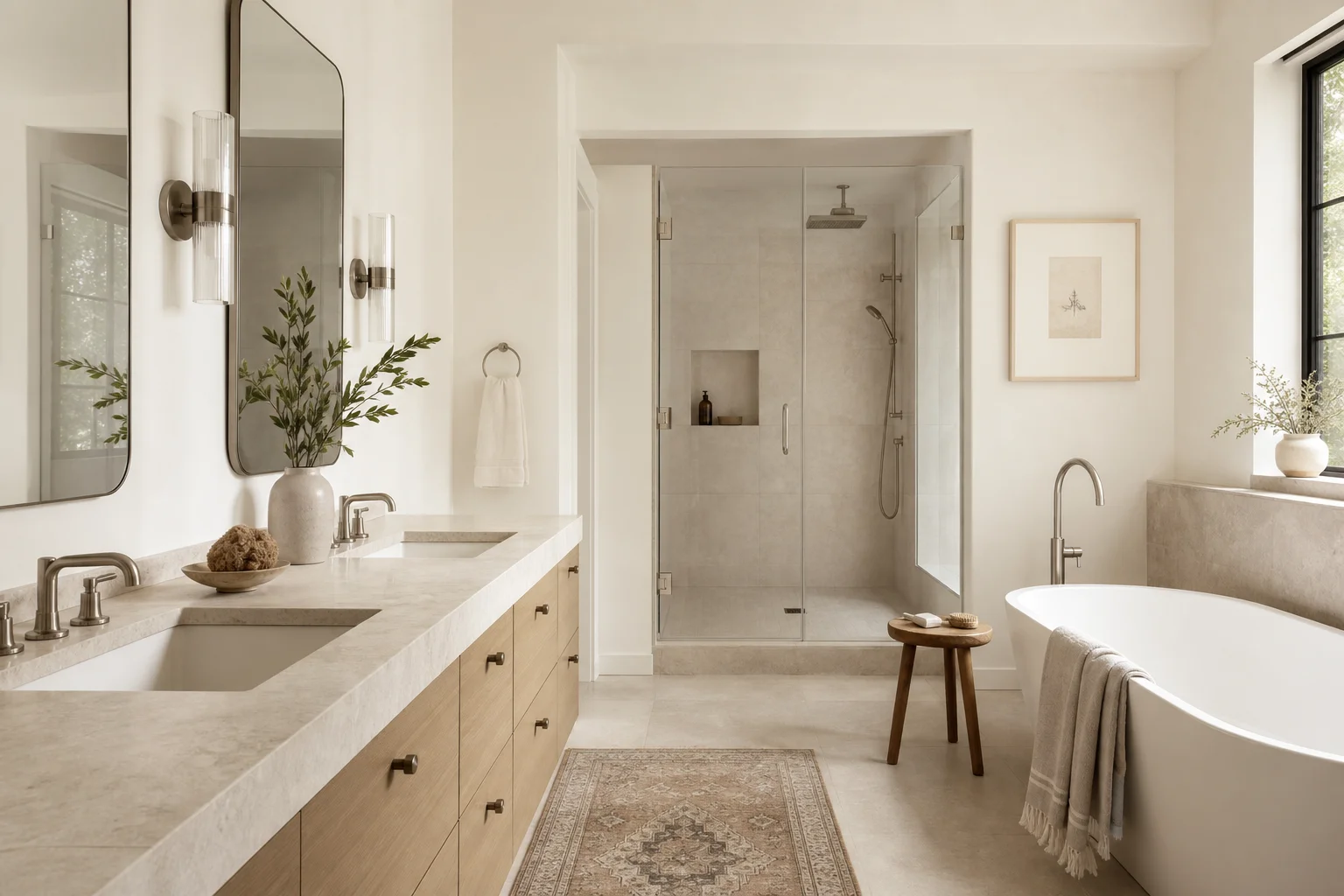
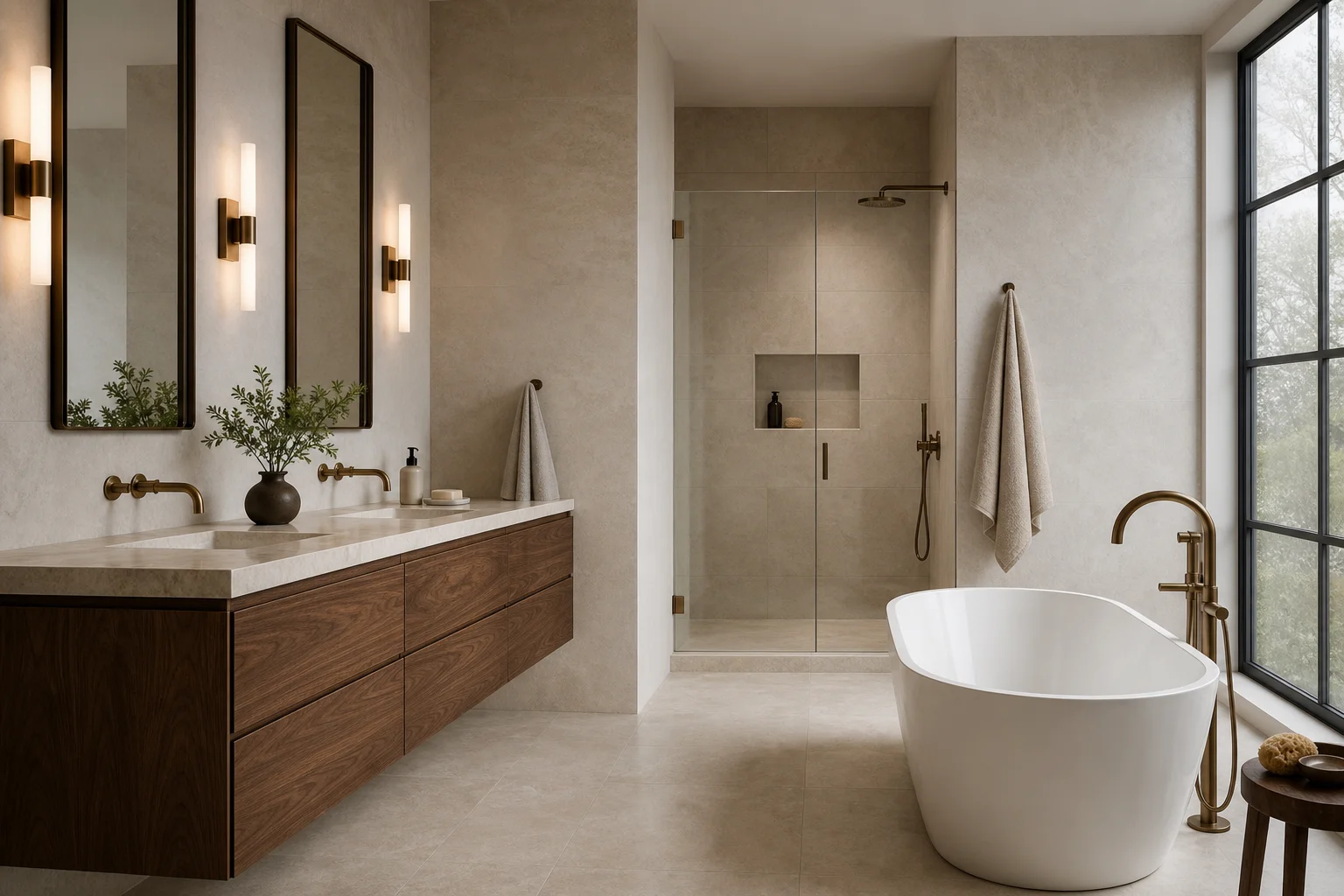
This works in materials without cost escalation. The contrast between a honed stone countertop and a polished chrome faucet is richer than either alone. Matte tile on the lower wall paired with a lighter, brighter tile above the water line creates a quiet hierarchy. A wood element, even a small one, introduces warmth that no amount of stone or porcelain provides, because the eye reads wood as organic and organic as safe.
Proportion and Edge Condition
A clinical bathroom often has too many visible edges. The edge of the shower curb. The edge of the mirror. The edge of the countertop. The line where tile meets painted wall. Each edge is an interruption that requires processing. A room with many sharp, unresolved transitions feels busy even when the materials are simple.
The calm bathroom manages edge conditions. The mirror is sized to fill the wall between two clear reference points rather than floating in the middle of an ambiguous field. The tile meets the wall at a clear line rather than a ragged edge. The countertop edge profile is consistent throughout. The shower enclosure, if framed, uses a consistent frame weight. These are detailing decisions, not material decisions, and they are made on the drawing before construction begins.
Ceiling height matters more than floor area for the feeling of roominess. A bathroom with 9-foot ceilings and 50 square feet feels larger and calmer than the same footprint at 8 feet. Where ceiling height cannot be changed, visual lightness in the upper wall zone (lighter materials, less detail) creates the same relative effect.
Acoustic Comfort
A bathroom is one of the hardest surfaces in a house. Every surface reflects sound. The result, in a tile-heavy room with no soft materials, is a room that feels bright and sharp to the ears even when it is quiet. This is another dimension of clinical.
There is almost nothing soft to introduce in a bathroom that is functional in a wet environment. The few exceptions are worth taking: a bath mat underfoot absorbs some floor reflection. A towel on a hook introduces a small absorbent surface. But the larger solution is not material introduction; it is managing the acoustic resonance of the room at the design stage.
Rooms with irregular geometry, modest size, and some variation in surface depth (niches, recessed cabinets, a bench in the shower) reflect sound less uniformly than perfectly parallel flat surfaces. A glass shower enclosure that is not parallel to the opposite wall diffuses the reflection. These are incidental benefits of decisions made for other reasons, but they are real.
The bathroom that is peaceful to be in is usually the one where the acoustic register matches the visual register: both are soft enough that the room does not announce itself. Hard surfaces that look soft, because they are warm in color and varied in texture, help the perception even when they cannot help the physics.
What "Considered" Means in Practice
The clinical bathroom is one where every decision was made without asking what experience it would produce. The calm bathroom is one where the light, the materials, the edges, and the acoustic behavior were each held against the question: what does this feel like at 6am?
That question is easier to ask at the design stage than to fix afterward. A lighting plan with three independent circuits, a material palette with variation in texture and temperature, a mirror and countertop that are proportioned to the wall rather than defaulted from a catalog, and an edge-condition strategy drawn before tile is selected: these produce the experience. They do not require any particular style or budget.
The single most reliable predictor of a bathroom that feels calm is that someone thought carefully about what it would feel like to be in it, not just what it would look like in a photograph. Those are different questions with different answers.
When we design a bathroom, we ask clients about the specific moments they want the room to serve: the quick Wednesday morning, the long Sunday evening, the first shower after a long trip. The material and lighting decisions that follow are calibrated to those moments, not to an abstract ideal of what a bathroom should contain.