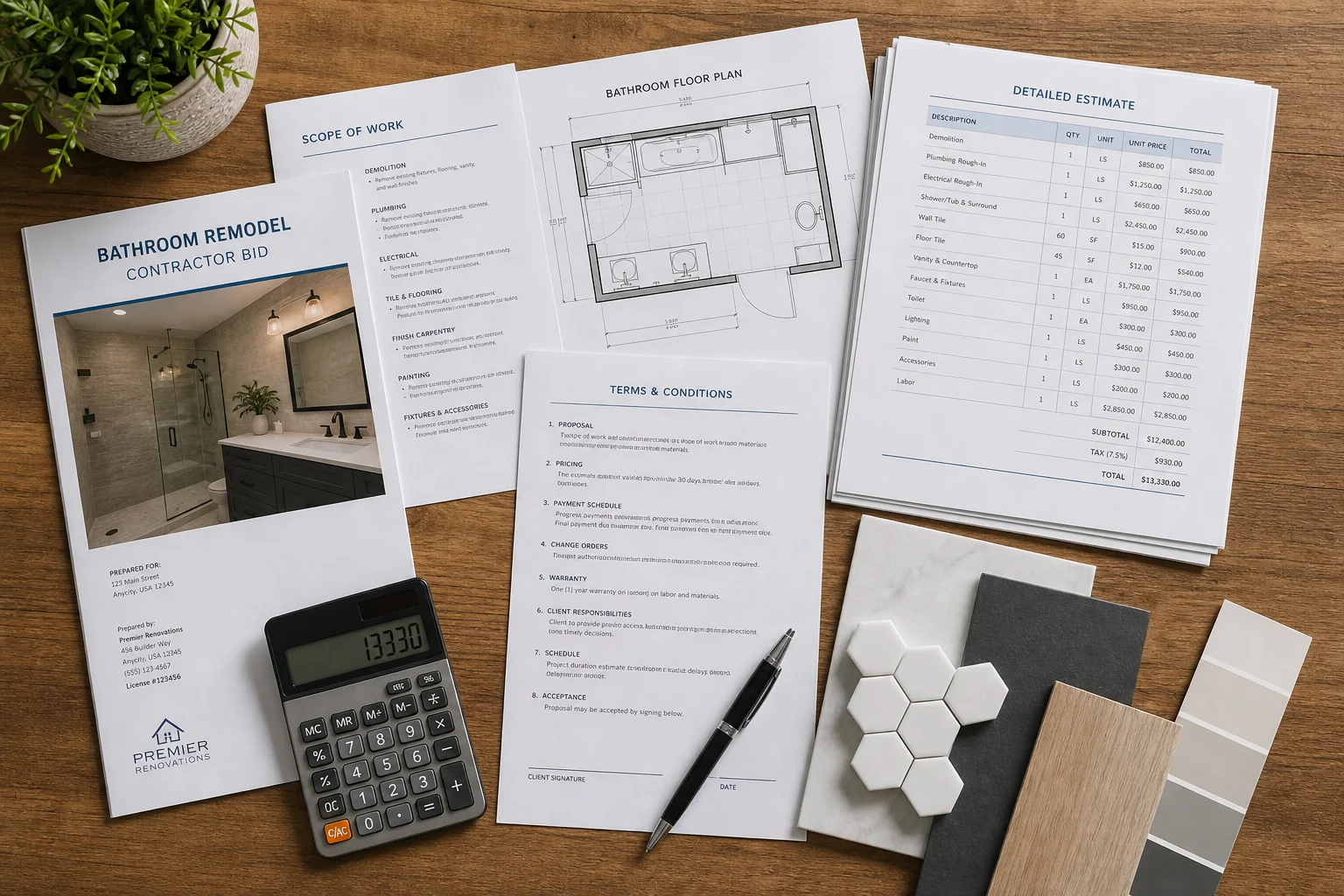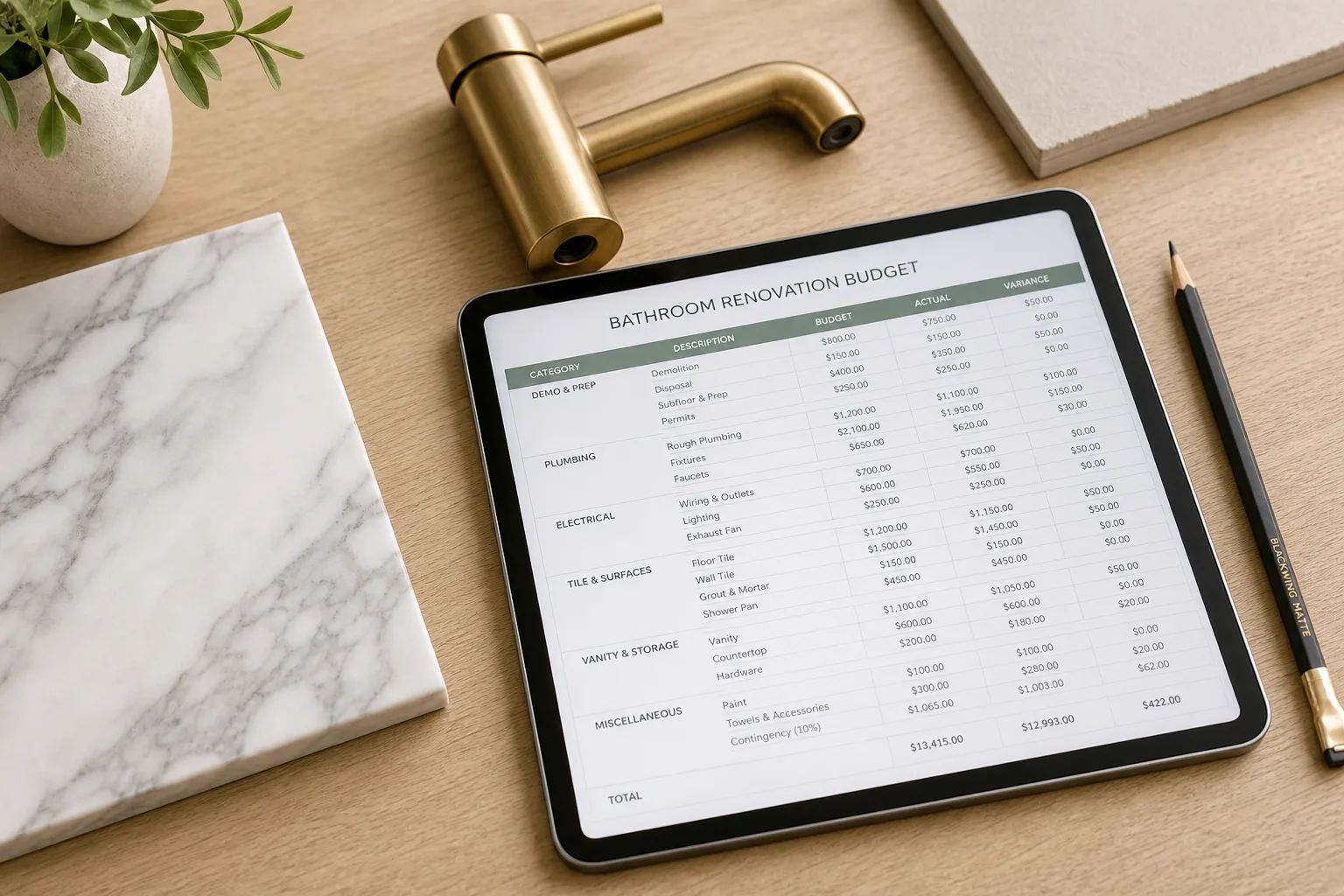
The answer you will get from a Google search is somewhere between $10,000 and $80,000. That range is useless. It spans the distance between replacing fixtures and demolishing everything back to studs, and it is influenced by national averages that have almost nothing to do with the labor market, permitting realities, and finish expectations of the Pacific Northwest.
The more useful question is not "what does a bathroom remodel cost" but "what determines cost in a bathroom remodel" and "what am I actually buying at different price points." Once you understand the cost drivers, you can have a real conversation with a contractor about what your specific project requires, rather than defending a number you read online against a number they wrote on a form.
The Biggest Cost Driver Is Scope, Not Square Footage
Bathroom remodels are priced by complexity, not by square footage. A 60-square-foot bathroom with a plumbing relocation, a wet room conversion, and custom stone tile can cost twice as much as a 100-square-foot bathroom with a standard layout and no structural changes.
The decisions that most dramatically affect cost, in rough order:
Plumbing relocation. Moving a toilet, shower drain, or vanity to a different location requires rerunning drain lines, potentially cutting through the subfloor, and repermitting. Moving a toilet a foot requires cutting concrete or joists and replumbing the drain. In a market with skilled plumbers billing over $100 per hour, and with permit timelines of several weeks, this work adds cost regardless of scope.
Wet room conversion. A curbless shower that requires the floor to be dropped to maintain drain slope is more complex than a standard shower replacement. Steam showers add waterproofing and HVAC requirements. Walk-in configurations that expand into adjacent space require structural work.
Tile scope. Labor is a large component of tile installation cost, and tile scope compounds. Large-format tiles require flatter substrates, additional prep time, and more precise cutting. Book-matched stone panels involve fabrication. Custom mosaic work is slow. A bathroom with tile on every wall, custom patterns, and inlays is not just more expensive in material; it is significantly more expensive in labor.
Existing conditions. Older homes frequently reveal problems at demolition: rotted subfloor, galvanized plumbing that needs replacement, out-of-level framing that requires correction before tile can be set. These conditions cannot be diagnosed before the walls open. A reasonable contingency budget (typically 15 to 20 percent) should be included in any project budget for a home over fifteen years old.
What Bathroom Remodels Actually Cost in This Market
National cost guides consistently underestimate Pacific Northwest primary bathroom remodels because they are built from national averages. Local labor costs are meaningfully higher; skilled tradespeople in this market bill at rates well above national figures, and the best crews carry backlogs. Permitting timelines add time, and time is cost. Homeowner finish expectations in this market are higher than the national middle.
For a primary bathroom remodel in the greater Pacific Northwest market, the realistic ranges by project type are approximately:
Cosmetic refresh (no layout changes, existing tile removed and replaced, new fixtures, new vanity, new lighting): $20,000 to $40,000. This range assumes sound structure, existing plumbing and electrical in reasonable condition, and mid-range finishes. It does not assume moving any walls or plumbing.
Full remodel, existing layout (gut to studs, full waterproofing, new tile throughout, new cabinetry, new fixtures, new lighting, permits): $45,000 to $80,000. This is where most well-executed primary bathroom projects land when the layout stays in place but everything else is rebuilt correctly, including waterproofing system rather than tile-over-tile.
Full remodel with plumbing reconfiguration: $65,000 to $120,000 depending on the degree of relocation and the finish specification. Projects involving wet room conversion, steam shower, or significant fixture relocation are at the upper end.
Custom primary suite at high specification (custom millwork, stone slab work, radiant floor, full design-build process): $100,000 and above. This is the price point where the room is being built as a considered piece of architecture rather than a renovation of what was there.
These ranges reflect projects done correctly with full permits and licensed trades. Work done without permits costs less in the short term and creates liability at sale, clouds the chain of insurance coverage, and often reflects quality shortcuts that produce the failures described elsewhere in this library.
The ROI Calculation You Should Stop Making
Most homeowners approaching a bathroom remodel ask about return on investment. The JLC / Remodeling Magazine Cost vs. Value report data for the Pacific Northwest puts the return on an upscale primary bathroom remodel at roughly 40 to 50 percent of project cost at resale. If you spend $90,000 on a bathroom, you may recover $36,000 to $45,000 in added home value.
That math looks bad if you frame it as an investment. It looks different when framed correctly.
A primary bathroom remodel is not a financial investment. It is a daily use decision. You will use the room every day for the next ten to twenty years before you sell the house. The question is not "what will I recover at resale" but "what is daily life in a room I am not apologizing for worth, over the next fifteen years, against the one-time cost of building it correctly."
The rooms that people regret are not the ones where they spent too much. They are the ones where they optimized for resale value, made compromises on quality to hit a budget tied to a return they expected, and then lived for fifteen years in a room that never quite felt right because every decision in it was made for a hypothetical future buyer rather than the actual present household.
Spend what the room you want actually costs. Build it correctly the first time. The cost of doing it again in eight years because the waterproofing was wrong or the quality was compromised will exceed the cost of doing it right once.
The One Number Worth Protecting
If there is a cost-control principle worth protecting in a bathroom remodel, it is this: do not borrow from the hidden work to pay for the visible work.
The hidden work is waterproofing, subfloor preparation, proper drain connection, ventilation routing, and electrical rough-in. It is not the tile. It is not the faucet. It is not the vanity. Homeowners can see the tile and the faucet; they cannot see the waterproofing assembly. The natural pressure in any budget negotiation is to keep the finishes that can be seen while reducing the things that cannot be seen. This pressure should be resisted.
The visible work can be value-engineered without consequence. There is a porcelain tile at $4 per square foot that performs identically to a tile at $14 per square foot in a wet area. There is a vanity at $1,200 that is well-made and a vanity at $4,000 that is better-made but not better by a factor of three. A faucet at $300 with a ceramic disc valve will not outlast a faucet at $1,200 with a ceramic disc valve.
There is no equivalent value-engineering available in the structural layer. A waterproofing membrane either creates a continuous barrier or it does not. A drain either has a clamping ring or it does not. Subfloor preparation either produces the deflection performance tile requires or it does not. Cutting cost in this layer produces a countdown, not a savings.
The right budget conversation is about where to invest in the hidden work and where to save on the visible work, not about reducing both uniformly to hit a number that feels safer.
When a client comes to us with a number, the first conversation is about what that number is supposed to buy. A scope that matches the budget is what we are trying to build. A scope that appears to match the budget but relies on thin allowances and omits contingency will produce a very different project than the one discussed. We write scopes with named systems, named materials, and a line-item contingency before we attach a price to anything, because we would rather have an honest conversation about budget at the start than an expensive one during demolition.