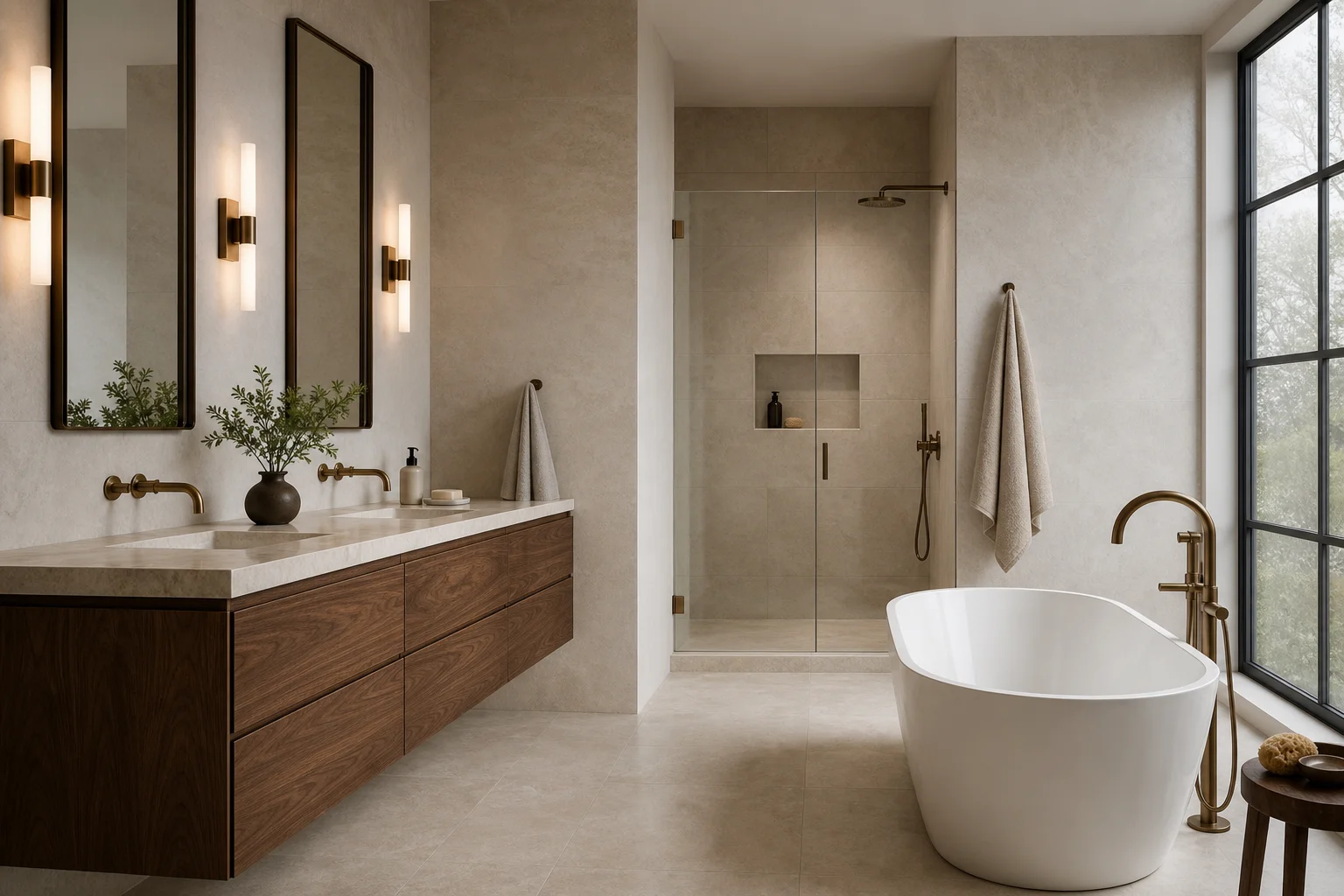
Some bathroom features are worth exactly what they cost on installation day, and no more. Others compound. The heated floor is worth more in February of year eight than it was in February of year one, because year one is still novel and year eight is normal life. The curbless shower is worth more when one person in the household is recovering from a surgery they have not had yet. The correctly placed niche is worth more when the morning routine has calcified around it for a decade. These are not features that photograph well in renovation reveals. They are features that change daily life in ways that become invisible through familiarity, which is a different kind of value entirely.
The bathroom decisions that appreciate over time share a common structure: they solve problems that do not go away, and some of them solve problems that grow more significant as the household changes. Understanding this distinction changes how a renovation budget should be allocated.
Why Some Improvements Compound and Others Do Not
Tile selection does not compound. A tile pattern you love on day one is a tile you have adjusted to by year three and actively wonder about by year seven. That is not a failure of taste. It is the normal way visual choices work. You acclimate to them. The aesthetic content is consumed through familiarity.
Functional solutions do not work this way. A heated floor does not become less warm. A curbless entry does not become less useful. A well-positioned niche does not stop being exactly where your hand reaches without looking. These features solve problems that do not resolve on their own, and some of them solve problems that grow more significant over time.
The word "compound" applies in both senses. The value accumulates. And the interest rate increases as the household changes.
The Heated Floor: January in Year Eight
The first time you step onto a radiant-heated bathroom floor in winter, the reaction is almost universally enthusiastic. Warm stone tile at six in the morning is pleasurable in the way that any new sensory improvement is pleasurable. You notice it. You mention it to people. You feel like you made a good decision.
By year eight, you do not notice it. That is when the value is highest.
This sounds like a contradiction, and it is not. The floor has been absorbed into the expectation of what a morning is like. On the occasional morning when the timer misfires and the floor is cold, you notice the absence in a way that makes clear how thoroughly the presence of warmth had become the baseline. You have ratcheted up your ordinary morning. The feature is not a luxury anymore. It is just what a bathroom floor feels like.
The mechanism that produces this is the same mechanism that makes a good mattress worth more in year five than in year one: it changes the background level of physical comfort for a repeated daily action. A bathroom floor is touched every single morning. The number of contacts over ten years runs into the thousands. Each one is marginally better than a cold floor would have been. The aggregate of that difference is substantial in a way that a beautiful countertop, touched only with cleaning cloths, is not.
There is a secondary effect worth noting. A warm floor surface raises the ambient floor-level temperature of the bathroom, which means the room recovers from shower humidity more quickly. A cold floor draws warm air toward it; a warm floor maintains a more stable thermal environment. This matters for the speed of mirror defogging, for the moisture content in grout and caulk joints, and for the general feel of the room in the hour after the last shower. The feature that reads as comfort is also doing maintenance work on the rest of the room.
Radiant floor systems installed correctly typically run for twenty-five years or more without maintenance. The running cost for a single bathroom is modest, and the system can be set on a timer to reach temperature before the household wakes. What you are paying for at installation is not heat. You are paying for a different version of every winter morning for the rest of the time you live in that house.
The Curbless Shower: Value That Waits for You
A curbless shower is not obviously more valuable on day one than a standard shower with a four-inch curb. On day one, it is simply aesthetically cleaner, easier to maintain, and a bit easier to enter. Those are genuine benefits. They are not the reason to build one.
The reason to build one is that the household will change in ways that cannot be fully anticipated.
There is a statistical near-certainty that someone in a household over a fifteen-year period will need a period of reduced mobility. A surgery recovery. A knee that was fine until it was not. A guest who is older than the household expects. A parent who moves in. An injury that happens to someone who was previously entirely healthy. The moment that need arrives, the value of the curbless entry changes category. It is no longer a design choice. It is infrastructure.
The curb in a traditional shower is a four-inch step that requires balance and grip to navigate. For someone using a walker, it is essentially a wall. For someone post-surgery, it is a safety calculation made every morning for weeks. For a household member who has lived in that shower for ten years and now finds the entry difficult, it is a reminder that the room was not built with them in mind.
The curbless shower was built with them in mind. That is what universal design means in practice: not a feature for people with disabilities, but a feature that works across the full range of what bodies do over time. The person who installs a curbless shower at forty-two is not being pessimistic about their future. They are being accurate about the probability distribution of what the next thirty years will contain.
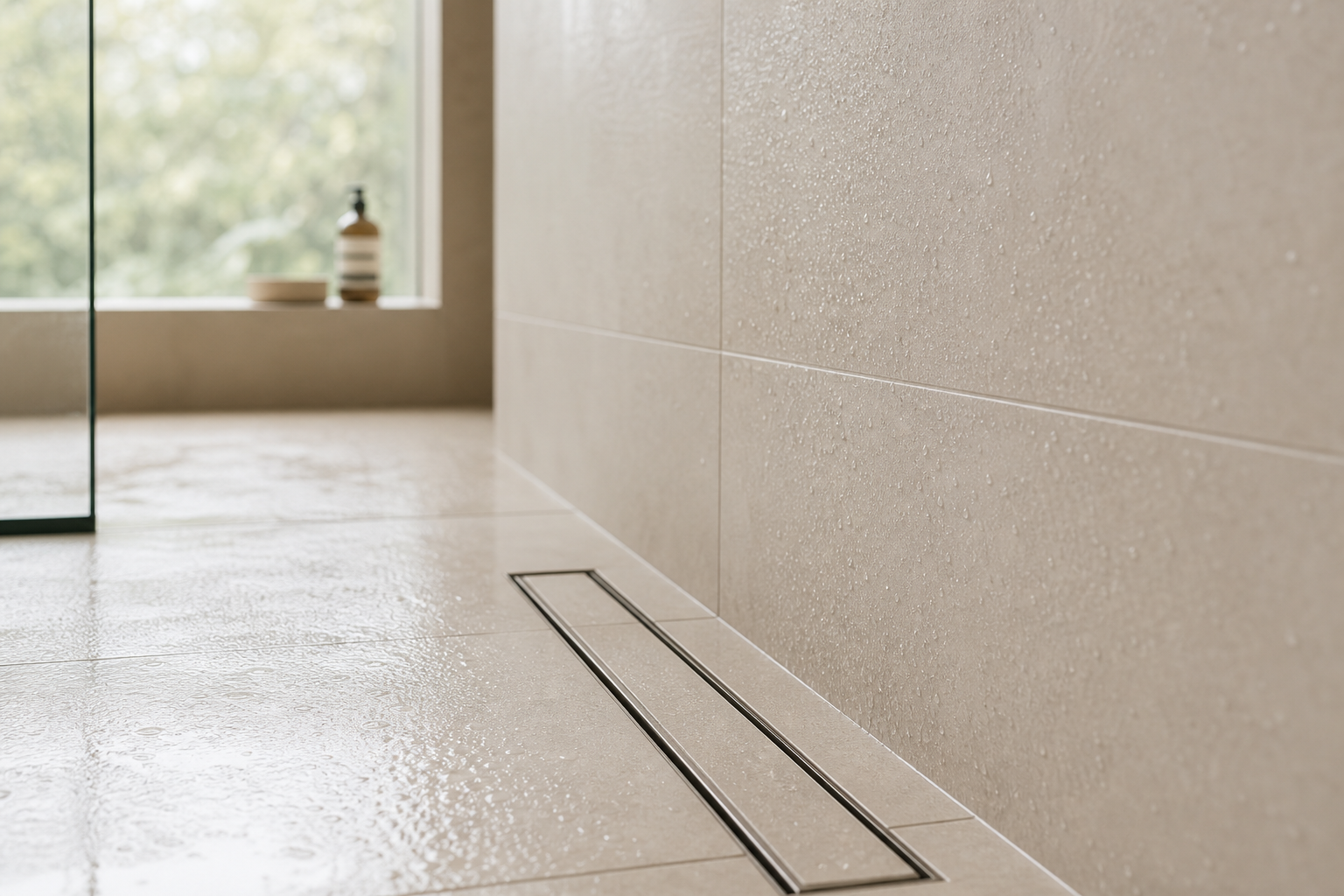
The construction requirements are real. A curbless entry requires a larger sloped floor area, careful drain placement, and more thorough waterproofing than a curbed shower. A linear drain flush with the finished floor typically manages water migration better than a center-drain configuration in a curbless layout. The work is more involved and costs more. But the cost is paid once, and the benefit is available for the entire life of the room. Converting a curbed shower fifteen years later, when mobility becomes a concern, costs far more than building correctly the first time.
The Niche at the Right Height: Invisible Because It Works
A shower niche is not inherently a compounding feature. A niche at the wrong height, placed for the tile's layout convenience or because the framing was already there, is something you consciously use for the first year and slightly annoy yourself with after that. The bottle that requires a stretch. The soap at a height where you look at it instead of reaching for it without thinking.
A niche at exactly the right height is different. "Exactly the right height" means at the height where your hand naturally reaches when standing in your normal shower position. Not so high that you look up to find it. Not so low that you bend. The position the arm finds without calculation.
This feature becomes more valuable over ten years because it stops being something you interact with and becomes part of the motion pattern of your morning. The hand reaches, the bottle is there, the hand returns. No cognitive content. You are not navigating the shower anymore. You are inhabiting it.
When a layout is correct, the bathroom has been absorbed into the body's routine in the same way a familiar keyboard is absorbed into a touch typist's fingers. The brain stops doing work it used to do. This is difficult to photograph and impossible to explain to someone who has never experienced the difference. But ten years of a slightly wrong niche height represents ten years of micro-corrections performed thousands of times, and the cumulative friction of those corrections is real in a way the initial installation cost is not.
The same logic applies to where the towel hook sits relative to where you reach stepping out of the shower. To whether there is a surface for a phone without moisture risk. To whether the light switch is on the hinge side or latch side of the door. These micro-ergonomic decisions are either correct or slightly wrong, and slightly wrong means performing a small adjustment thousands of times over the life of the room.
Ventilation That Actually Works: What a Decade Without Mold Looks Like
Most people live with inadequate bathroom ventilation for years before they connect it to the problems it causes. The mirror that takes longer to clear than it should. The grout that darkens in the upper corners. The paint that blisters near the ceiling. The smell that is not quite mildew but is not quite not mildew. These are not mysterious phenomena. They are predictable consequences of a room that retains moisture after every shower.
An exhaust system that moves sufficient air and discharges it correctly to the exterior changes the character of the room over time in a way that is cumulative and significant.
In the first year, the difference is subtle. The mirror clears faster. The room feels less damp thirty minutes after a shower. The grout in the upper corners does not darken. These are changes in trajectory, and trajectories only become visible over time.
By year five, the bathroom that ventilates properly still looks like the bathroom from year one. Grout is the original color. Paint is intact. Surfaces are dry within an hour of the last shower. The room smells like nothing, which is what a clean room smells like.
By year ten, the difference between a well-ventilated bathroom and an under-ventilated one is the difference between a room that still works and a room that is accumulating a problem. The moisture not removed from the under-ventilated bathroom spent years migrating into wall cavities, keeping grout joints damp, accelerating caulk failure, and feeding the organic chemistry that produces the smell. None of these are dramatic events. They are the slow accumulation of a daily deficit.
Proper ventilation requires three things: a fan sized adequately for the room, a duct that runs to the exterior rather than into an attic or soffit, and a control that ensures the fan runs long enough after the shower to clear the moisture load. A countdown timer switch or a humidistat costs almost nothing compared to the repair bill for a wall cavity that absorbed moisture for eight years. Building science research recommends running a bathroom fan for at least twenty minutes after showering to remove the moisture that continues evaporating from wet surfaces after the water shuts off. A single hot shower can introduce several pints of water vapor into the air; the fan's job is not just the time you are in the room.
The ten-year version of good ventilation is a bathroom that still looks like the bathroom you built. That is harder to photograph than a tile choice. It is worth considerably more.
The Vanity at the Right Height: The Relief That Accumulates
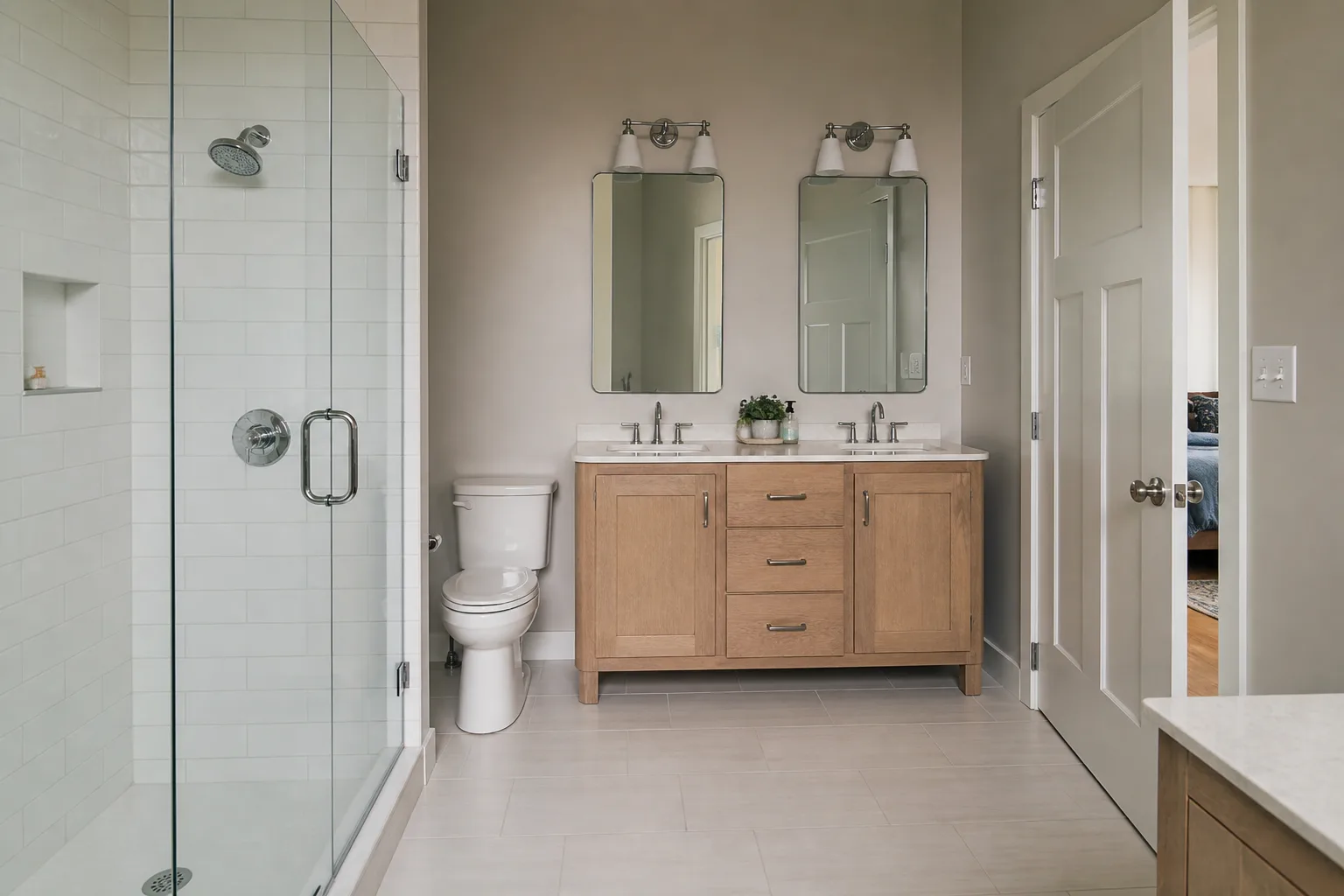
Standard vanity height for most of the twentieth century was thirty-two inches. This figure was inherited from cabinet industry standards that prioritized manufacturing consistency over the ergonomics of daily use. The result is a vanity surface that requires most adults to lean forward to use it, placing a sustained asymmetric load on the lumbar spine and neck during the morning routine.
A comfort-height vanity, typically thirty-four to thirty-six inches depending on the household's proportions, changes the geometry. At the right height, the user stands upright. The arms reach forward and slightly down. The posture is the neutral posture. Brushing teeth, washing the face, applying skincare, shaving: all of it done without a forward lean sustained for minutes every single morning.
This does not feel significant on day one. On day one, everything is new and you are not calibrated yet. By year three, you have performed the morning routine at this vanity roughly a thousand times. The upright posture has become unremarkable.
The compounding nature of this feature is in the repetition. A morning routine performed once is trivial. A morning routine performed seven hundred times a year for twenty years while leaning forward slightly is a different cumulative physical experience than the same routine performed upright. The relief of correct ergonomics does not peak at installation and fade. It is present every morning, invisible because it is working.
The counterintuitive thing about ergonomic improvements is that you notice them most when they are absent. The rental bathroom with a too-low vanity, after years of the right height. The hotel bathroom designed for aesthetics rather than daily use. These encounters are useful because they reveal, by contrast, what the absence of correct ergonomics feels like. It feels like slight work. Not pain. Not discomfort. Work. The body is solving a problem it should not have to solve.
What Year Ten Actually Looks Like
In year ten, the bathroom built with these features has a specific quality that is difficult to articulate but immediately recognizable. It is a room that has been lived in without being worn down by the living.
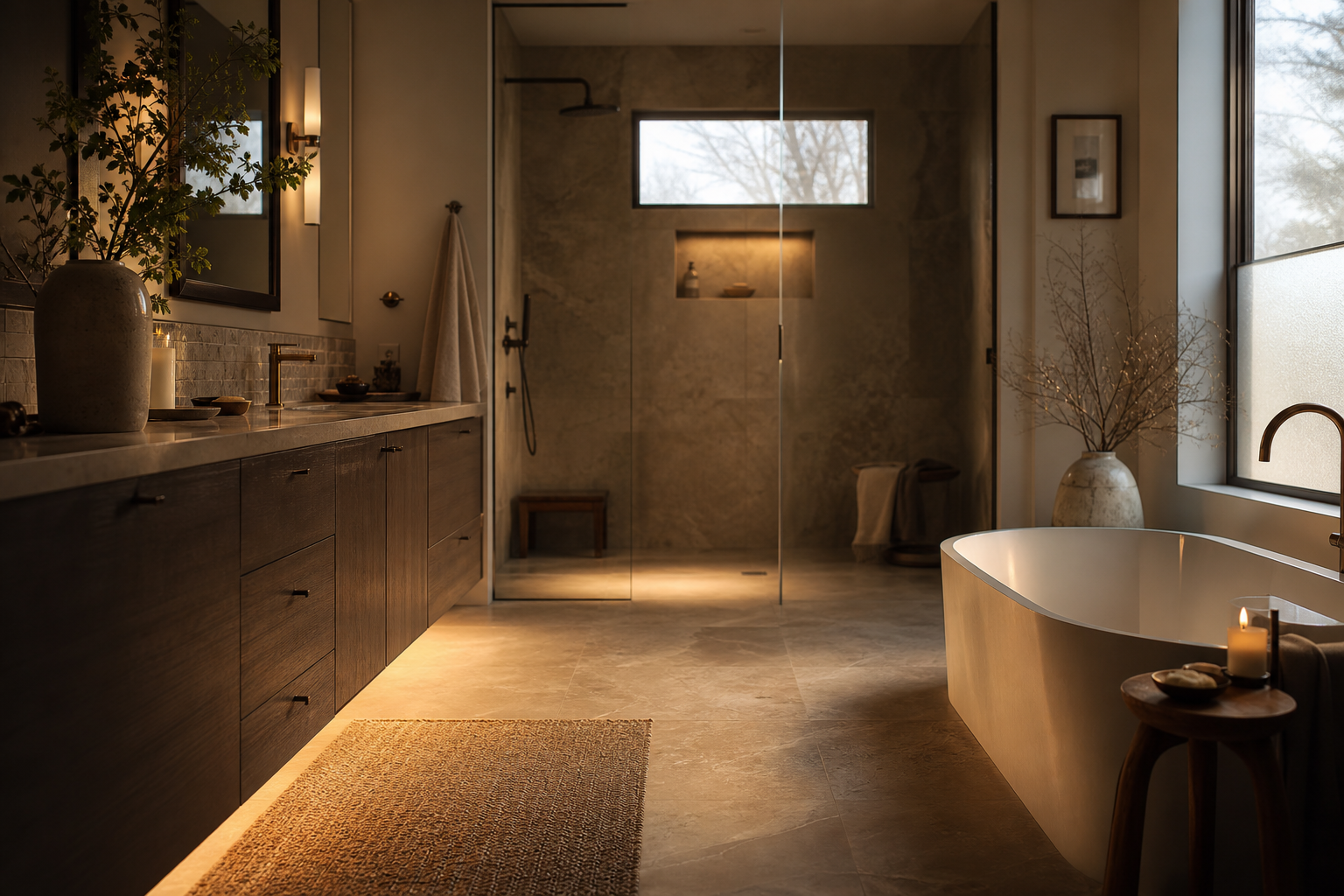
More concretely: it is six-thirty in the morning in February. The floor is warm before you step out of bed, because the timer brought it to temperature forty minutes ago. The shower entry is level, the same height it has always been. The niche is where your hand goes. The fan runs for twenty minutes after the last person showers, and the room is dry by nine. The vanity is the right height, and you are upright while you use it. None of these things are remarkable. That is entirely the point.
The features that compound are not the features you will describe to a friend the way you describe the tile or the fixture. They are the reason the room feels like a room that works rather than a room that looked good in photographs. Ten years of that difference adds up to something worth considerably more than the cost difference between getting these choices right and getting them wrong.
We have worked on rooms from previous clients who have lived with them for five and ten years. The features they mention without prompting are almost never the tile choice or the fixtures. They are the radiant floor that changed their winter mornings, the curbless entry that became essential when a knee surgery arrived eight years later, the niche placed at exactly the right height, the ventilation that left the room dry instead of damp. These are not the features that drove the renovation decision. They are the features that made it worth it.