The hardest part of a bathroom renovation is not the design decisions or the budget. It is six weeks of a missing bathroom, unexpected decisions that arrive on Tuesday morning, dust that reaches rooms that should be sealed, and the specific stress of watching your house be a construction zone while you are trying to live in it. The households that survive this without significant relationship friction are the ones who talked about it honestly before the demo crew arrived.
That is not a small observation. The renovation industry talks almost exclusively about the design and budget sides of a project. The daily-life side, the part where two people who share a bathroom suddenly do not have one, where every morning involves a different kind of problem-solving, where a contractor calls at 7:30 a.m. with a question about the tile layout, goes mostly unaddressed in the project planning conversation. It should not.
The Missing Bathroom Problem Is Logistics, Not Inconvenience
In a household with one primary bathroom, a full renovation removes that bathroom for the project duration. In a household with two bathrooms where one is the primary, a renovation of the primary moves daily routines into a secondary space that was not designed as the primary.
Neither scenario is insurmountable. Both require actual planning, not just an assumption that people will figure it out.
The logistics questions worth answering before the project starts: What is the shower plan? If the household has a second shower, who uses it first and what is the timing? If there is no second shower, is a gym membership for the duration the right answer, or a neighbor arrangement, or temporary access somewhere else? Are there children whose school-morning routines are timing-sensitive? Is there someone in the household whose work schedule means they leave before 6 a.m.? Is there someone recovering from an illness or injury who has specific needs the temporary arrangement must accommodate?
These are questions with real answers that most households can work out if they spend thirty minutes on them before the project starts. They are also questions that do not get answered if no one asks them, and then they get answered at 5:45 a.m. on the third day of demolition, in a way that creates friction.
Gym memberships for the project duration are underused as a solution. A month-to-month membership at a gym near the house typically costs forty to eighty dollars, provides a reliable shower with no household logistics coordination, and removes the morning bathroom competition entirely. The cost is trivial relative to a renovation budget, and the daily quality-of-life benefit is significant.
For households with a single bathroom and children, some contractors can sequence the project to preserve toilet access on a rolling basis even when the shower is unavailable. This is worth asking about during the planning phase, not after demolition.
Dust Does Not Respect Containment
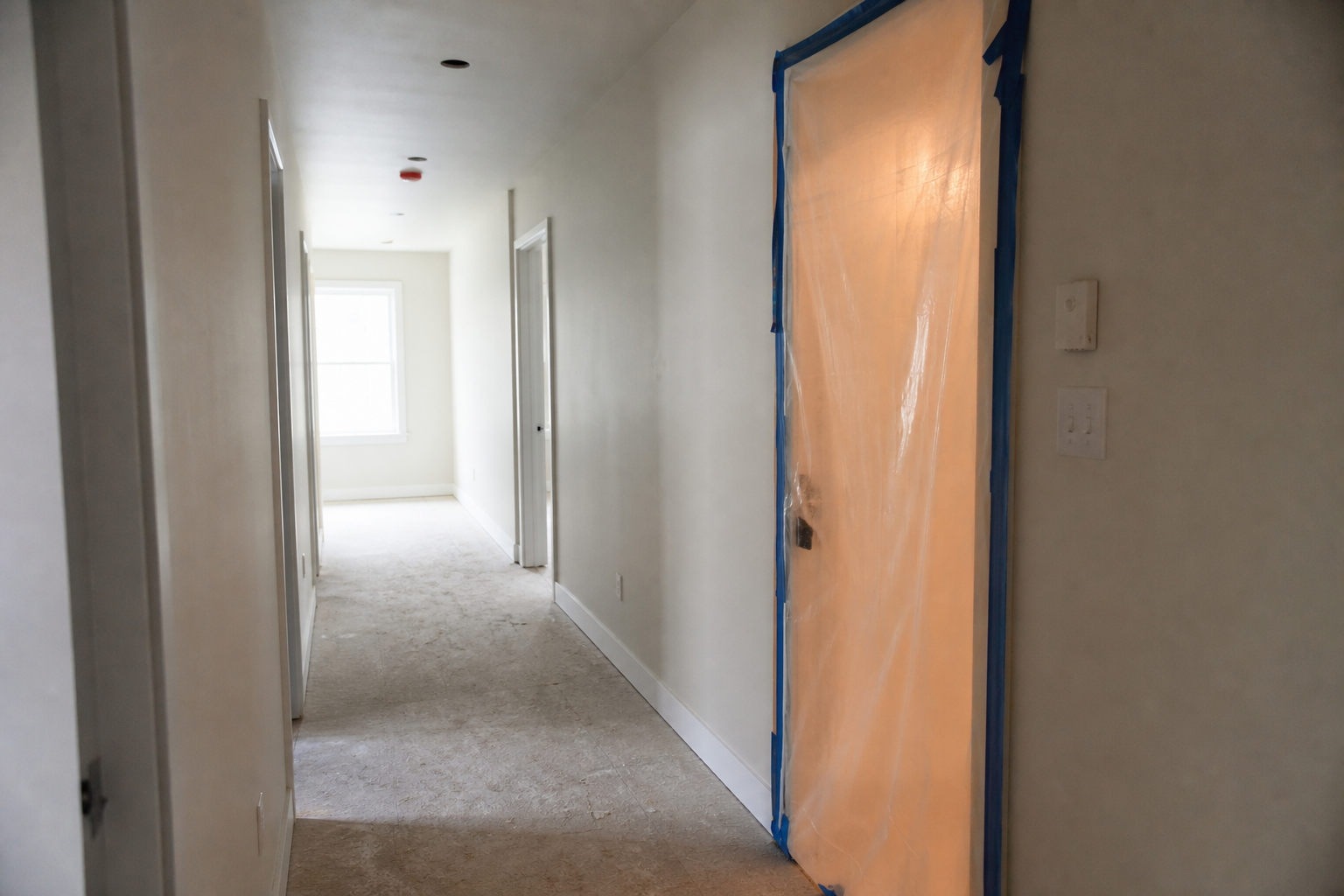
Every contractor who does interior renovation work sets up dust containment. Plastic sheeting over doorways. Tape around gaps. A path from the work area to the exterior. The containment reduces dust migration meaningfully. It does not eliminate it.
Construction dust is fine-particle material that becomes airborne during demo, cutting, sanding, and grinding operations. Fine particles stay suspended in air long after the work stops and travel through gaps that plastic sheeting does not reach: the gap under a door, the heating duct that passes through the work area, the return air duct that is shared with other rooms. No residential containment setup blocks all of these pathways.
The practical implication is that surfaces in adjacent rooms will accumulate fine dust over the course of a renovation. Electronics, in particular, benefit from being moved or covered during the project. Bookshelves and open-shelf storage items within the dust radius will need cleaning when the project ends. Any item that is sensitive to particulate contamination, photographic equipment, musical instruments, medical equipment, should be moved out of the adjacent zone before work begins.
This is not a criticism of contractor containment practices. It is a description of physics. Fine particles move through air. Air moves through a house. A renovation that lasts six weeks will move dust into areas that everyone agreed would be protected. Knowing this in advance is the difference between expected inconvenience and a source of conflict.
HVAC systems deserve specific attention. If the renovation area shares a return-air pathway with the rest of the house, that duct should be blocked or the system should be run minimally during the project. A forced-air system that is running normally during demolition is actively distributing demo dust to every room it serves. Many contractors routinely address this. It is worth confirming in the project planning conversation rather than discovering after the fact.
The Unexpected Decision
Every bathroom renovation surfaces unexpected decisions. The nature of residential construction is that the existing conditions behind finished surfaces are not fully known until demolition reveals them. Rotted subfloor. A plumbing rough-in that is in the wrong position. A wall that turns out to be load-bearing. A previous remodel that used non-standard materials. These are not failures of planning. They are the ordinary complexity of working with existing structures.
What matters is how the household is prepared to respond to them.
An unexpected decision during an active renovation arrives with a time constraint. The contractor needs an answer. The project schedule is running. The subfloor needs to be addressed before the new tile can be set. The wrong answer, which is to be caught off guard and need several days to decide, means the crew is waiting, the schedule slips, and costs accumulate.
The preparation for unexpected decisions is not knowing what the decisions will be. It is agreeing in advance on how the household will make them. Who is the decision-maker? If two people share the project equally, who has final authority when they disagree? What is the response-time expectation when the contractor calls with a question? Is one partner reachable by phone during work hours and the other is not?
A household that has agreed these things in advance handles unexpected decisions as they are: normal operational problems that the project requires. A household that has not agreed them encounters the unexpected decision as both a logistical problem and a relationship negotiation happening simultaneously, at 9 a.m. on a Tuesday.
Decision Fatigue Is Real
Before a renovation starts, the design decisions feel manageable. There are maybe twenty or thirty choices to make: tile, fixtures, vanity, countertop, mirror, lighting, faucets, hardware. Over the course of the design phase, those choices get made.
And then the project starts, and there are more decisions. The tile sample in the bathroom light looks different than it did in the showroom. The grout color that looked right on a chip looks different across forty square feet. The contractor found a small niche area that was not in the drawings, and there are three options for how to handle it. The fixture that was specified is back-ordered, and here are two alternatives.
The decisions that arrive during construction are often smaller than the original design decisions, but they arrive under time pressure and emotional load. The household is already managing disrupted routines, dust, and noise. Adding a grout-color reconsideration to that context is harder than the decision itself would suggest.
The households that handle this best are the ones who made primary material selections with enough conviction that small field variations do not reopen the larger question. A household that felt confident about the tile before the project started handles the "does this look right in the installed light" moment differently than one that was still uncertain at the time of ordering.
The second helpful practice is agreeing, before the project starts, that minor field decisions that fall within an agreed budget range can be made by one household member on behalf of both, without requiring a conference. This removes the time pressure from a category of decisions that does not require full household consensus.
The Noise and Schedule Reality
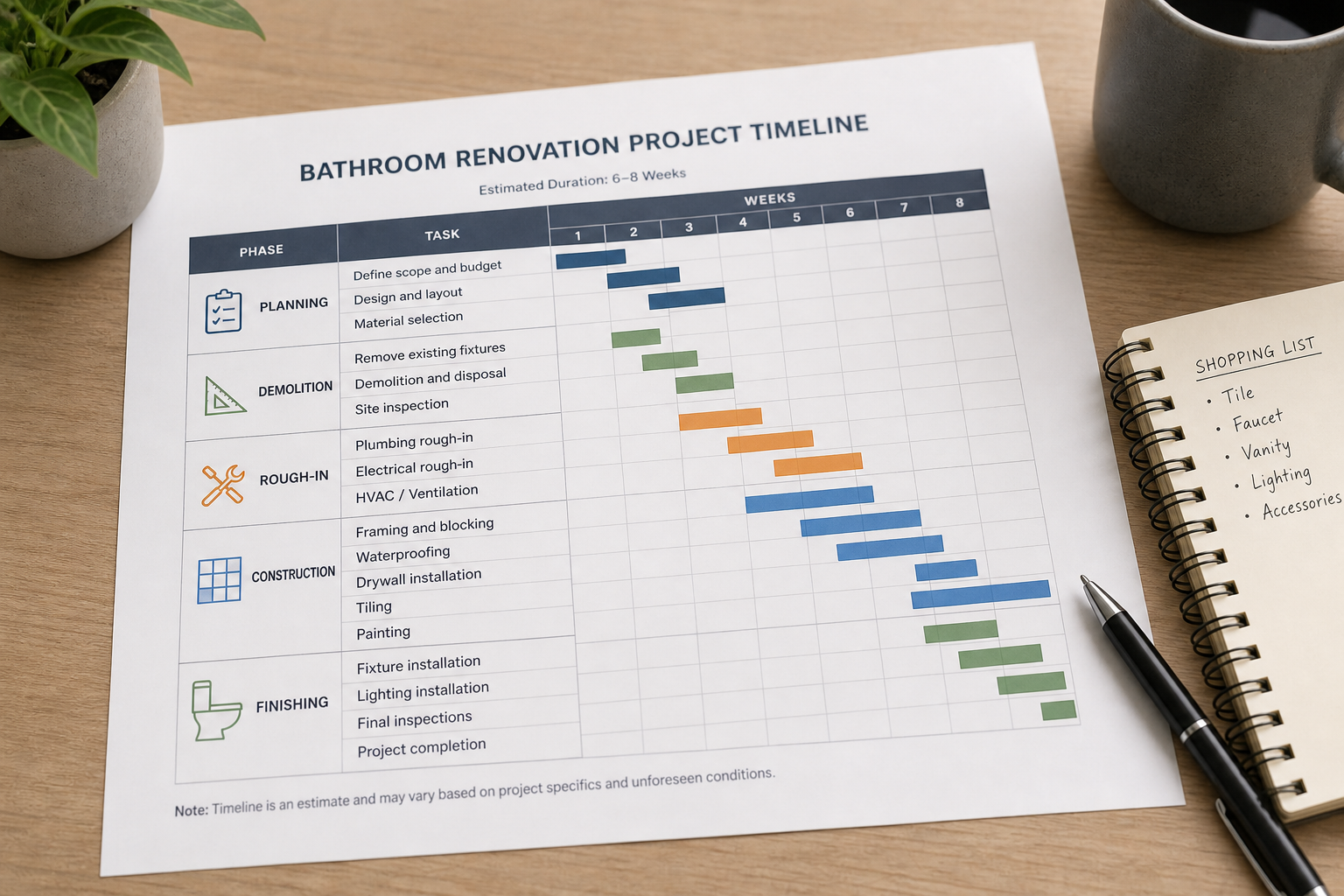
A typical bathroom renovation that involves full demolition, waterproofing, tile, plumbing, electrical, and finish work runs six to eight weeks. Some run shorter with favorable conditions and no surprises. Some run longer.
During that period, work typically happens on weekdays from roughly seven or eight in the morning until four or five in the afternoon. Some contractors work Saturday mornings. The noise is present for most of the working day and includes impact sounds from demolition and setting work, power tools, and the particular sound of a tile saw running in a nearby room.
For households where one person works from home, this is a significant daily consideration. A project start time of seven in the morning means that anyone trying to sleep past that time in an adjacent bedroom during the first week of demo will not succeed. The tile saw is not subtle.
Planning for this means being honest about what home-office work looks like during a renovation week. Some people adapt without difficulty. Some find that they are significantly less productive during construction weeks and benefit from working elsewhere during the active demo and tile phases specifically. This is worth planning for rather than discovering.
The schedule will also slip. Most residential projects slip by a few days to a week or two for reasons that are ordinary and not anyone's fault: a material delivery is delayed, an inspection has a queue, a subcontractor has a prior commitment on a specific day. Treating the end date as a probable range rather than a fixed date reduces the friction when slippage occurs.
The Relationship Variable
There is a documented pattern in household renovation stress that most contractors are aware of and nobody talks about directly. The stress is not usually about the renovation itself. It is about the decisions within the renovation and how the household makes them together.
The tile choice that seemed settled gets reconsidered when one partner sees the installed sample. The vanity that was agreed upon arrives and one person immediately regrets it. The budget that was fixed when the contract was signed has been exceeded by the second week of unexpected subfloor work, and the two people who agreed to that budget have different feelings about what comes next.
None of these are the contractor's problem. All of them will feel urgent during the project.
The preparation is not becoming better decision-makers under stress. It is reducing the number of decisions that have to be made under stress by making more of them before the project starts. Every material selection finalized before demo begins is one fewer decision made during construction. Every budget contingency agreed to before the project starts is one fewer financial negotiation during the project.
The households that come through a bathroom renovation in better shape than when they started are the ones who treated the planning phase as seriously as the design phase. The design phase produces a beautiful room. The planning phase determines whether the six weeks of producing that room are survivable.
Before construction starts, we give clients a what-to-expect document that names the specific sources of friction we have seen on every project. Not to alarm anyone. To help households have the conversation before the unexpected decision arrives at 8am on a Tuesday.