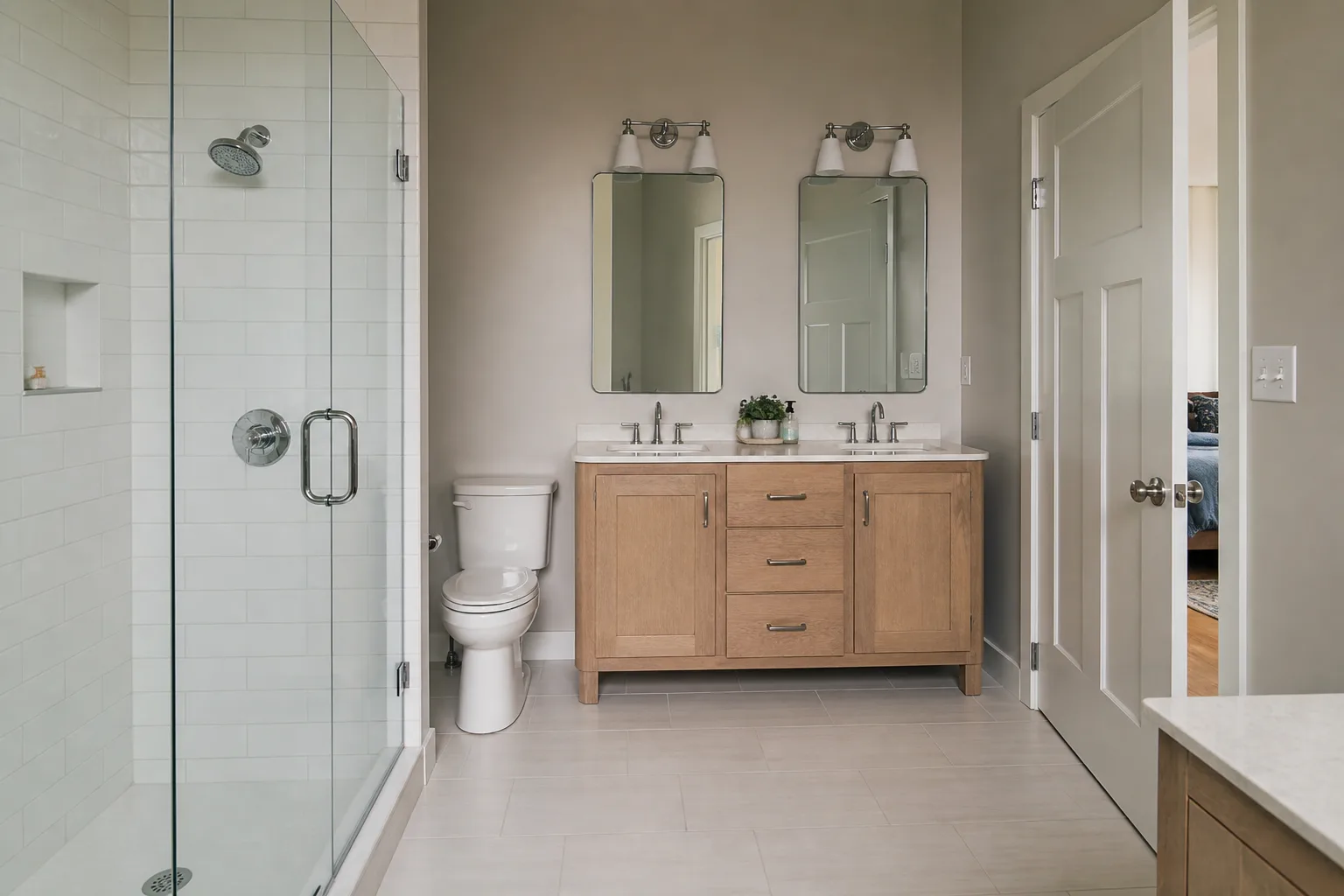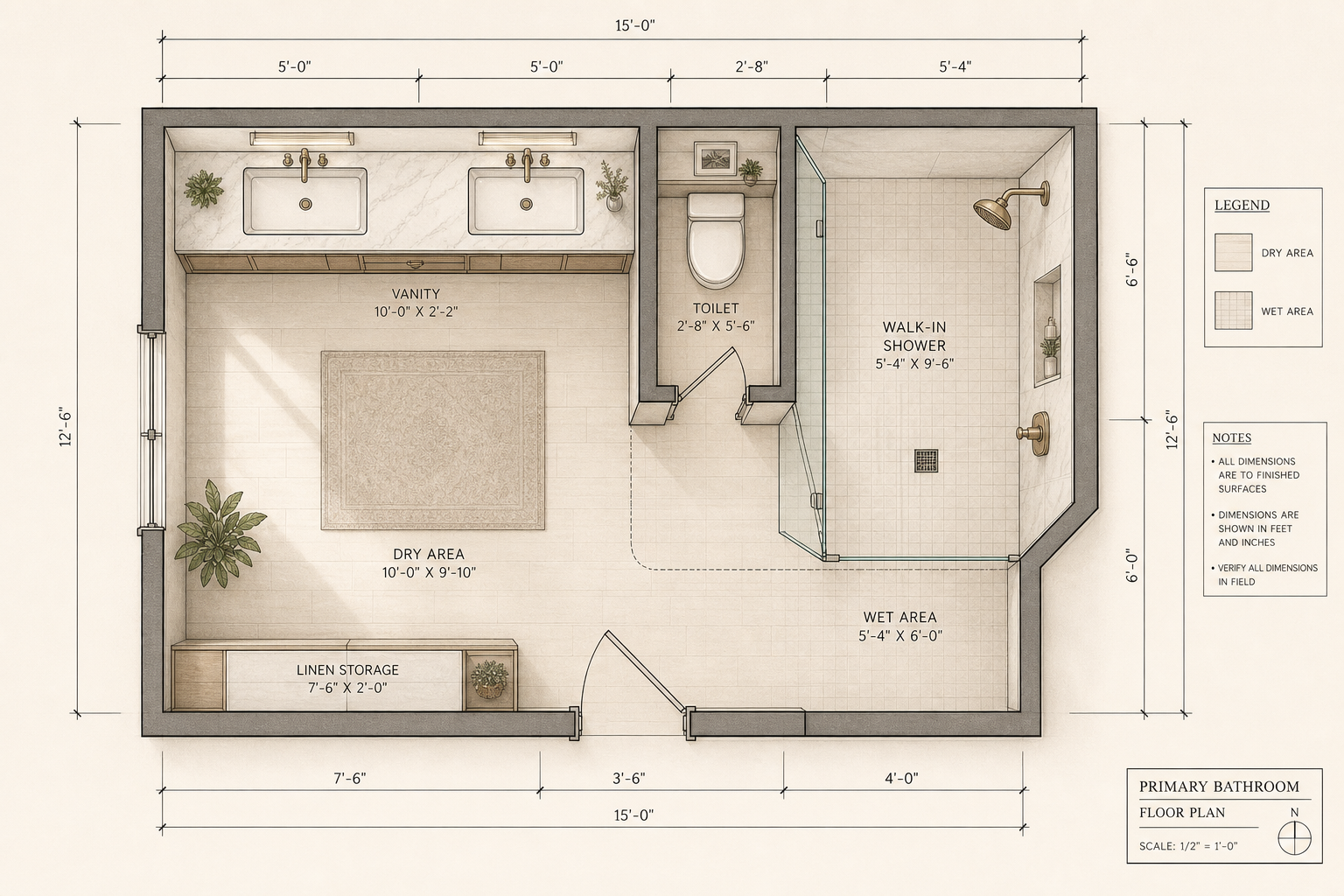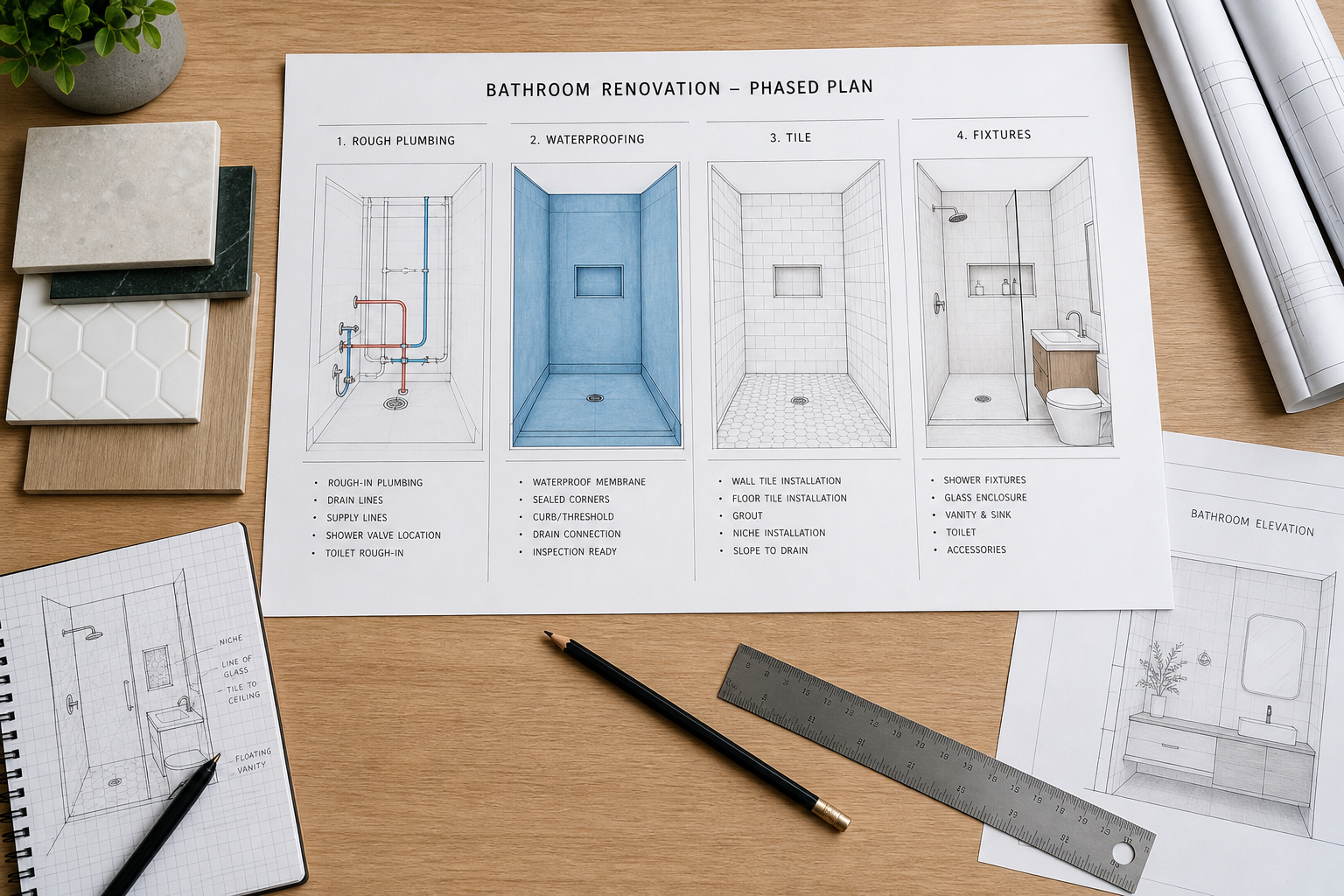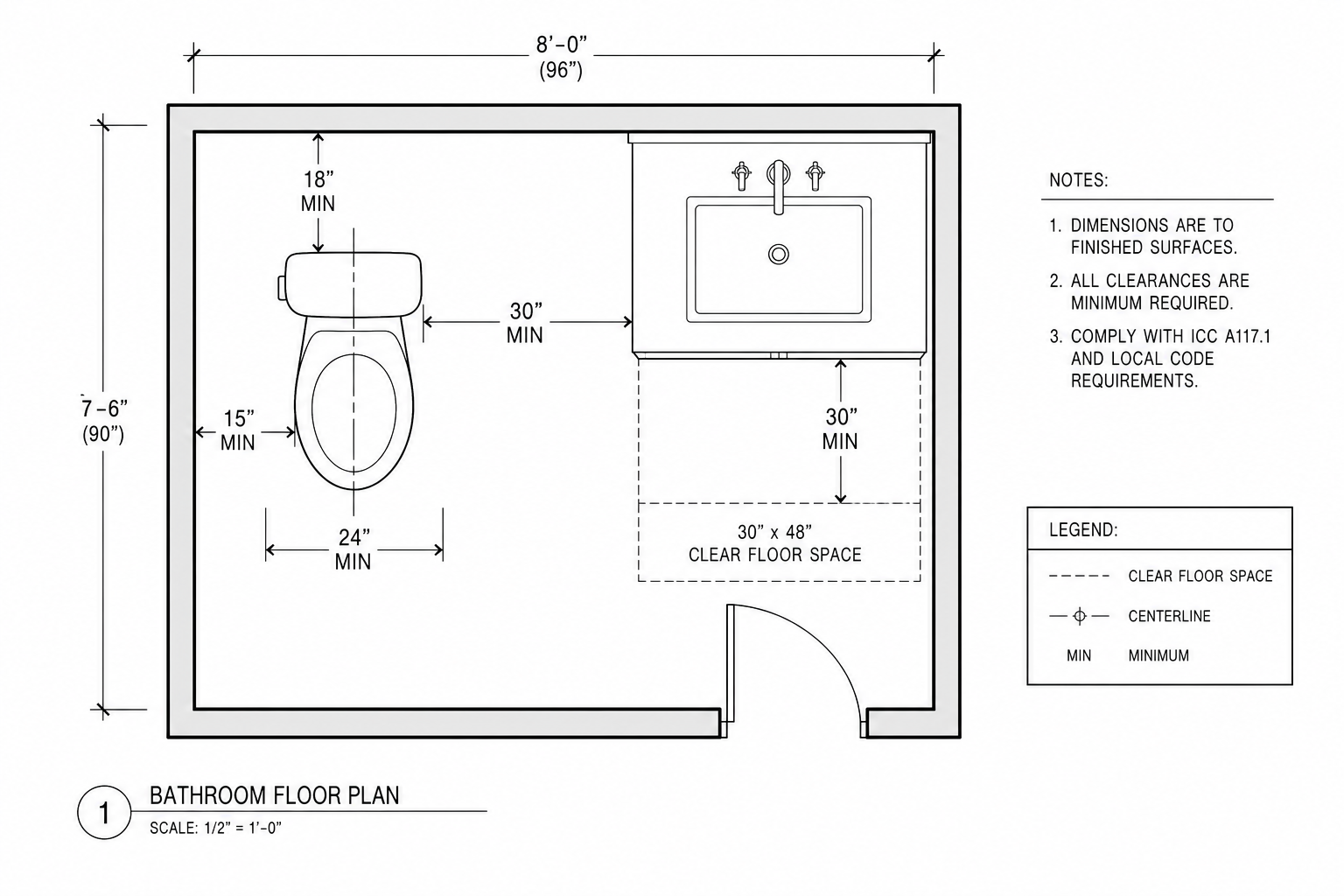
The IRC code minimum for toilet clearance (15 inches from centerline to any obstacle) produces a bathroom where the toilet and vanity fight each other. The NKBA recommendation of 18 inches is the actual minimum for comfortable use, and 24 inches is where neither fixture feels crowded.
Code compliance and comfortable use are not the same standard. A bathroom can pass inspection with a toilet centerline exactly 15 inches from the edge of a vanity cabinet and still feel wrong every morning. The user's knee hits the cabinet face when sitting. The elbow collides with the counter edge when reaching for the toilet paper. The vanity drawer cannot open fully because the toilet footprint intrudes into the swing path. None of those conditions violate the International Residential Code. All of them violate the basic purpose of a bathroom layout, which is to allow two fixtures to be used without negotiation.
What the Code Actually Requires
The International Residential Code, Section R307.1 and plumbing provisions in P2705, establishes minimum clearances measured from finished surfaces, not from framing.
The toilet centerline must be at least 15 inches from any side wall, partition, vanity, or other obstruction on each side. Centerline means the vertical axis through the center of the trapway and seat, measured horizontally to the nearest obstruction. A vanity cabinet face, a shower glass panel, and a freestanding tub edge all count as obstructions if they fall within that measurement zone.
In front of the toilet, the code requires at least 21 inches of clear floor space to any wall, fixture, or door in its open position. That dimension is measured from the front of the bowl to whatever is closest. A door that swings into the clearance zone can create a violation even when the floor plan looks adequate on paper with the door shown closed.
When two toilets are installed side by side, their centerlines must be at least 30 inches apart. When a toilet sits adjacent to another fixture such as a bidet or a second toilet, the 30-inch center-to-center rule applies.
These are minimums for safety and basic function. They ensure a person can approach the fixture, sit, and stand without being physically blocked. They do not ensure comfort. Building Code Trainer, summarizing IRC and IPC provisions, notes explicitly that these dimensions are legal minimums for residential bathrooms, distinct from the larger clearances recommended for accessible restroom stalls.
A layout drawn to code minimums fits more fixtures into a small footprint. That efficiency is why builders and designers default to 15 inches when space is tight. It is also why so many secondary bathrooms feel cramped despite being technically compliant.
What the NKBA Recommends Instead
The National Kitchen and Bath Association recommends 18 inches from the toilet centerline to any side wall or adjacent fixture, with 30 inches of clear space in front of the bowl.
That three-inch difference from the IRC side clearance is the distance between compliance and comfort. Eighteen inches allows the seated user's elbows to clear the adjacent vanity without contortion. It allows the standing user at the vanity to move without stepping into the toilet's approach zone. It provides enough visual and physical separation that using one fixture does not require awareness of the other's presence.
The NKBA front clearance recommendation of 30 inches exceeds the IRC minimum of 21 inches by nine inches. That margin matters for tall users, for users who need forward lean when standing, and for door approach paths that code may count as compliant at 21 inches but feel obstructed in practice. Peak Property Services, in its bathroom clearance guidance, summarizes the distinction clearly: IRC provides legal minimums focused on safety, while NKBA recommendations reflect ergonomic research and long-term usability.
The NKBA also recommends 30 inches center-to-center between adjacent fixtures, matching the IRC on that dimension. Where the two standards diverge most meaningfully for toilet-to-vanity spacing is the side clearance at the toilet centerline.
Neither standard is legally binding unless local jurisdiction adopts NKBA guidelines into code, which most do not. The NKBA numbers are professional recommendations. They represent what experienced kitchen and bath designers specify when the floor plan allows, and what they fight for when a builder tries to shave three inches off the toilet zone to widen a shower.
Why 24 Inches Is Where the Room Starts to Work
Professional designers who have lived with code-minimum bathrooms often target 24 inches from toilet centerline to vanity edge as the threshold where the layout stops feeling compromised.
At 24 inches, the seated user has genuine lateral space. The vanity user can open a standard drawer without encroaching on the toilet footprint. Cleaning around the toilet base does not require yoga. Two adults can occupy the room in sequence without one waiting in the doorway because the other is blocking access to both fixtures simultaneously.
The cost of those extra inches is floor area. In a five-by-eight-foot bathroom, moving from 15 to 24 inches side clearance may require a smaller vanity, a compact toilet with a shorter depth, or a pocket door instead of a swing door. Those trade-offs are real. They are also the reason layout decisions belong at the design stage, not after cabinets are ordered and the rough plumbing is stubbed.
Toilet depth affects the calculation. An elongated bowl extends roughly two inches farther than a round front. In a tight layout, specifying a round-front or compact elongated model can recover floor depth that side clearance consumes. The fixture selection and the spacing dimension are linked variables, not independent choices.
Vanity depth matters equally. A standard 21-inch deep vanity projects farther into the room than an 18-inch deep compact unit. Wall-hung vanities can reduce visual bulk without changing the critical centerline-to-obstruction measurement, but the cabinet face still defines the obstruction line unless the vanity is recessed into an alcove.
How the Measurement Is Taken in Practice
The most common layout error is measuring to the wrong point.
Clearance is from the toilet centerline, not from the edge of the toilet tank, not from the corner of the room, and not from the face of the vanity cabinet unless that face happens to be the nearest obstruction at centerline height. The centerline runs through the middle of the fixture as installed. A toilet shifted even one inch off the planned centerline can convert a compliant layout into a failed inspection or an uncomfortable one.
Measurements are taken to finished surfaces. If the plan shows 18 inches to the vanity but the vanity stone overhangs the cabinet box by an inch and a half, the finished face of the stone is the obstruction. Tile wainscot that projects from the wall reduces clearance. A towel bar at elbow height does not count as a floor-plan obstruction, but a radiator or half wall does.
Door swing is measured in the open position. IRC front clearance of 21 inches is to the nearest obstruction with the door open. A floor plan that shows adequate clearance with the door closed may fail with the door open. Pocket doors and barn doors eliminate swing encroachment but introduce wall thickness and hardware requirements that must be accounted for in the layout.
Plumbing rough-in location locks the toilet centerline before finish materials are installed. Moving a toilet flange after the subfloor is down is possible but costly. Getting the centerline right on the plan is cheaper than moving it in construction.
What Happens When the Layout Is Wrong
A cramped toilet-to-vanity dimension does not fail immediately. It fails in daily use.
The user adapts. They sit angled on the toilet to clear the vanity. They store toilet paper in a location that avoids the knee collision zone. They open the vanity drawer only partially. The adaptations become permanent behavior. The room feels small even if it is not, because every interaction with two primary fixtures requires simultaneous awareness of both.
Resale value follows usability. A secondary bathroom that passes code but feels hostile to use is a room buyers note during walkthroughs even if they cannot articulate why. Primary bathrooms with generous fixture separation read as renovated with intention. Bathrooms at code minimum read as tolerated.
Remodeling is the correction point. Once the vanity is installed and the toilet flange is set, recovering three inches of side clearance requires moving at least one fixture, which means re-piping, re-ducting if the vanity moves, and often replacing flooring throughout the room. The layout error that took ten minutes on paper costs thousands to fix after installation.
Bid comparison exposes the spacing problem when layouts are not included. Two contractors may price the same vanity and toilet fixtures while assuming different centerline locations. One bid may assume a 15-inch clearance that fits the existing flange. Another may propose moving the flange to achieve 20 inches but omit that relocation cost from the fixture line item. The homeowner sees identical products at different prices and cannot see that the cheaper bid is buying a bathroom that will feel tight for twenty years.
The opinion that belongs here: treating IRC minimums as the design target is a false economy. Three inches of side clearance cost floor area on the plan. They save daily friction for every user for the life of the room. A layout drawn to 18 inches minimum, with 24 inches wherever the footprint allows, is not oversized. It is calibrated to how adults actually occupy a bathroom.
We check toilet centerline clearances against NKBA guidelines on every layout we draw, not just IRC minimums. We flag any dimension under 18 inches before it is committed to.