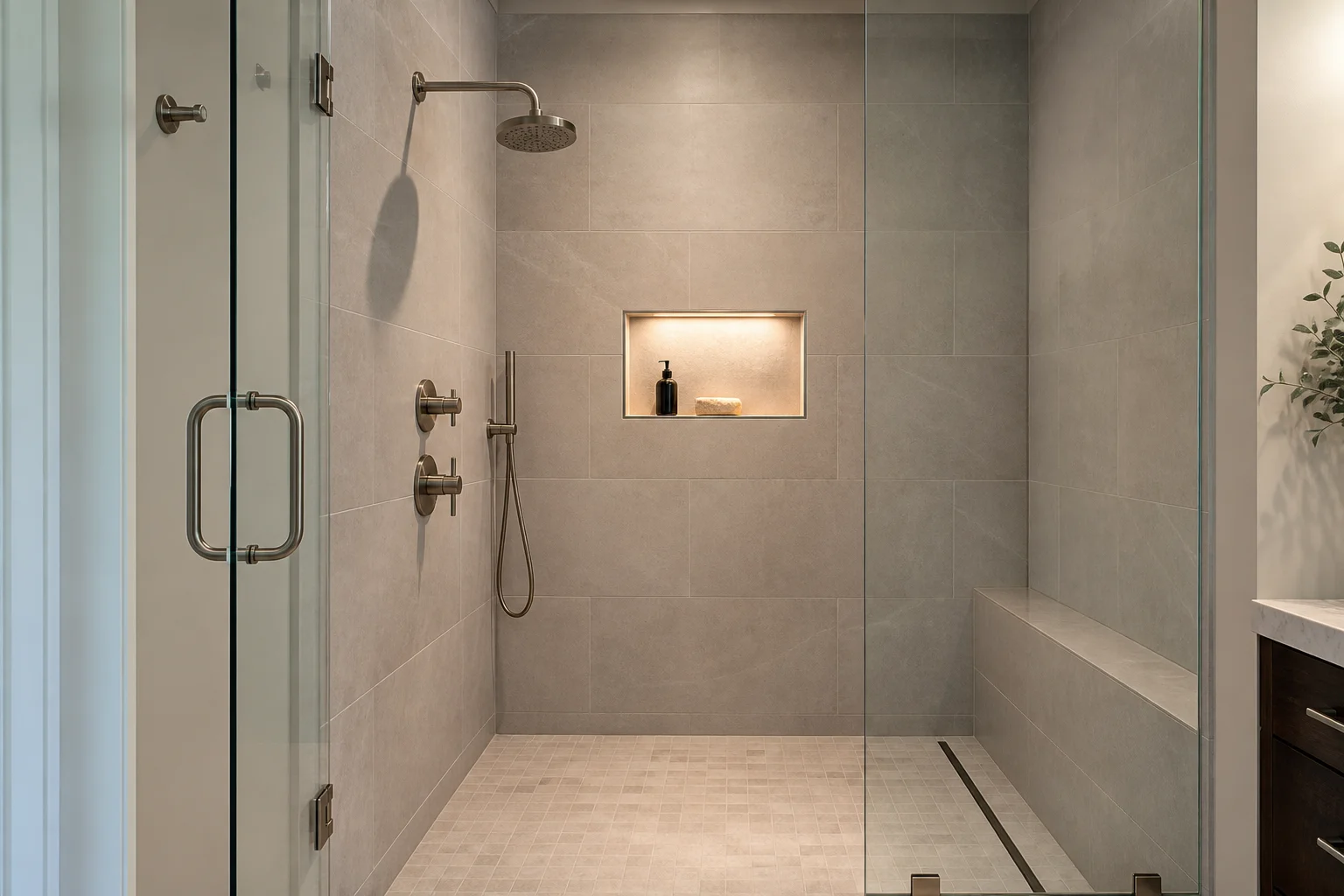
A shower niche placed for visual effect, centered on the wall, aligned to the tile pattern, positioned at whatever height worked in the drawing, is decoration. A niche placed for the actual height of the person using it, on the wall they face when showering, with a shelf depth that fits a real shampoo bottle, is infrastructure.
The distinction matters because niches are built into the wall during construction. They cannot be moved after tile is set without demolition. A decorative niche that looks balanced in the elevation drawing and sits at the wrong height produces daily annoyance for fifteen years. An infrastructure niche that looks slightly off-center in the tile layout and sits where your hand naturally reaches produces daily satisfaction for the same duration.
Most niche failures are placement failures, not waterproofing failures. The niche is built correctly, flashed correctly, and tiled correctly. It is just in the wrong place for a human body.
What Makes a Niche Infrastructure Rather Than Decoration
Infrastructure answers to use. Decoration answers to appearance.
An infrastructure niche is located on the wall the user faces while showering, at a height where the primary user's hand reaches without bending or fully extending. It is deep enough that a standard shampoo bottle stands upright without protruding into the spray path. Its width accommodates the actual number of products the household uses, not the number that looks proportional in a photograph. Its bottom shelf slopes toward the shower so water drains rather than pools.
A decorative niche is located where the tile layout looks balanced: centered on a field of subway tile, aligned to grout lines, symmetric with a second niche on the opposite wall nobody uses. Its height is whatever dimension looked right when the elevation was drawn, often 48 inches from the floor regardless of who stands in the shower. Its depth is whatever the stud cavity provides without reframing. Its width is chosen to fit a tile module rather than a bottle.
Innovate Building Solutions, a bathroom remodeling firm, identifies reachability as the primary niche mistake: niches placed at 42 to 48 inches work for standing adults of average height, but a six-foot-five user needs the niche higher and a seated user needs it at 33 to 36 inches. A niche placed for tile symmetry without user measurement serves the wall, not the person.
Height: The Variable That Determines Daily Use
Standard guidance places the bottom of a primary niche at 48 to 60 inches from the finished shower floor. HomeImperfect's shower niche dimension guide specifies 48 inches as the standard placement, putting the niche at chest height for most adults. My Showerline recommends 48 to 60 inches for standing users, noting that placement too low requires bending and placement too high risks items falling out during retrieval.
These ranges are starting points, not universal rules. They assume an average adult height of roughly five-foot-eight to five-foot-ten. Households deviate from that average in both directions.
Taller users need the niche bottom at 54 to 60 inches or higher. Shorter users and children benefit from a lower placement or a second niche at 24 to 36 inches. Seated shower users, including those who use fold-down benches or transfer from wheelchairs, need niches at 33 to 36 inches from the floor per Innovate Building Solutions' accessibility guidance. A single niche at 48 inches serves none of these edge cases well if they represent the primary user.
The evaluation method is direct. Stand in the shower at the position you normally occupy. Raise your dominant hand to the height where you would naturally grab a bottle. Mark that height on the wall. That is where the niche bottom belongs, adjusted down by one to two inches to account for shelf thickness. If two users differ significantly in height, two niches at different heights serve better than one niche at a compromise height that serves neither.
For tub-shower combinations, a common placement is 12 inches above the tub deck for bath products used while soaking. That location is wrong for standing shower use and right for bath use. Combined-function enclosures need niches at both heights or a single niche sized for the primary function.
Wall Selection: Face the User, Not the Entry
The wall that faces the user during showering is the wall that holds the niche. In a standard rectangular shower with the valve on one side wall, the user typically faces the back wall or the wall opposite the entry. That facing wall is where the hand goes during rinsing, conditioning, and reaching for product.
Placing a niche on the entry wall puts it behind the user during most of the shower. Placing it on the valve wall puts it adjacent to the controls, which works for some layouts but conflicts with valve trim, temperature controls, and the elbow room needed to operate them. Placing it on the wall opposite the entry but offset to center on the tile pattern may put it where the user does not face.
Corner niches solve some placement problems in larger showers by using the corner geometry where two walls meet. They work when the corner is within reach from the standing position. They fail in small showers where the corner is too far from the spray center or too close to the entry splash zone.
USA Cabinet Store's shower design guide recommends coordinating niche placement with stud bay locations at 16 inches on center and tile layout to ensure centered, visually balanced positioning. The guide correctly notes that reframing may be required. The priority order should be user reach first, stud location second, tile symmetry third. When stud location and tile symmetry conflict with reach, infrastructure wins. Reframe or use a prefabricated niche box sized for the available cavity.
Depth and Width: Fit Real Bottles, Not Sample Boards
Standard niche depth is three and a half to four inches, matching the depth of a two-by-four stud wall cavity after backer and tile consume the interior face. Apollo Tile's niche dimension guide notes that standard prefabricated niches are sized for 89-millimeter stud depth, which is why most off-the-shelf units are three and a half inches deep.
Three and a half inches accommodates most standard shampoo and conditioner bottles standing upright. Oversized pump bottles, gallon containers, and some premium brand formats exceed that depth and protrude into the shower space. Protrusion is not just visual. Bottles that extend beyond the wall plane get knocked off during movement, collect soap scum on their exposed faces, and reduce effective shower width in tight enclosures.
Innovate Building Solutions warns that niches deeper than three and a half inches, sometimes created when tile-setters build custom niches in two-by-six walls, are prone to mold growth in the deeper, darker corners where water pools and air circulation is poor. Depth beyond four inches requires deliberate slope and often benefits from rigid foam insulation in the cavity behind the niche to reduce condensation on cold exterior walls.
Width ranges from 12 to 24 inches for single niches, with 12 by 24 inches being the most common horizontal format. Vertical niches at 12 inches wide by 24 to 36 inches tall work in narrow showers where horizontal width is constrained. Multiple shelves within a vertical niche serve tall and short users from the same wall cavity.
Height of the niche opening typically runs 12 to 14 inches for a single shelf. That accommodates standing bottles with room to spare. Lower height with a single shelf wastes vertical storage. Excessive height without intermediate shelves wastes wall cavity and creates a cavity that is hard to keep clean.
Before finalizing dimensions, gather the actual products the household uses. Stand them on a shelf at the proposed depth. Measure the row width. Add two inches for finger clearance. That is your niche width.
Slope, Waterproofing, and the Construction Details
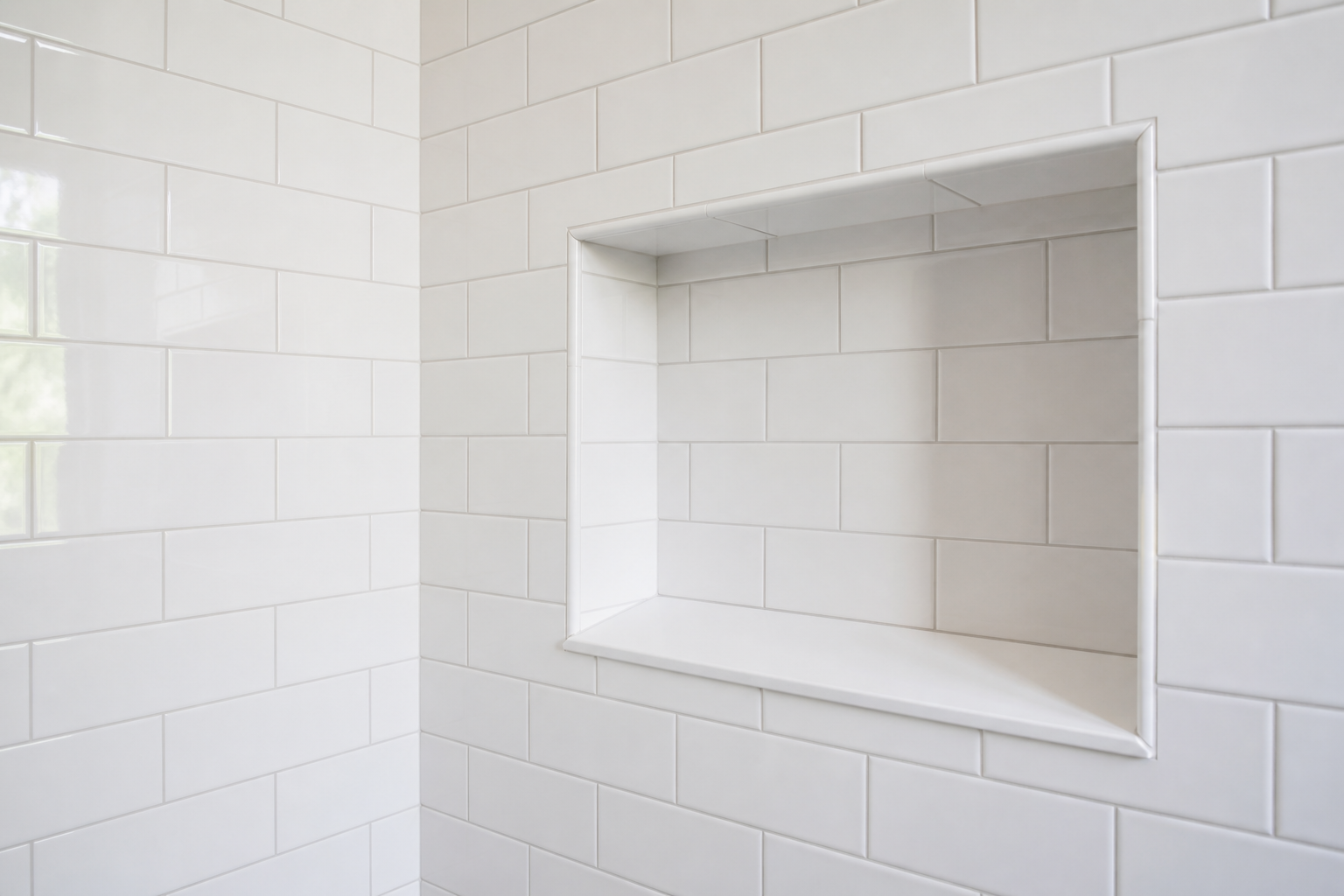
A niche that holds water is a niche that grows mold. The bottom shelf must slope toward the shower at a minimum of one-sixteenth inch per foot, roughly three to five millimeters over the shelf depth. Apollo Tile and most tile industry guidance specify this slope explicitly. Water that pools on a level shelf stagnates, deposits mineral residue, and supports biological growth in the grout joints at the shelf back.
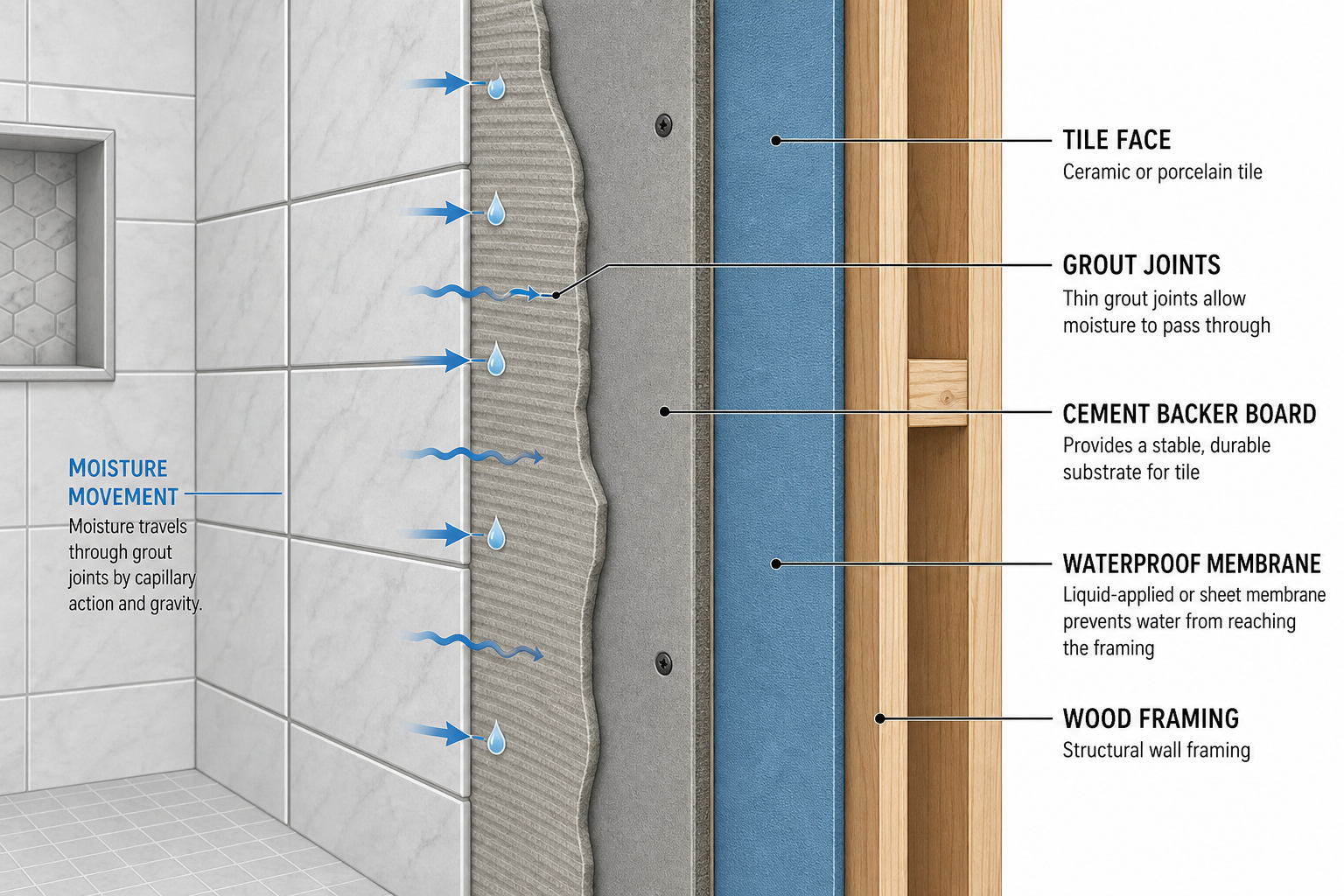
Waterproofing must extend into the niche cavity as a continuation of the shower membrane, not as a separate afterthought. The membrane lines the niche box, laps over the shelf edge, and connects to the field membrane without gaps. Prefabricated niche boxes from Schluter, Noble, and similar manufacturers include integrated waterproofing flanges for this purpose. Custom-built niches require the same membrane continuity, installed before tile.
Grout in niches sees more water exposure than field tile. Epoxy grout at the shelf and back joints reduces maintenance and mold risk compared to cementitious grout. The shelf joint where horizontal meets vertical is a change-of-plane joint that should receive elastomeric sealant rather than rigid grout per TCNA Detail EJ171, the same rule that applies to floor-to-wall transitions.
Niche placement on exterior walls requires additional consideration. A cavity in an exterior wall exposes the back of the niche to temperature differentials that promote condensation. Rigid foam insulation in the cavity behind the niche reduces that risk. Niche placement on interior walls avoids the condensation problem entirely and is preferred when layout allows.
Common Layout Mistakes
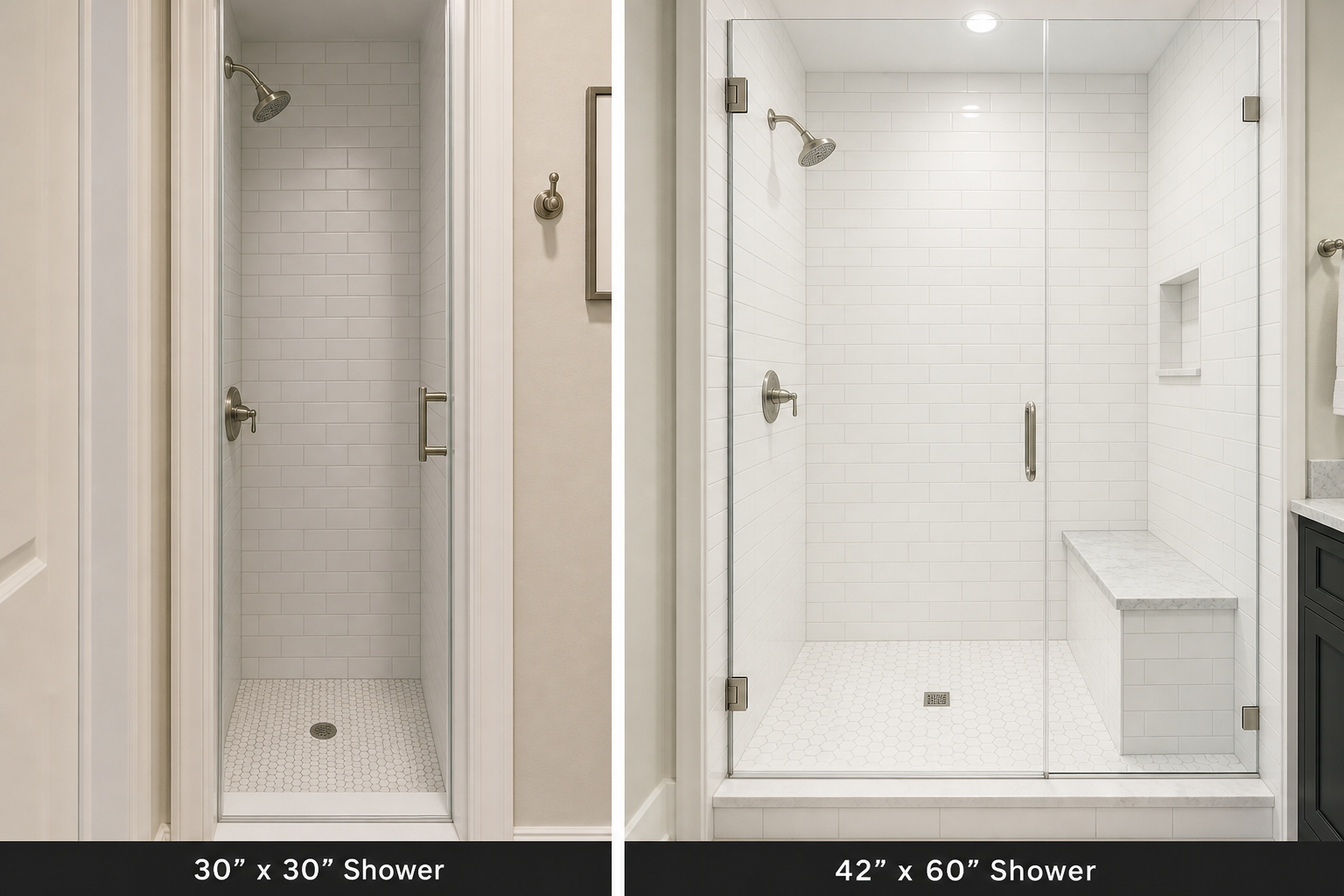
Centering the niche on the back wall when the user stands at an angle toward the valve places storage out of reach. Installing a long horizontal niche in a 36-inch-wide shower consumes the only wall space where the body needs clearance. Placing two symmetric niches on opposite walls when only one is reachable doubles waterproofing complexity for half the utility. Sizing the niche to fit the tile module rather than the bottles produces a beautiful grid with products that do not fit.
Installing the niche before confirming shower entry location, valve height, and user height locks in a position that may conflict with all three. The correct sequence is: confirm shower footprint and entry, set valve and head locations, measure primary user reach height, then place the niche on the facing wall at the measured height within an available stud bay.
Prefabricated niche boxes that fit within standard 16-inch-on-center framing simplify installation and reduce reframing cost. Custom niches between studs require header support above the opening and careful membrane detailing. The custom route is justified when product storage needs exceed standard box dimensions or when multiple shelves at specific heights serve multiple users.
Niche placement is one of the last decisions we lock in, after shower entry location, valve height, and user height are established. It goes where it is actually used, not where it looks balanced.