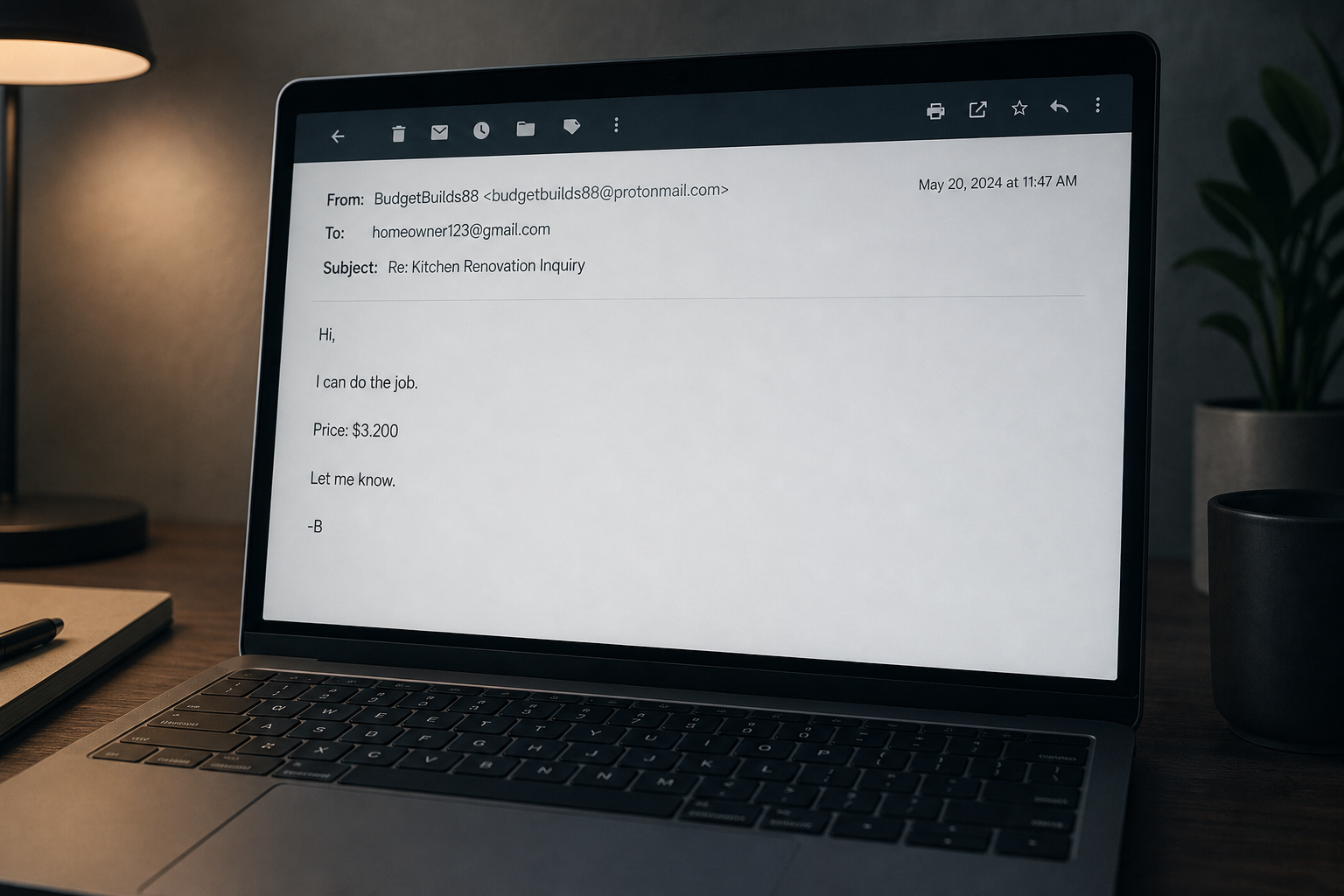
A contractor's first written communication, whether it is the inquiry response, the first estimate, or the initial scope summary, contains more diagnostic information about how they will run a project than a two-hour in-person meeting. Most homeowners read it for price. They should be reading it for precision, process, and what is conspicuously absent.
The first email sets the pattern. Contractors who write vague scopes, skip exclusions, and quote timelines without reasoning in the first message do not become more precise after you sign. They become harder to reach. The first written communication is the cheapest moment to evaluate how someone works. Once you are three weeks into demolition, you are evaluating with sunk costs.
What the First Email Should Contain
A professional first response to a bathroom remodel inquiry, even before a site visit, typically includes acknowledgment of the project type, a brief description of the firm's relevant experience, next steps (site visit, design consultation, or scope review), and a realistic timeline for when a detailed estimate will follow. It may include preliminary budget range expectations if enough scope information was provided in the inquiry.
A professional first estimate, after a site visit, should include a defined scope of work, material specifications or allowances with enough detail to compare, labor and materials separated or clearly categorized, permit and inspection language, payment schedule tied to milestones, estimated timeline with phase breakdown, exclusions stated explicitly, and valid-until date.
None of this requires the contractor to be verbose. It requires them to be specific. Specificity in the first written communication correlates strongly with specificity during the project.
Red Flag: Vague Scope Language
The most common and most costly red flag in a first estimate is scope language that sounds complete but defines almost nothing.
"Bathroom renovation: $52,000" is not a scope. It is a number attached to a room name.
"Install tile as discussed" assumes a discussion that is not documented in writing.
"Standard fixtures" does not specify brand, model, or finish.
"All associated work" is language contractors use when they do not want to list what associated work includes.
A scope that cannot be handed to a different contractor for comparison is a scope designed to protect the author, not the homeowner. If the first email or estimate uses these phrases without attached specifications, the contractor is either rushing, inexperienced at estimating, or planning to define scope later through change orders.
What you want instead: "Remove existing tile, fixtures, and vanity. Install Schluter-Kerdi shower system on shower walls and pan. Install 12-by-24-inch porcelain tile on shower walls and bathroom floor per layout drawing. Install dual vanity with quartz top, model specified in allowance schedule." That scope can be compared. That scope can be held accountable.
Red Flag: Allowances Without Product Identity
Allowances are placeholders for selections not yet finalized. They are legitimate in early estimates. They are red flags when they appear in final estimates without resolution.
"$4,500 tile allowance" tells you nothing. Is that ceramic or stone? Does it include installation of a complex pattern or a straight lay? Is it enough for the square footage of your shower?
"$2,800 plumbing fixture allowance" could cover a midrange three-piece set or a single premium faucet.
Allowances in a first estimate are acceptable if the process for resolving them is described: "Allowances will be finalized during selection phase; overage billed at cost plus markup; savings credited." Allowances in a final contract without product names are a mechanism for the contractor to install whatever fits the number.
Compare two estimates both showing "$3,000 vanity allowance." One includes a note: "Based on 60-inch double vanity, semi-custom, quartz top, typical lead time 6 weeks." The other includes no note. Same line item. Different risk.
Red Flag: Timeline Stated Without Structure
"Should be done in about four weeks" is a red flag. "About" is doing work the contractor does not want to account for.
A timeline in a first estimate should reference phases: demo, rough-in, inspection, waterproofing, tile, fixture install, glass, punch list. It should acknowledge pre-construction time if the estimate follows a site visit where selections were not finalized. A contractor who quotes four weeks without mentioning permit time, material lead times, or glass fabrication is quoting construction time and presenting it as project time.
Timeline red flags in first communications:
- No mention of permits when scope includes plumbing or electrical work
- No mention of inspection scheduling
- No acknowledgment of material lead times for items not yet selected
- Completion date with no phase breakdown
- Pressure language ("we can start next week if you sign by Friday")
The last item is not always malicious. Contractors with backlog want to fill schedule gaps. But urgency in the first email, before scope is defined, suggests the contractor is optimizing for signed contract, not for project success.
Red Flag: Missing Exclusions
What a contractor does not say in the first estimate matters as much as what they do say.
Professional estimates include an exclusions section or inline exclusions: asbestos abatement not included, structural repair beyond $X not included, relocation of plumbing stack not included unless specified, painting outside bathroom not included. These exclusions protect both parties by defining boundaries.
A first estimate with no exclusions is assuming either that nothing will come up (unlikely in any remodel) or that anything not explicitly included will become a change order billed later. The second scenario is more common.
Ask directly: "What is not included in this number?" A contractor who cannot answer immediately has not thought through the scope. A contractor who says "everything you need" without listing specifics is describing a number, not a project.
Red Flag: No Permit Language
Bathroom remodels involving plumbing relocation, new circuits, or structural modification require permits in virtually every jurisdiction. A first estimate with no mention of permits is one of three things: the scope does not require permits (possible for purely cosmetic work with no plumbing or electrical changes), the contractor plans to skip permits (a serious problem), or the contractor forgot (a different serious problem).
Permit language in a first estimate does not need to be exhaustive. It needs to exist: "Permits and inspections included for plumbing and electrical rough-in. Homeowner responsible for HOA approval if applicable." Absence of any permit reference on a full gut remodel estimate is a stop sign.
Red Flag: Payment Terms That Front-Load Risk
Industry guidance from NARI and state consumer protection agencies recommends limiting upfront payment to 25 to 30 percent, with subsequent payments tied to completed milestones. A first estimate requesting 50 percent deposit before work begins, or full material payment before delivery, shifts risk to the homeowner.
Payment red flags in first communications:
- Deposit over 30 percent with no milestone structure
- Final payment due before punch list completion
- Cash-only payment requests
- No written payment schedule attached to the estimate
These patterns appear in first emails and estimates because contractors who operate this way do not change their payment terms after you express concern. They move on to the next inquiry.
Red Flag: Communication Quality Itself
Before evaluating content, evaluate how the communication reads.
Response time without follow-through. A contractor who responds in two hours with a one-line "I can do it for $40K, when do you want to start?" is responsive but not thorough. Speed without substance is its own red flag.
Template responses that ignore your inquiry. If you described a curbless shower, plumbing relocation, and heated floors, and the response is a generic bathroom remodel brochure with no reference to your scope, the contractor is not reading inquiries carefully. They will not read your change requests carefully either.
Spelling, formatting, and organization. This is not a grammar test. It is a process test. Estimates with inconsistent numbering, math that does not add up, or sections that contradict each other suggest the document was assembled quickly without review. That assembly process will repeat during your project.
Reluctance to put anything in writing. A contractor who prefers phone calls for scope discussions but will not document what was said is a contractor whose verbal commitments will not survive the first disagreement.
Red Flag: Price Without Context
An estimate significantly below other bids is not a gift. It is information.
Bids 20 to 30 percent below comparable scope usually indicate one of three things: the scope is narrower (less demolition, no waterproofing, no permit costs, cheaper materials substituted without disclosure), the contractor missed line items they will recover through change orders, or the contractor is underbidding to win the job and plans to make margin through upsells and extras.
The first email that leads with price ("We can do your bathroom for $35,000") without scope attachment is optimizing for the homeowner who compares numbers without comparing rooms. Ask the low bidder to explain the difference line by line against a higher bid. Competent contractors can explain their number. Lowball contractors explain why the other guy is "overpriced."
What a Good First Email Looks Like
Compare the red flags to a first communication that suggests competence:
- Acknowledges specific scope elements from your inquiry
- Describes next steps clearly (site visit, design intake, or scope review meeting)
- Sets expectation for when a detailed estimate will follow
- Does not quote a firm price before seeing the space (or quotes a range with stated assumptions)
- Mentions relevant experience without generic superlatives
- Provides registration or license number when asked, without defensiveness
- Responds to follow-up questions in writing, with specifics
After the site visit, a good first estimate names products or allowance schedules, describes waterproofing approach, includes permit language, states exclusions, separates labor and materials, ties payment to milestones, and breaks timeline into phases.
The contrast is not subtle. You will recognize it immediately once you have seen both types.
What to Do When You See Red Flags
One red flag is not necessarily disqualifying. Vague scope in a preliminary email before a site visit is less concerning than vague scope in a post-visit estimate. An allowance for tile during design phase is normal. An allowance for tile in a contract ready for signature is not.
Multiple red flags in the first written communication, especially vague scope combined with aggressive timeline, missing exclusions, and high deposit requirements, suggest a pattern. Patterns persist through projects.
Request a revised estimate with specific scope language. Ask for written answers to the exclusions question. Ask for permit and inspection language. Compare the response to your request. A contractor who revises willingly and specifically is showing how they respond to client input. A contractor who resists, deflects, or produces a slightly longer version of the same vague document is showing how they will respond to every question during construction.
We have reviewed enough competitor bids alongside our own to know the specific phrases that signal incoming problems. "We'll figure it out" for scope questions. "$X allowance" with no product name. "Should be done in about" for timeline. These are not innocent omissions.