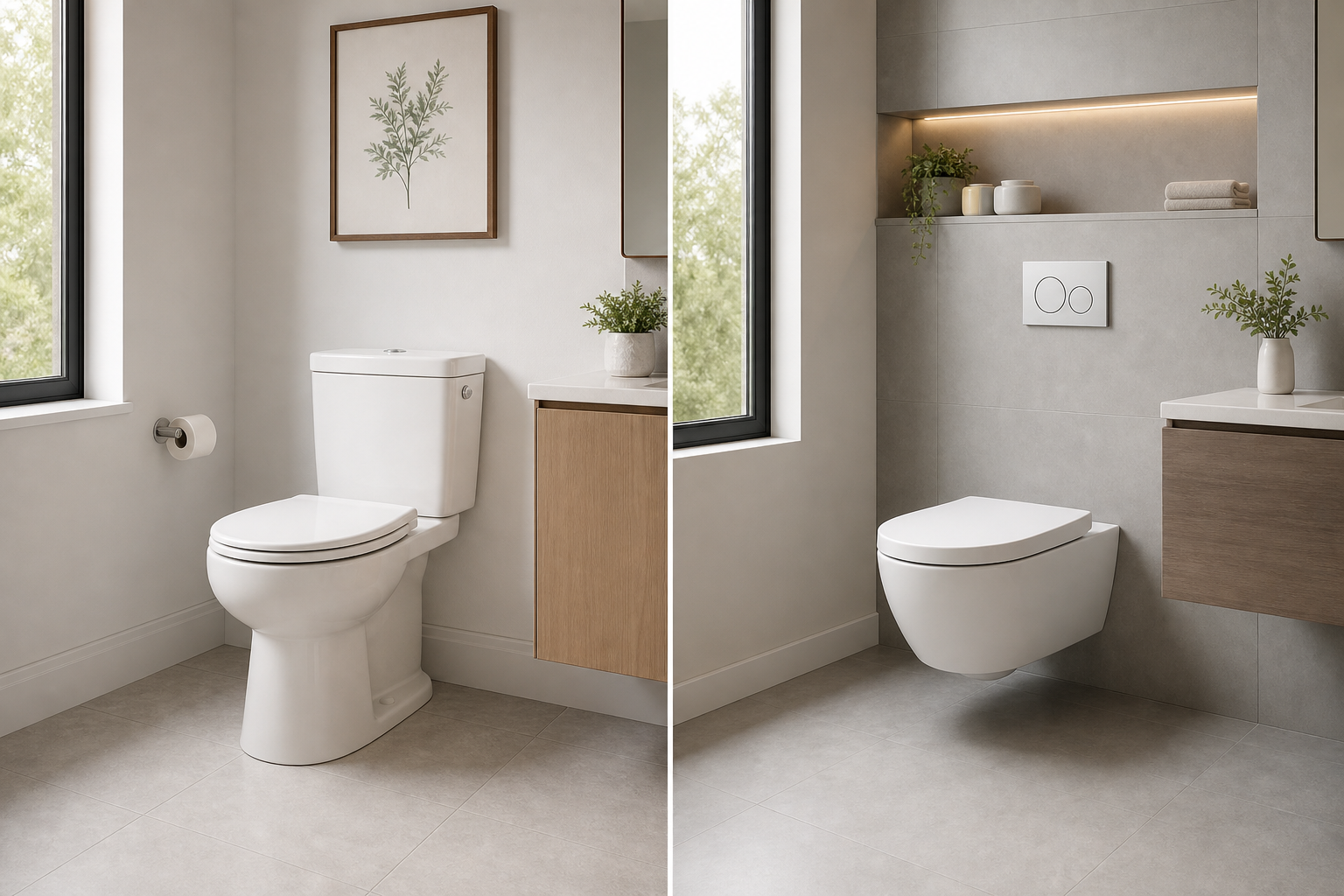
A wall-mount toilet is genuinely easier to clean around and reads as more resolved in a well-designed bathroom, and it is also harder to install, requires structural wall preparation that most bathrooms were not built with, costs significantly more than an equivalent floor-mount unit, and demands a plumber familiar with in-wall carrier systems for any future service call.
That is the complete trade-off, stated plainly. The visual benefit is real. The overhead is also real. Understanding both in full is the only way to make the decision with clear expectations for the next twenty years.
The toilet is not typically where renovation decisions get complicated, which is part of why the wall-mount question catches homeowners off guard. The category looks like a straightforward product upgrade, the way selecting a better faucet is a straightforward product upgrade. It is not. A wall-mount toilet is a system, and the product is the least complicated part of it.
The Visual Case, and Why It Holds
The argument for a wall-mount toilet begins with cleanliness and reads as a design argument but is grounded in something more practical.
A floor-mount toilet has a footprint: the base of the porcelain, the floor bolts, the wax ring concealment, and the area immediately around it that grout lines interrupt and where cleaning tools cannot easily reach. In a well-tiled bathroom, the base of a floor-mount toilet is the most difficult surface to clean. The porcelain meets the floor at a curved transition designed for manufacturing efficiency rather than for the cleaning habits of the person who will use the bathroom twice a day for the next fifteen years. Over time, the area around a floor-mount toilet base accumulates the kind of residue that regular mopping does not address.
A wall-mount toilet eliminates that surface entirely. The floor continues uninterrupted beneath the toilet. A mop, a vacuum, or a damp cloth passes under it without negotiation. The grout lines run continuously. The toilet appears to float. The effect is visible in the photograph and maintained in daily life. This is unusual in renovation promises, where visual effects are often more persistent in photographs than in lived experience.
The design argument is also legitimate. In a room with a clear design language, a pedestal toilet base introduces a visual element that competes with the floor tile, disrupts the horizontal reads of the room, and anchors the toilet more heavily to its location. A wall-mount toilet recedes visually and gives floor space to the room rather than to itself. In a bathroom where every other decision has been made to reduce visual noise, a floor-mount toilet can be the loudest surface in the room.
These benefits are real across the life of the installation. They do not fade in year three. The cleaning advantage compounds, because every cleaning of the bathroom floor is slightly less effortful, and over twenty years of cleaning cycles, that delta becomes material.
The Installation Requirements
The cleaning advantage and the visual resolution come with installation requirements that do not apply to any floor-mount toilet.
A wall-mount toilet requires an in-wall carrier frame. This is a heavy steel rack, engineered to transfer the combined weight of the toilet bowl and the person using it from the wall into the floor framing below. The carrier frame bears loads that range from the static weight of the ceramic bowl to the dynamic impact loading of a person of any body weight sitting down or standing up. Carrier systems from manufacturers including Geberit, Zurn, and Kohler are engineered to support loads of 880 pounds or more, but the engineering only functions if the carrier is installed into framing that can receive it and is anchored correctly.
This means the wall behind the toilet cannot be a standard 2x4 framed wall. The carrier frame requires at minimum a 2x6 framing cavity to accommodate both the frame and the in-wall tank that holds the water supply for flushing. In most bathrooms, that wall does not exist. Creating it requires either furring out the finished wall surface to add depth, which consumes floor space, or opening the wall, re-framing with deeper lumber, and rebuilding the finished surface from scratch.
In a new construction or gut-renovation context, this requirement is absorbed into the scope of the project and adds to the budget but does not add disproportionate complexity. In a partial renovation where the toilet location is changing from a floor-mount, the wall modification is a project within the project. The tile behind the toilet must be removed. The wall must be opened. The framing must be rebuilt. The drywall and backer and tile must be reinstalled to the final finished surface, which now includes a flush actuator plate rather than a standard toilet tank.
The in-wall tank is the component that most shapes the finished wall requirement. It sits inside the cavity and holds the flush mechanism. Servicing the tank requires access through the actuator plate mounted in the finished wall surface. That plate is typically 8 to 10 inches wide and lives at the visual center of the toilet installation. Access plates are designed to be minimally visible in well-executed installations, but they are a permanent feature of the wall, and they must be kept accessible for any future tank service.
The Cost Difference, Broken Down
The price comparison between a wall-mount toilet and a floor-mount toilet requires accounting for the full system, not just the toilet bowls.
A wall-mount toilet bowl from a quality manufacturer, Kohler, TOTO, Duravit, or Grohe, ranges from approximately $400 to $1,200 for the bowl alone. The carrier system, purchased separately, adds $300 to $700 depending on manufacturer and configuration. The flush actuator plate, which is visible in the finished wall, adds $80 to $400 depending on finish and style. Total product cost for a mid-range wall-mount installation runs from approximately $800 to $2,300 before any labor.
A comparable floor-mount toilet from the same quality tier ranges from $400 to $900 for the complete unit, bowl and tank. The installation requires a wax ring, floor bolts, and a supply line, all of which are standard plumbing materials adding $30 to $60. Total product cost for a mid-range floor-mount installation runs from approximately $430 to $960.
The labor and structural preparation costs are where the gap widens substantially. A standard floor-mount toilet replacement by a licensed plumber takes one to two hours. A wall-mount installation that requires wall modification, carrier frame installation, in-wall tank placement, and finished wall reconstruction can take a plumber one to two days of work and may require a separate drywaller and tile setter to complete the finished surface. Total installation cost for a wall-mount in a bathroom that requires wall preparation typically runs $800 to $2,000 in labor above the product costs. Total installed cost for a mid-range wall-mount toilet system in a bathroom requiring wall modification: $2,000 to $5,000. For a floor-mount toilet in the same quality tier: $600 to $1,400.
The Long-Term Service Question
The cost and complexity of installation are one-time considerations. The service question is a permanent feature of owning a wall-mount toilet.
In-wall carrier systems and flush mechanisms require periodic maintenance. The flush valve, the fill valve, and the dual-flush actuator components all have finite service lives. Accessing them requires opening the actuator plate, working inside the wall cavity, and sometimes removing the actuator plate frame itself. The work is not beyond the skill of a competent plumber, but it is not the standard toilet repair that any plumber can complete in thirty minutes with parts from a supply house.
Not all plumbers are familiar with in-wall carrier systems. Geberit and Zurn carrier systems use proprietary parts that must be ordered from the manufacturer or from specialty plumbing supply houses. TOTO carrier systems are similar. A homeowner who calls a general plumber for a flush mechanism service on a wall-mount installation may encounter a technician who has not serviced the system before, which extends the call duration and may result in a recommendation to call a plumber who has. In regions where wall-mount toilets represent a small fraction of installed base, that plumber may not be immediately available.
This is not a disqualifying consideration. It is a service reality that should be understood before the installation. A homeowner who purchases a wall-mount toilet should know what carrier system it uses, keep the installation documentation accessible, and verify that at least one plumbing contractor in their area has serviced that carrier system before they need a repair.
The Question Worth Asking for a Specific Bathroom
The decision is not, in the end, about whether wall-mount toilets are generally superior to floor-mount toilets. They offer real advantages. They carry real costs and service requirements. The decision is whether those advantages justify those costs for a specific bathroom and household.
In a bathroom that is undergoing a gut renovation, where the walls are already open and the plumbing is being relocated, the marginal cost of installing a wall-mount carrier system is lower than in any other context. The structural preparation is happening anyway. The decision to specify a wall-mount toilet adds the carrier system cost and the in-wall tank and plate cost, but the labor difference narrows significantly when the wall is already open.
In a bathroom that is receiving a surface renovation, where the goal is to update fixtures without opening walls, the wall-mount upgrade is a larger undertaking. It requires the project to expand in scope to accommodate structural work that was not in the original plan.
The cleaning advantage matters most in bathrooms that see heavy daily use and where consistent, effortless cleaning is a genuine household priority. It matters less in a guest bathroom used a few times per month.
When a client asks about wall-mount toilets, we present the full installation requirement, the carrier frame, the thickened wall, the finished panel requirements, before showing any product options. The visual payoff is real. The overhead is also real.