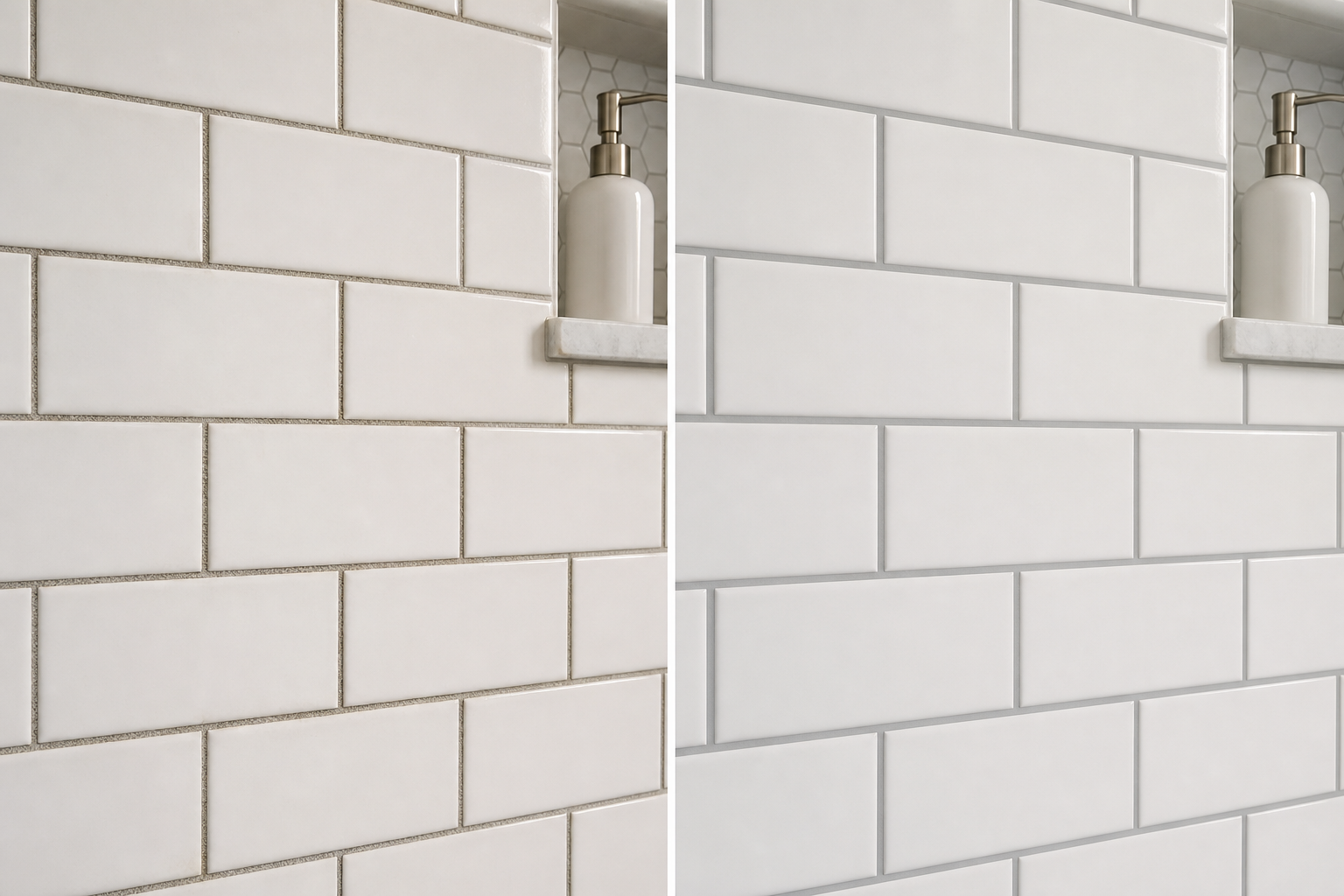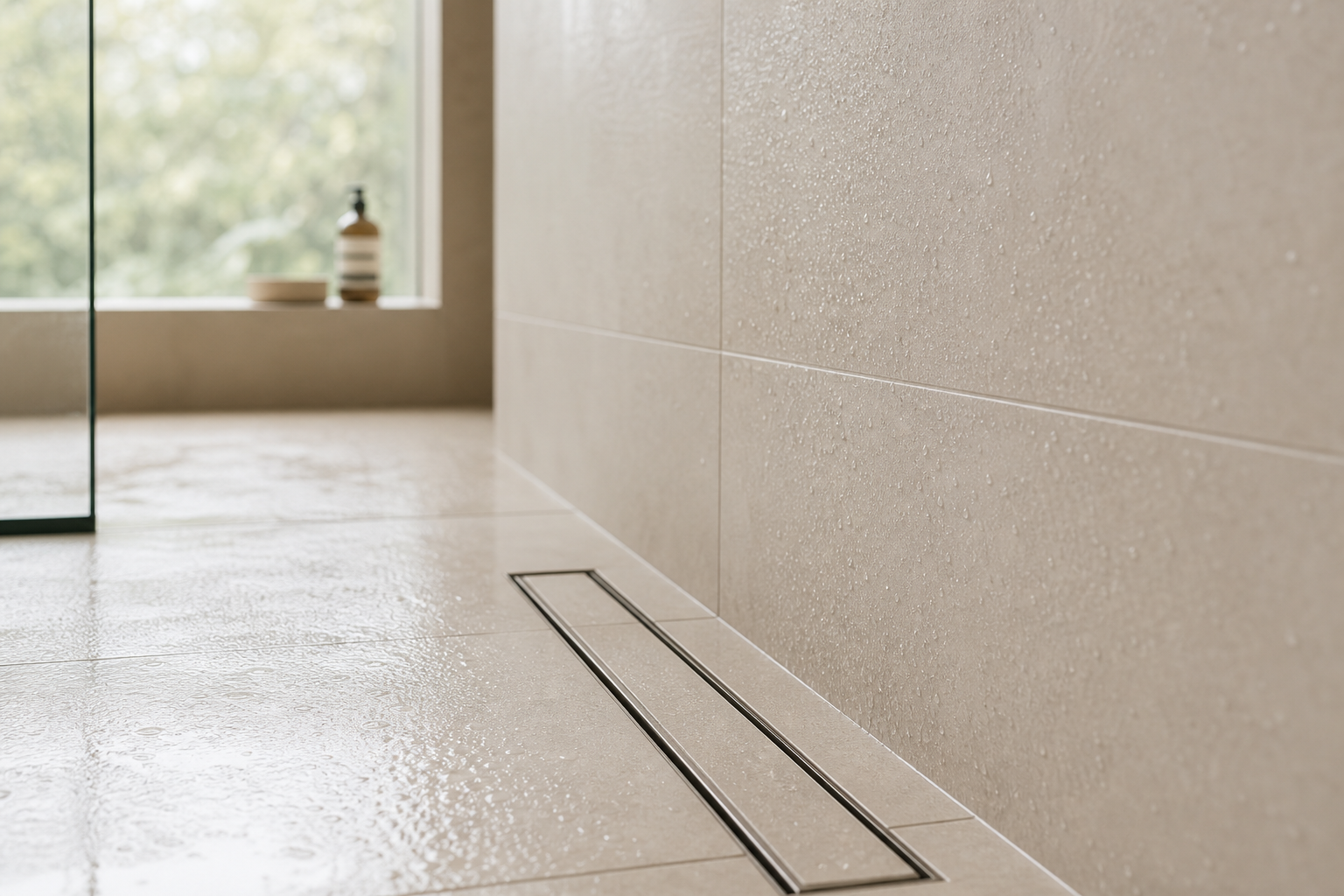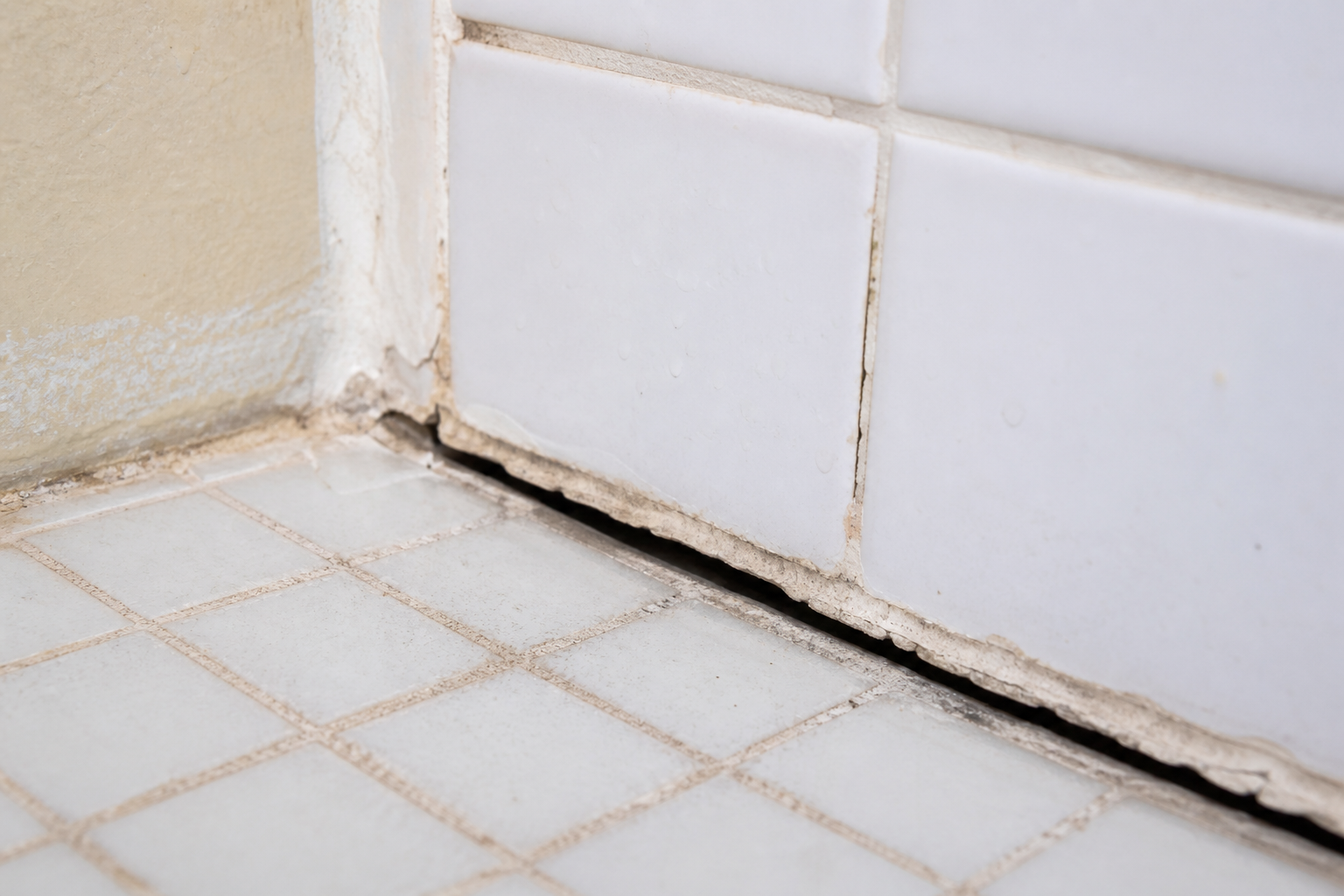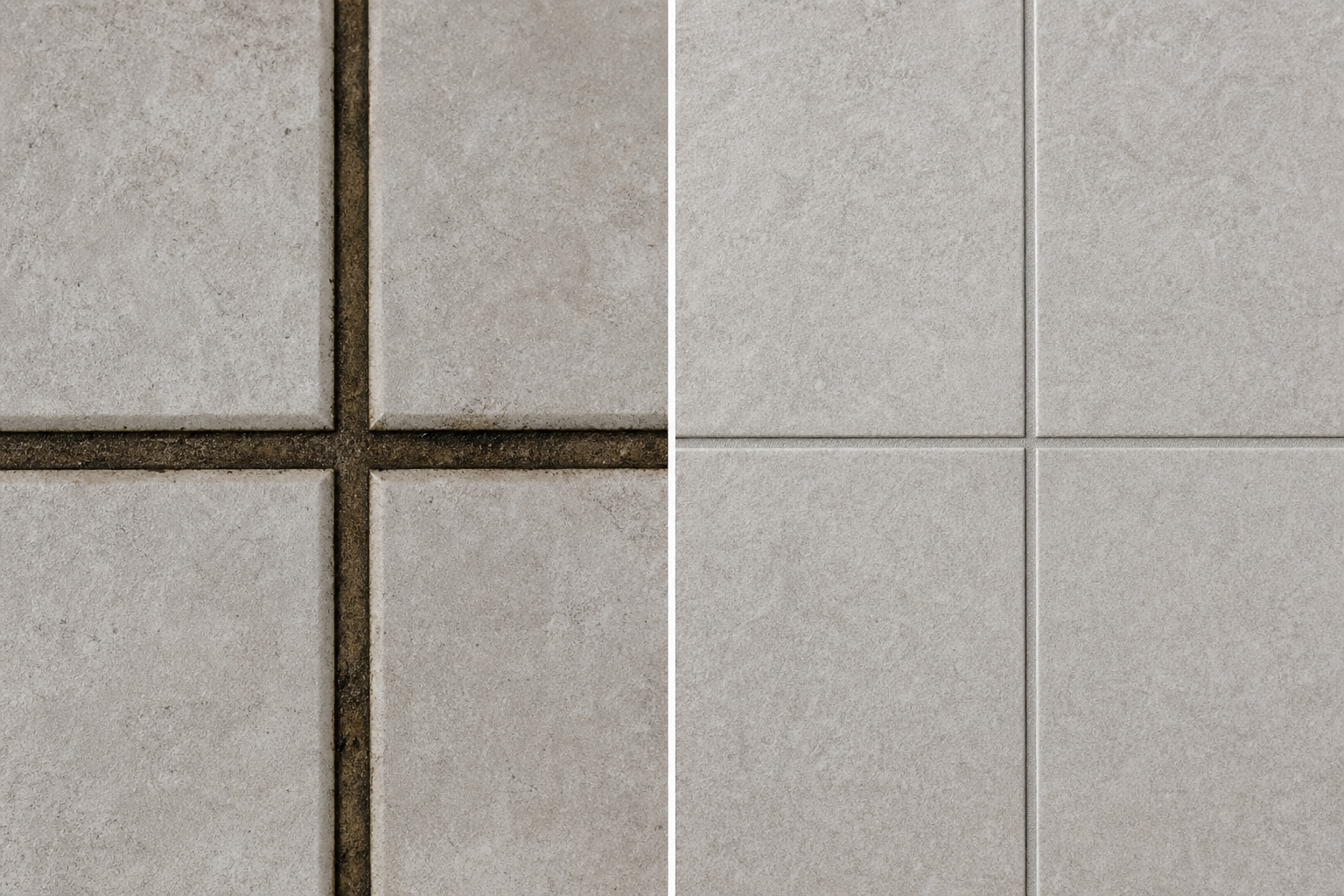
Grout line width and profile determine how much dirt accumulates in the joint, how visible that dirt becomes, and how much effort it takes to remove. Wide, recessed grout lines collect soil and moisture in a channel that mops and squeegees cannot reach efficiently. Narrow, flush grout lines shed both because the cleaning surface is continuous with the tile face. Most bathrooms are specified for the visual effect of the joint at installation and maintained with regret once the accumulation pattern becomes clear.
This is not an argument against grout. Grout is structurally necessary. It accommodates tile dimensional variation, allows for movement, and provides a compressible joint at changes of plane. The argument is that joint width and finish profile are maintenance specifications disguised as aesthetic ones, and treating them as purely visual decisions produces floors and walls that demand disproportionate cleaning time for the life of the installation.
The Physics of Dirt in a Grout Joint
A grout joint is a recessed channel between two hard surfaces. In that channel, three mechanisms operate simultaneously.
Mechanical trapping: dirt particles that land on the floor are swept or mopped across the tile face. When the cleaning tool reaches the joint, particles fall into the recess below the tile surface plane. On a floor with 1/4-inch wide, 1/8-inch deep recessed joints, the broom or mop pad rides over the tile face and leaves the channel untouched. Cotto d'Este, in their maintenance guidance for porcelain stoneware floors, notes that grout lines are slightly recessed compared to the tiled surface, which means brooms and vacuum cleaners are not always as effective at removing everyday dust and dirt from grout as they are at removing it from tiles. Over time, contaminants accumulate and darken the joint.
Capillary retention: grout is porous, especially cement-based grout. Moisture that enters the joint from shower spray, wet feet, or mopping carries dissolved minerals and organic matter into the grout matrix. In bathroom environments, humidity promotes mold and fungal growth in joints that stay damp, further darkening the grout and producing odors that persist after surface cleaning. The joint does not dry at the same rate as the tile face because it is recessed and shaded from airflow.
Surface area exposure: wider joints expose more grout surface per square foot of floor. A 12-by-12-inch tile grid with 1/4-inch joints has substantially more grout area than the same grid with 1/16-inch joints. More exposed grout means more surface to collect contaminants and more linear feet of joint to clean by hand when the mop fails.
These three mechanisms compound. A wide, recessed, cement-based grout joint in a bathroom floor is the highest-maintenance configuration available. A narrow, flush, epoxy grout joint is the lowest. Most residential bathrooms land somewhere in the middle and wonder why the floor never looks quite clean.
Width: What Changes When Joints Get Wider
Grout joint width is specified at installation and cannot be changed without regrouting or replacing tile. The width determines both the visual grid and the maintenance channel.
At 1/16 to 1/8 inch, typical of rectified large-format tile installations, the joint is a hairline. Dirt that enters has a narrow channel to occupy. Mops and microfiber pads contact most of the joint surface during routine cleaning because the recess depth is minimal. The visual grid is suppressed. Maintenance time per square foot is lowest.
At 1/8 to 3/16 inch, typical of standard porcelain and ceramic installations, the joint is visible but not dominant. This is the most common residential specification. Cleaning efficiency depends heavily on profile: a flush joint at this width cleans nearly as easily as a narrow joint; a deeply recessed joint at this width traps significantly more soil.
At 1/4 inch and wider, typical of calibrated tile, handmade tile, and some floor specifications, the joint becomes a design element and a dirt channel simultaneously. Each joint is wide enough to shadow dirt visibly and deep enough that flat mops skip over it. Cleaning requires targeted attention: a brush, steam, or grout-specific cleaner applied to the joint line. This is not occasional deep cleaning. It is the baseline maintenance schedule for wide-joint floors in wet areas.
The ANSI A108.02 standard sets minimum joint widths based on tile type and layout pattern, not maintenance preference. Running bond patterns on tile with sides longer than 15 inches require minimum average joints of 1/8 inch for rectified tile and 3/16 inch for calibrated tile. These minimums exist to accommodate tile warpage and dimensional variation, not to optimize cleaning. But the maintenance consequence of wider minimums on calibrated tile is real: more joint area, more recess depth, more trapping.
Profile: Flush Versus Recessed
Joint width is one variable. Joint profile, the relationship between the grout surface and the tile face, is the other.
Flush grout is finished level with the tile face. On square-edged and rectified tile, ANSI A108.10 requires grout joints to be uniformly finished, and the industry standard for rectified tile is a flush joint. The cleaning surface is continuous. A mop pad or squeegee blade passes from tile to grout without dropping into a channel. Dirt has no recess to settle into. Flooring industry guidance consistently recommends flush or slightly recessed profiles (0 to 1 millimeter) for floor tiles in high-traffic and wet areas because they reduce edge chipping and offer easier sweeping and mopping.
Recessed grout sits below the tile face, creating a visible channel. On cushioned-edge tile, the grout is finished to the depth of the cushion, not the tile face, by specification. The rounded edge of pressed tile partially compensates for the recess by reducing the sharp step between tile and joint. On rectified tile with square edges, a recessed joint creates a sharp channel that collects debris and casts a shadow line under directional lighting.
Deeply recessed or heavily tooled joints, sometimes specified for aesthetic effect on floor tile, are the worst maintenance configuration. The joint acts as a gutter. Water pools in it after mopping. Dirt concentrates in the lowest point. Cleaning requires tools narrow enough to enter the channel, which means hand work on every joint in the room.
Epoxy grout introduces a profile exception. ANSI A118.3 allows epoxy grout joints to have a contoured depression of no greater than 1 millimeter for a 1/4-inch wide joint. Even with epoxy's non-porous surface, that slight depression creates a channel that flat cleaning tools partially miss. The staining resistance of epoxy compensates for some of the profile disadvantage, but the mechanical trapping of recessed profile still applies to surface debris.
Cement Grout Versus Epoxy: Maintenance Behavior
Grout type changes how dirt interacts with the joint, independent of width and profile.
Cement-based grout is porous. Dirt and moisture enter the matrix and discolor the grout body, not just the surface. Scrubbing removes surface contamination but not material that has absorbed into the joint. Over time, cement grout in a bathroom floor darkens from the inside. Regrouting or color restoration becomes the only remedy. Penetrating sealers reduce absorption rates but degrade and require reapplication on a schedule that most households do not maintain.
Epoxy grout is non-porous. Contaminants sit on the surface rather than entering the matrix. Soap scum, mineral deposits, and dirt can be wiped or scrubbed off because they have not bonded into the grout body. Epoxy grout in a shower or bathroom floor maintains its original color with routine surface cleaning rather than requiring periodic deep restoration. The trade is installation cost and difficulty: epoxy demands faster cleanup, skilled application, and higher material cost per pound.
For bathroom floors that will see daily foot traffic and regular wet conditions, epoxy grout at any width and profile outperforms cement grout on maintenance behavior. The non-porous matrix eliminates the absorption pathway that makes cement grout progressively darker regardless of how often the surface is cleaned. If the specification calls for cement grout in a wet-area floor, joint width and profile become more critical because the maintenance burden cannot be offset by material performance.
Where the Specification Goes Wrong
The typical sequence in a bathroom renovation runs aesthetic selection first, technical specification second, if at all. The client chooses tile from a showroom display. The joint width is whatever the installer defaults to for that tile type. The grout profile is whatever the installer produces with their float technique. The grout type is whatever is in the installer's truck. Maintenance behavior is discovered after move-in.
The correction is to treat joint width, profile, and grout type as part of the specification review before tile is ordered, not as installation details decided on site.
For shower floors, narrow joints with epoxy grout finished flush represent the lowest maintenance configuration compatible with wet-area performance. For bathroom floor tile outside the shower, medium-width joints with epoxy or well-sealed cement grout finished flush to slightly recessed balance visual effect with cleaning efficiency. For feature walls where maintenance is primarily dust rather than moisture and foot traffic, joint width and profile matter less and aesthetic choices carry more weight.
Wide joints with recessed cement grout on a bathroom floor should be a deliberate choice made with full understanding of the cleaning schedule they require, not a default that results from tile selection alone.
When we specify floor tile for areas that will see daily traffic, grout joint width and profile are part of the specification review, not the aesthetic discussion. The question is not whether the joint looks good in the showroom. The question is what happens when a wet mop passes over that joint every week for five years, and whether the person doing the mopping has the time and tools to clean what the joint traps.