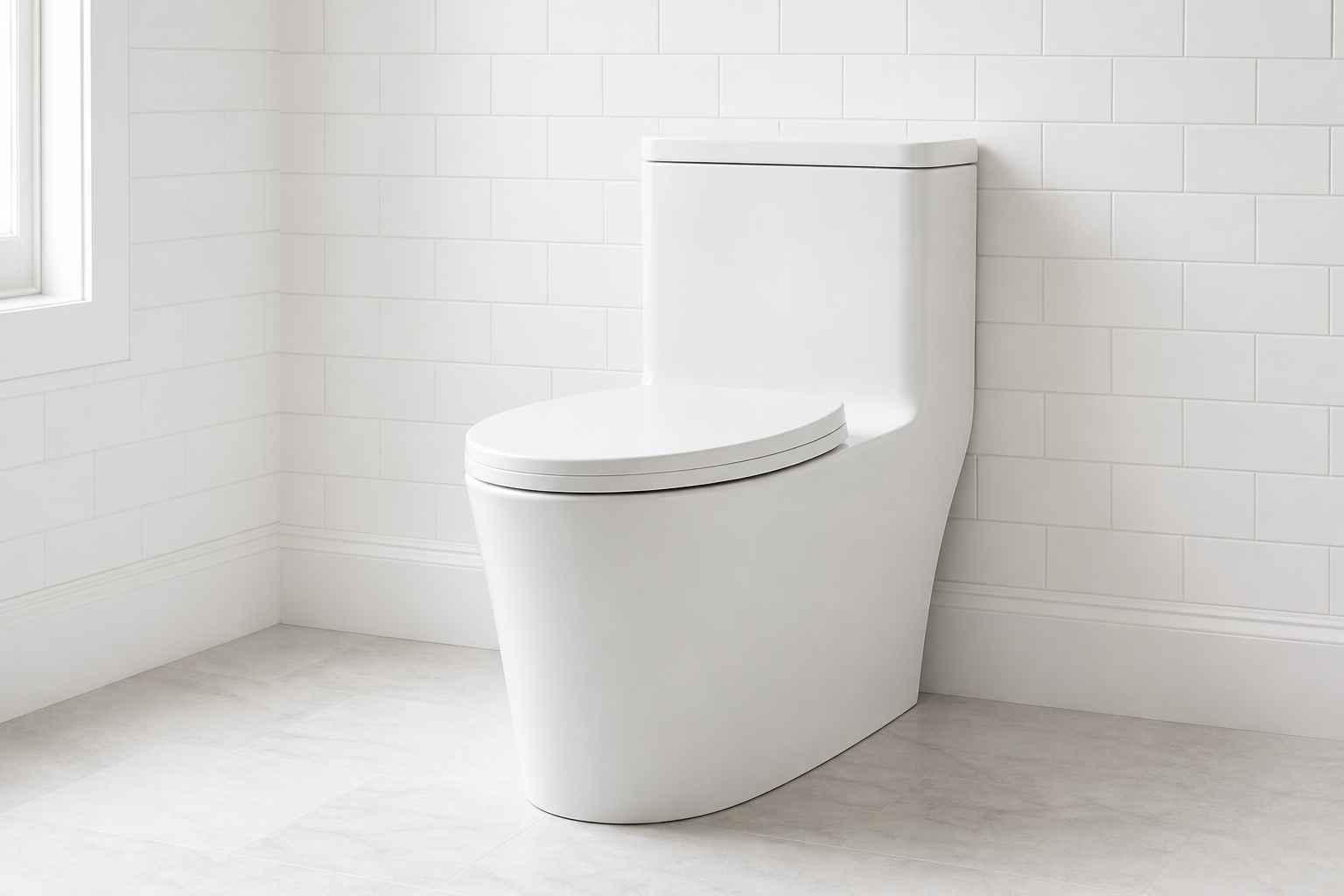
The toilet is the most-used fixture in the bathroom and the one that gets the least specification attention during a renovation. The decisions that determine whether a toilet performs reliably for twenty years, whether the flushing mechanism holds up without adjustment, whether the bowl stays clean without sustained effort, and whether a simple repair requires an internet search or a quick trip to a hardware store, are not visible in a showroom photo and not mentioned in most specifications.
Most bathroom renovations spend the most time on tile selection and fixture finishes. The toilet is specified last, often by brand name alone, sometimes by price point alone. That approach works fine until the day it does not: until the flush valve starts running, until the trapway clogs repeatedly despite normal use, until the seat hardware corrodes, until a needed part requires more than a week to source. By that point, the renovation is years behind you and the toilet is in the wall.
Specifying a toilet that holds up for twenty years requires looking at four things that most people do not look at on the showroom floor: the trapway design and glazing, the flush mechanism and water efficiency, the internal parts supply chain, and the rough-in geometry.
The Trapway Is Not Just a Drain Pipe
The trapway is the curved passage inside the toilet body that carries waste from the bowl through the porcelain and into the drain pipe below. It is also one of the better indicators of long-term performance available in a standard specification, and it is almost never discussed.
Toilets are made with either a glazed or unglazed trapway. An unglazed trapway is rough-textured on its interior surface, the same surface condition as the exterior of the porcelain body. A fully glazed trapway is coated with the same smooth ceramic glaze that lines the bowl. The difference in performance is not subtle. An unglazed trapway provides more surface texture for waste and mineral deposits to adhere to. A fully glazed trapway provides the same low-adhesion surface as the bowl, which allows waste to pass through with less resistance and deposit buildup.
Consumer Reports and The Spruce, which have both conducted comparative toilet testing, identify a fully glazed trapway as one of the most consistent predictors of reliable flushing performance over time. A toilet that clogs repeatedly despite normal use is often a toilet with an unglazed or partially glazed trapway that has accumulated deposits over years of use. The bowl may look clean because the bowl is visible and gets cleaned. The trapway is not visible and does not get cleaned, so any tendency to accumulate material compounds rather than corrects.
Some manufacturers, including TOTO, apply proprietary glaze coatings to both the bowl and trapway that go beyond standard ceramic glaze. TOTO's Cefiontect coating is a smooth, hydrophilic surface that causes waste to slide off more easily than standard glazed ceramic. The Spruce's testing notes that TOTO coats the entire toilet with a baked-in glaze that is smooth even at the microscopic level. Whether the specific coating is worth the premium relative to a standard fully glazed competitor depends on the installation, but the baseline standard should always be a fully glazed trapway, which is a specification criterion that appears in the technical data for any serious toilet product.
What "1.28 GPF" Actually Means for Performance
The federal water efficiency standard for toilets in the United States has been 1.6 gallons per flush since 1992. WaterSense-labeled toilets, certified by the EPA, use 1.28 gallons per flush or less while meeting performance criteria established through third-party testing. The EPA's residential toilet program notes that WaterSense-certified toilets use 20 percent less water than the current federal standard and that replacing older toilets can save the average family nearly 13,000 gallons annually.
That efficiency standard was initially met with skepticism. The first generation of 1.6-gallon toilets introduced in the early 1990s often did not flush well, and many homeowners have carried the assumption forward that efficiency and performance are in tension. They are not in current products. The performance criteria required for WaterSense certification include verified flushing capacity through third-party testing, not just water volume measurement. A toilet that passes WaterSense certification has demonstrated that it clears the bowl effectively at the lower water volume.
The Maximum Performance (MaP) test, a voluntary industry certification distinct from WaterSense, measures how many grams of simulated solid waste a toilet can clear in a single flush. Scores are reported in grams, from 250 to 1,000 grams, with 600 or higher generally considered a strong performance level for household use and 800 or higher considered exceptional. A WaterSense-certified toilet with a MaP score above 800 is a toilet that has been independently verified for both water efficiency and flushing performance. That combination is available across a wide price range, and it is the combination worth looking for rather than treating efficiency and performance as separate axes.
The argument for a 1.28-gallon toilet is not only environmental. It is financial. A household of four that replaces a pre-1994 toilet flushing at 3.5 gallons can save a meaningful amount of water annually, and that saving compounds over twenty years of use. The EPA estimates more than $3,400 in lifetime savings for the average household over the life of a WaterSense toilet. That number is not close enough to justify a significantly inferior product, but in a comparison between two otherwise equivalent toilets where one has WaterSense certification and one does not, the certified product is the rational choice.
Flush Mechanism: Gravity Feed Versus Pressure Assist
The choice of flush mechanism is one of the more consequential decisions in toilet specification and one of the least discussed in residential renovations.
The large majority of residential toilets use a gravity-feed flush mechanism: a tank fills with water, a flush valve opens and releases the water into the bowl, gravity carries it through the trapway, and the tank refills. Gravity-feed toilets are quiet, mechanically simple, and easy to service with widely available parts. When the flapper starts to fail, it is a five-dollar part available at every hardware store. When the fill valve needs replacement, the same is true. The service history of a gravity-feed toilet is accessible to any competent plumber and to most reasonably handy homeowners.
Pressure-assist toilets use a sealed pressure vessel inside the tank that stores compressed air and water. When the flush valve opens, the pressurized water is released with considerably more force than a gravity-feed flush. The result is a more powerful flush from less water, and the bowl empties more completely with a single flush. Pressure-assist toilets are common in commercial applications where the more powerful flush addresses the demands of high-traffic use.
The trade-off in residential applications is noise, complexity, and parts accessibility. A pressure-assist flush is noticeably louder than a gravity-feed flush, which most households find acceptable in a commercial restroom and uncomfortable in a master bathroom at 6 in the morning. The pressure vessel requires specific replacement parts that are not stocked at most hardware stores, and a failed pressure vessel requires either a specific part or replacement of the entire tank assembly. For a primary bathroom in a household where quiet operation matters and basic serviceability is a priority, gravity-feed is the right choice in most cases.
This does not mean pressure-assist is a poor product. It means the choice should be deliberate and informed rather than the result of whichever toilet the supply house had in stock.
The Rough-In Dimension Nobody Measures Until It Is Wrong
The rough-in is the distance from the finished wall to the center of the toilet drain pipe in the floor. Most residential bathrooms in North America have a 12-inch rough-in. Some older homes have a 10-inch rough-in. A small number have 14-inch rough-ins. The toilet you specify must match the rough-in in the room, or the toilet will not fit correctly against the wall.
This sounds obvious. It is also the single most common installation error in toilet specification, particularly in renovations where the plumber who set the original flange is not the same person making the fixture selection. The existing toilet often sits a specific distance from the wall. The rough-in can be confirmed by measuring from the wall to the center of the existing toilet bolts. But that measurement is often not taken until the new toilet has arrived and does not fit.
A 12-inch toilet specified for a 10-inch rough-in will sit too far from the wall. A 10-inch toilet specified for a 12-inch rough-in will sit too close to the wall, with a gap between the tank and the wall that is both visually odd and practically inaccessible for cleaning. Neither condition is correctable without returning the toilet and ordering the correct rough-in dimension, which adds weeks to a project timeline and shipping costs to the specification error.
Measuring the rough-in before any toilet is selected costs nothing. Not measuring it costs time, money, and sometimes the sunk cost of a toilet that cannot be returned because it has been unboxed.
Supply Valve and Internal Parts Compatibility
The supply valve at the wall feeds water to the toilet tank. It is not part of the toilet, but it affects the toilet's long-term performance in a specific way: if the supply valve cannot maintain a consistent flow rate, the fill valve inside the tank struggles to refill the tank at the designed rate, which can produce an audible trickling sound between flushes, a slow refill that increases the cycle time, or a fill valve that eventually fails from operating at the edge of its designed flow condition.
Older supply valves with corroded stops or partial blockages are common in bathroom renovations where the toilet is being replaced but the plumbing at the wall is being left in place. If the existing supply valve has not been touched in fifteen years, the renovation is the correct time to replace it along with the toilet, not to discover the problem six months later.
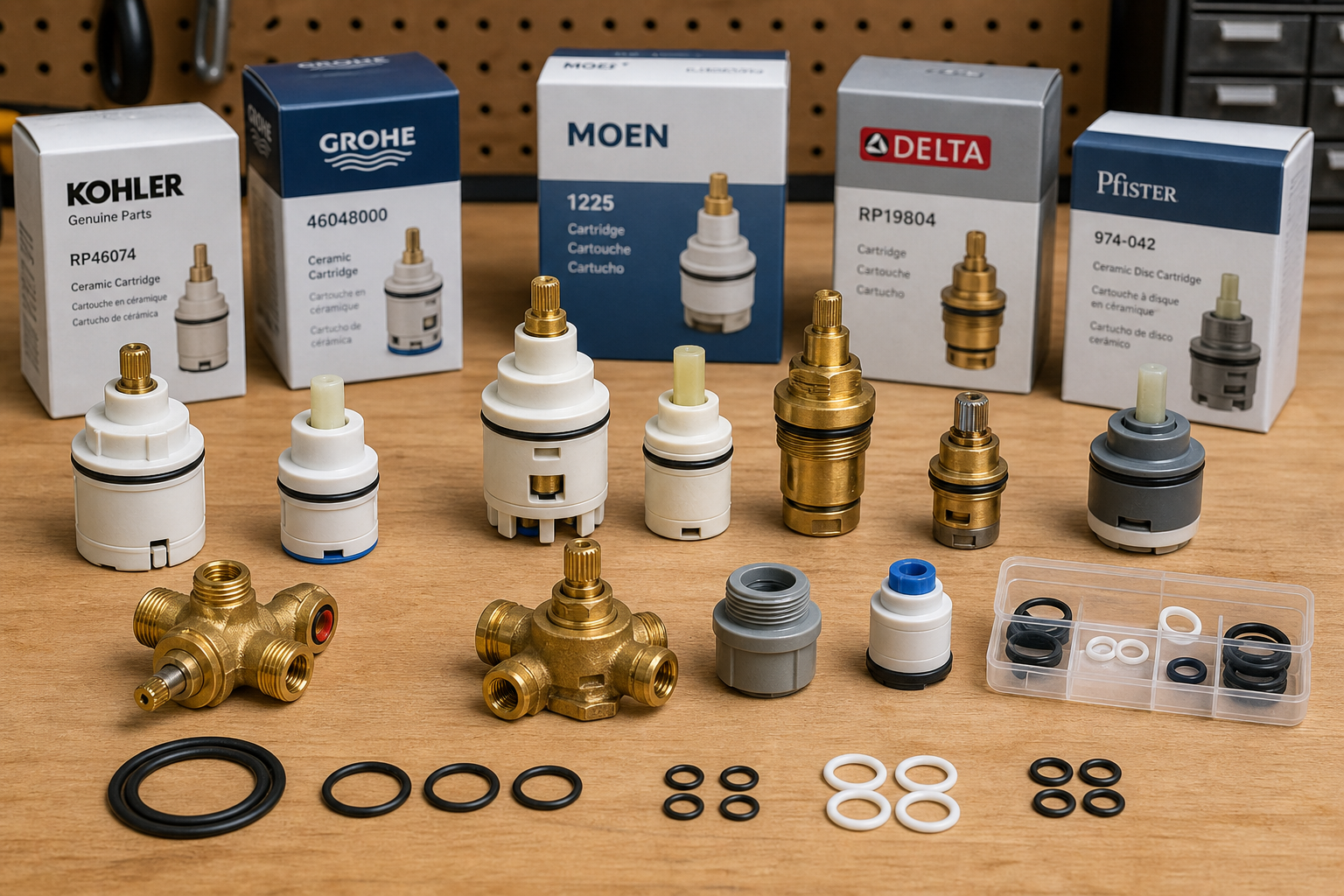
The internal parts of the toilet, the fill valve and flush valve, should use components from established manufacturers whose parts are stocked at hardware stores independently of the toilet brand. Brands like Fluidmaster and Korky manufacture replacement fill valves and flappers that are compatible with most gravity-feed toilets. If the toilet uses proprietary internal components that are only available through the manufacturer, the service story for that toilet is closer to a pressure-assist product than a standard gravity-feed one, even if the flush mechanism itself is gravity-feed.
A Note on Brand Reliability
The brand comparison question in toilet specification resolves fairly simply. TOTO, Kohler, and American Standard have extensive product histories in the North American market, long-established parts distribution, and consistent documentation. Each brand has specific product lines that perform better or worse than others within their catalog, and a higher price point within any of those brands does not automatically mean better long-term serviceability. What each brand offers is a known service infrastructure: parts are documented, plumbers are familiar with the products, and replacement components for models that remain in active production are available.
Brands without that distribution history, regardless of how attractive their marketing is or how well-reviewed their product is at the moment of purchase, carry a longer-term risk that is difficult to quantify at specification time but becomes very clear when a part is needed eight years later and the brand has either exited the market or changed its product line significantly.
Our default specification for primary baths includes a fully glazed trapway, a 1.28 gpf WaterSense-certified flush, and a named brand with a consistent repair parts history. We present the technical basis for each criterion before showing product options.