Over ten years of real bathroom use, porcelain tile requires no material-specific maintenance beyond regular cleaning. Natural stone requires consistent sealing every one to three years, specific pH-neutral cleaning products, and in most polished applications, professional honing and repolishing at some point. The maintenance gap is real, and it compounds every year the household does not sustain the required schedule.
This is not an argument against natural stone. Marble, travertine, slate, and limestone can be extraordinary bathroom materials. They have warmth, variation, and a quality of light absorption that no manufactured product currently matches. They are also materials with specific vulnerabilities that respond to chemistry, not just physical wear. Understanding those vulnerabilities before selecting stone is the condition for the material relationship going well. Not understanding them is how a household ends up with a bathroom they resent.
What Makes Stone Fundamentally Different From Porcelain
Porcelain tile is a manufactured ceramic product fired at temperatures that produce a dense, near-vitrified body with water absorption of 0.5 percent or less. The ANSI A137.1 standard defines porcelain tile as achieving this low absorption, which effectively means the tile body is impermeable under typical bathroom conditions. Its surface hardness, resistance to staining, and resistance to chemical attack are products of its manufacturing process and are essentially permanent properties that do not degrade with time and cannot be renewed by maintenance.
Natural stone is a geological material whose properties vary by type, quarry, and even slab. Its porosity, hardness, and chemical sensitivity are inherent characteristics of how it formed. Marble and limestone are calcium carbonate stones, which means they are vulnerable to acidic pH: vinegar, citrus cleaners, many common bathroom products, and even carbonated water can etch the polished surface by chemically dissolving the calcium carbonate and leaving a dull mark. Granite is primarily silica-based and more resistant to acid attack, but still porous enough to absorb staining agents. Travertine shares marble's calcium carbonate chemistry and adds a characteristic open pore structure that requires specific approaches to sealing and maintenance.
These differences are not remediable by sealing alone. A penetrating stone sealer reduces the rate at which liquids enter the stone body. It does not change the stone's chemical sensitivity to acidic materials. Etching is a surface phenomenon that occurs at the polished face, and it happens regardless of whether the stone is sealed, because the etch occurs on the surface rather than by absorption into the stone. A sealed marble floor can still etch from a drop of shampoo left standing on the polish.
The Sealing Schedule And What Happens Without It
Most natural stone used in bathroom applications requires periodic reapplication of a penetrating sealer to maintain its stain resistance. The frequency depends on the stone type, the sealer product, and the use intensity, but a common range is every one to three years for bathroom floors and shower walls.
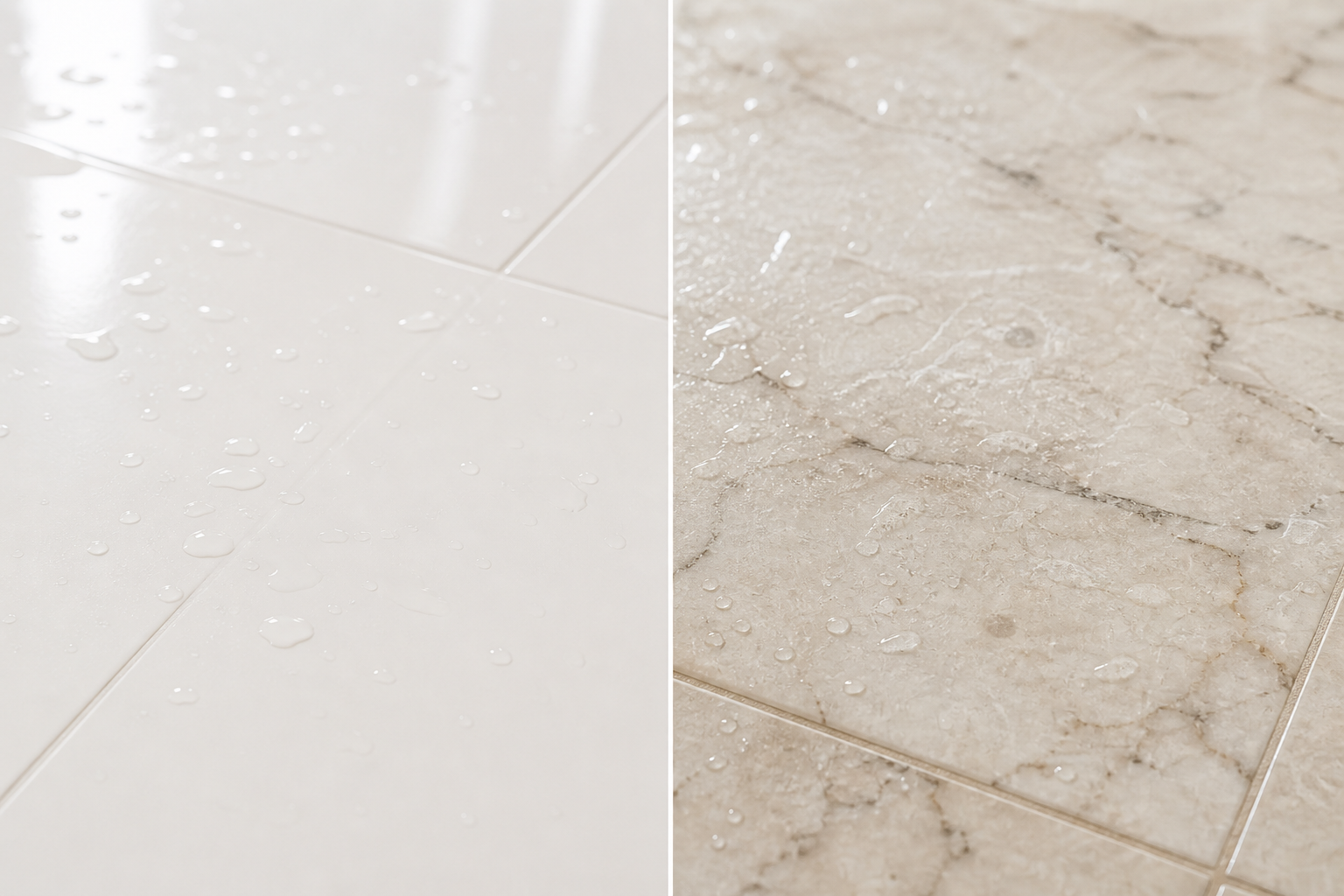
The water test is a reliable field check: pour a small amount of water on the stone surface and observe whether it beads or absorbs. A properly sealed stone will bead water for several minutes. A stone that needs resealing will show a dark water mark within thirty to sixty seconds as the surface pulls moisture in.
When sealing is deferred or skipped, staining agents find easier access to the stone body. In a primary bathroom, the relevant agents include soap scum residue, shampoo and conditioner product, body oils, rust from iron in water supply, and general grime. In an unsealed or under-sealed stone surface, these agents penetrate and create staining that becomes increasingly difficult to remove as it works deeper into the pore structure.
Some stains can be drawn back out with a poultice, which is a paste of an absorbent material mixed with a chemical appropriate for the stain type. This is a skilled and time-consuming process, and it works best when the stain is relatively recent. Deep staining from years of neglected sealing may require professional treatment or may be effectively permanent.
This is not a consequence of poor-quality stone. It is a consequence of stone's inherent character. A household that understands and commits to the sealing schedule will maintain the stone in good condition for decades. A household that intends to seal the stone but defers the task from year to year will have increasingly stained stone and an increasingly expensive remediation path.
Etching: The Damage That Sealing Cannot Prevent
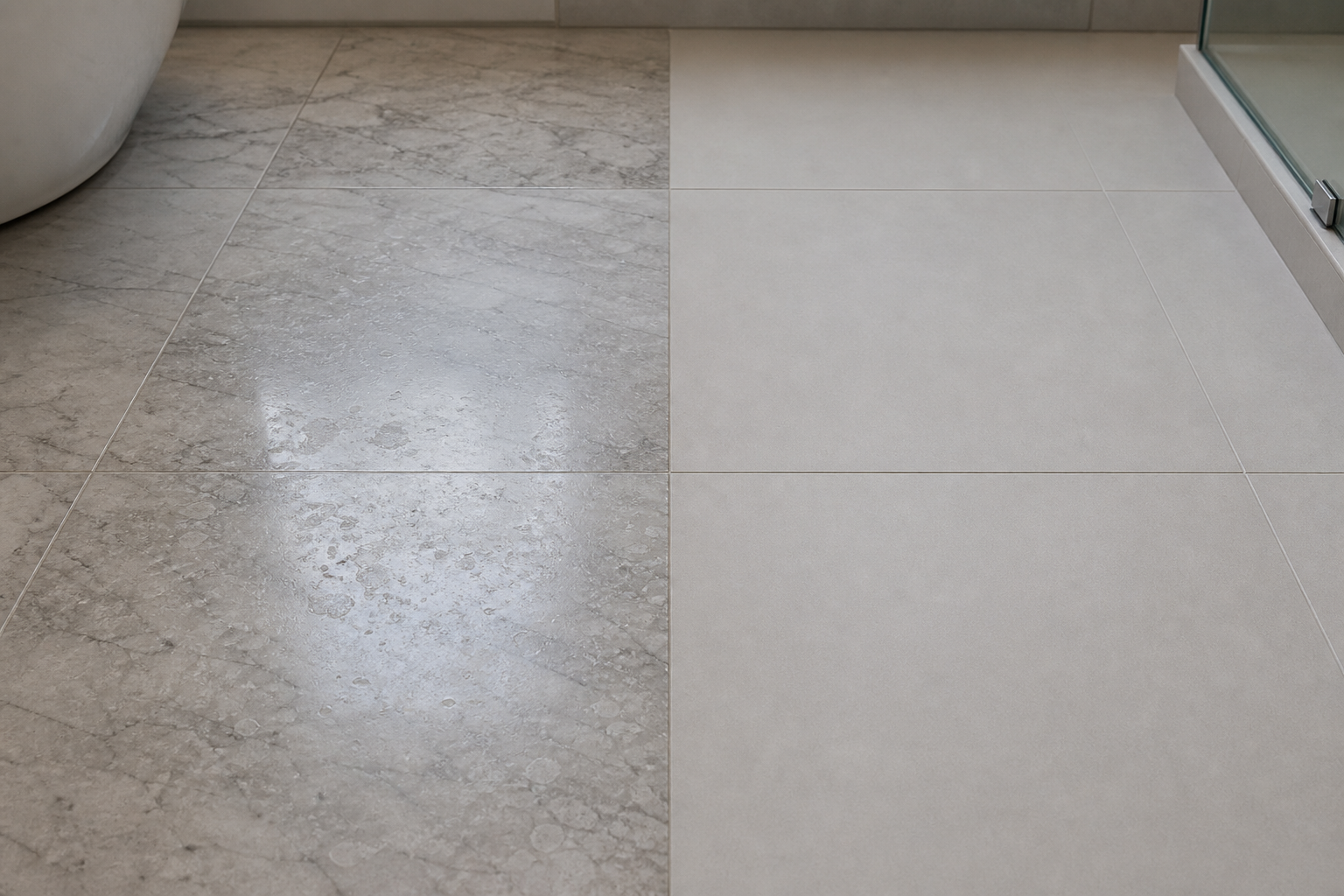
Etching is the flat matte mark left on a polished calcium carbonate stone surface when acid contacts the polish and dissolves the crystalline structure of the top layer. It is the maintenance challenge that surprises stone owners most often because it appears even on stone that was recently sealed and looks clean in all other respects.
The etch appears because polish on marble or limestone is achieved by mechanically grinding the stone face progressively finer until the crystal structure itself becomes reflective. This is not a coating. It is the material itself, ground to a specific surface roughness. When acid contacts the polished face, it dissolves those surface crystals. The result is a permanent change in the surface topography: the crystals are gone, the area is microscopically rougher, and it reflects light diffusely rather than specularly. The mark is dull and slightly recessed relative to the surrounding polished surface.
Common sources of etching in a bathroom include: toothpaste (typically pH 7 to 9, causing mild etching on very sensitive stones), soap scum removal products not formulated for stone (often acidic), any product containing citric acid or vinegar, and hard-water stain removers, which are almost universally acidic. Most commercially available household cleaners are inappropriate for calcium carbonate stone. This is not a minor inconvenience. It requires building a cleaning protocol around the stone's chemistry, training everyone in the household, and reading ingredient labels before any new cleaning product enters the room.
Light etching on a honed finish is less visible than on a polished finish because the surface was not highly reflective to begin with. This is one reason honed marble is often recommended for high-use bathroom floors: the reduced polish means etch marks are less visible as the surface develops wear. But honed finishes are also more open-pored and more susceptible to staining, which compounds the maintenance requirements in the opposite direction.
Professional restoration of an etched marble surface involves re-polishing the affected area or the entire floor by diamond grinding it back to a clean, uniform surface and then re-polishing. The cost of professional marble restoration in a primary bath typically ranges from several hundred to several thousand dollars depending on square footage, condition, and finish type. Most polished marble bathroom floors will need at least one professional restoration in a ten-year period under real household use conditions.
What Ten Years Looks Like On Each Material
A polished marble floor in a primary bathroom, under daily use by a household that generally tries to maintain it but does not follow a strict protocol, will show visible etching at the most-trafficked areas within about three to five years. The stone will need professional restoration once or possibly twice over ten years. The sealing schedule will have been partially followed, meaning some staining may be present but the stone will be recoverable. The maintenance cost over ten years, including professional polishing, specialty cleaners, and sealer product, will typically be in the range of one to three thousand dollars, not counting the homeowner's time.
A porcelain floor in the same bathroom, at the end of ten years, will look like it did at two years. The grout will show age commensurate with how it was cleaned. The tile faces will not have etched, stained, required resealing, or needed professional restoration. The material-specific maintenance cost over ten years is essentially zero.
This is not a small gap. It is the entire difference between a material that asks for a relationship and a material that does not. Neither characterization is a criticism. Some households embrace the stone relationship. They track the sealing schedule, they own a quality stone cleaner, they call the restoration company when it is time. The stone ages gracefully and continues to look like what it is: a natural material with depth, variation, and warmth that compounds over time rather than diminishing.
Other households intend to maintain the stone and do not. The degradation is gradual enough that each year feels like a continuation of the year before rather than a decision point. Then one day the bathroom looks tired and the options are expensive restoration or replacement. The porcelain alternative would not have required that inflection.
Choosing With Honest Expectations
The maintenance difference between stone and porcelain is not a reason to categorically avoid stone. It is a reason to select between them based on accurate information about what each material asks.
The relevant questions are not whether you like the look of marble more than porcelain, because most people do. The relevant questions are: does your household run on the kind of discipline that sealing and specialty cleaning require? Are you willing to read cleaning product labels before using anything in this room? Do you regard the occasional professional restoration as a reasonable maintenance expense, the way some households regard the maintenance of a wood floor? If the answers are yes, stone can be a wonderful long-term decision.
If the answers are no, or uncertain, the gap between intention and execution will express itself in the stone surface over time. The porcelain that you select for practical reasons will not feel like a compromise in year seven. The stone you selected despite uncertainty about maintenance will.
When a client is deciding between porcelain and stone for a primary bath, we put the ten-year maintenance projection on paper alongside the installation cost. Some households commit to the stone maintenance relationship willingly. Others choose porcelain and put the savings elsewhere.